
The Men’s Health Clinic Lead Conversion Playbook: Booking Rates, Speed-to-Lead, and the Front Desk Problem Nobody Talks About
At a men’s health clinic, the leads usually aren’t the problem.
On a recent strategy call with a multi-location TRT practice, the ads had an 80%+ impression share, and the automated texts were “teeing everything up” — yet leads were still going cold.
The reasons had almost nothing to do with marketing: a front desk that spends four hours a day putting out fires, questions only the doctor could answer, and no owned follow-up role.
Here’s the FAQ on fixing lead conversion at a men’s hormone clinic — operations included, because that’s where the leads actually die.
Why aren’t my clinic’s leads booking appointments?
Usually because nobody responds while the lead is still warm.
A lead who waits four hours gets on Google, finds your competitor, and calls them instead.
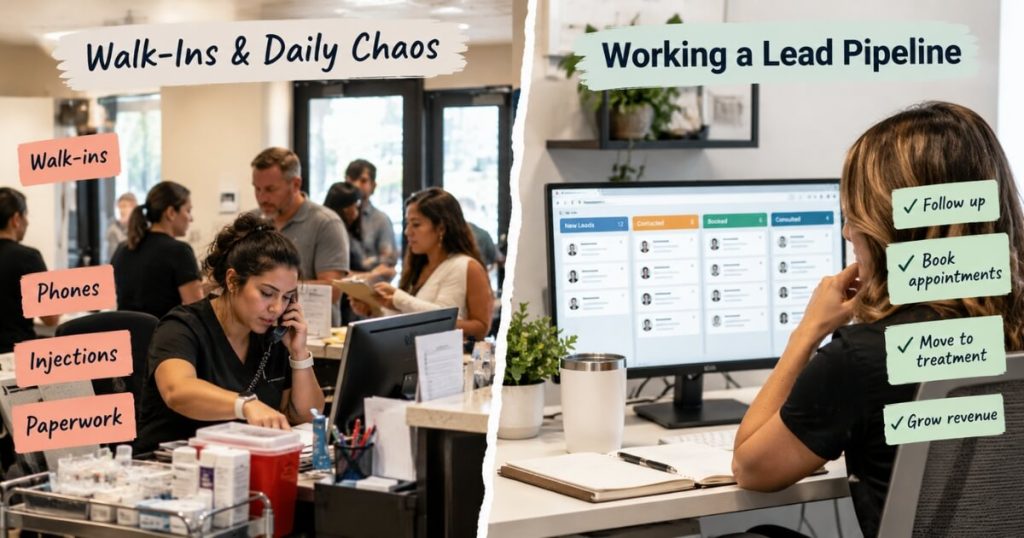
Here’s the pattern we see inside real clinics: mornings are chaos.
Walk-ins, unscheduled injection visits, and patients dropping by “to pick something up” consume the front desk’s time.
Meanwhile, the same people responsible for following up with new leads are the ones surviving that chaos.
The automated texts fire on time, but the human replies that close the booking wait until the afternoon catch-up.
By then, some leads have lost interest or found someone else.
One clinic owner described it precisely: people can either work on a project or put out fires, and very few can do both.
So before blaming the ad account or the landing page, audit the response gap.
If leads regularly wait hours for a human reply during business hours, you don’t have a lead problem.
You have a workflow problem wearing a marketing costume.
What booking rate should a men’s health clinic target on leads?
Around 50% of all leads booked.
That’s the number that matters — and if it’s being hit, it doesn’t matter much how.
That’s the benchmark we hold clinics to: book roughly half of everything that comes in, blended across website, ads, and other sources.
Well-run cash-pay practices prove much higher is possible on high-intent flow.
But 50% is the floor that says your machine works.
One more data point worth stealing: at the clinic on that call, the physician-owner personally called leads.
His booking rate was about 95%.
Nobody’s suggesting the doctor work the phones.
His hours are worth more elsewhere, and it undercuts the “you’re busy, you’re important” positioning.
But the reason it worked is replicable: patients’ questions got answered instantly by someone with authority.
That’s why the fix isn’t “doctor calls everyone.”
Instead, write down the answers the doctor carries in his head and train the team on them.
You can also add small authority signals, like signing automated texts from the practice’s physician.
Should we text leads or call them first?
Text first, automatically and instantly.
Then call the moment a lead engages, because someone replying to a text has their phone in their hand.
Text-first respects how people actually respond to an inquiry they submitted online.
Many prefer not to answer cold calls at all.
The automation should tee everything up: answer the basics, set expectations, and offer the booking link.
But the moment a lead is actively texting back, that’s the call window.
They’re holding the phone, they’re engaged, and a two-day text thread can usually become a booked consult in a three-minute conversation.
Then put a clock on the human side.
During business hours, when the automation says “we’ll be back with you shortly,” shortly means 30 minutes.
And frame every conversation the same way: the patient contacted you because they have a problem.
They may be tired, have low drive, be overweight, or be dealing with something else.
Identify the problem fast and get them the solution.
If that happens within an hour of first contact, the booking usually follows.
That’s the heart of a working patient acquisition system: speed, authority, and a next step.
How do I staff follow-up so leads stop falling through the cracks?
Give lead follow-up to one person, physically and mentally separated from front-desk chaos — and pay them on bookings.
The front desk can’t nurture leads between walk-ins.
Interruptions and projects can’t share a desk.
The fix at the clinic on our call was to move a capable team member away from the busy desk.
Then make lead response his owned role with a five-minute follow-up standard.
Arm him with a written FAQ of the questions patients actually ask, drafted from the doctor’s answers.
And put him on the same commission structure as the rest of the intake team.
That way, everybody wins every time a new patient signs up.
Two supporting moves matter as much as the role itself.
First, tame the walk-in culture that creates the fires.
Unscheduled injection visits and “I’ll just swing by” patients get warmly redirected to scheduled slots.
For example: “Come at 1:15 and we’ll be ready for you.”
Second, set the expectation before demanding the result.
Tell the team the reply standard, then let them surface the barriers that stop them from hitting it.
Remove those barriers before holding them accountable.
Expectation first, barriers second, accountability third.
How should a TRT clinic price its membership — and when should prices go up?
Start accessible, then raise prices once referrals are steady.
One playbook we’ve watched work: launch at $125 a month, and at around 200 members, move new patients to $150 while keeping a first-responder discount.
That’s the real progression from a men’s clinic we work with.
The clinic started at $125 a month, with a discounted rate of $100 for firefighters and police.
Once the practice crossed roughly 200 members with a steady stream of referrals coming in, new members joined at $150.
Meanwhile, first responders and military members continued receiving a discount, bringing their monthly rate to $125.
The next five hundred members came in at the higher price.
The discount isn’t charity; it’s targeting.
First responders and military are tight communities that refer heavily, so the discounted segment functions as a referral engine.
Membership economics are what make all of this worth systematizing.
That recurring revenue turns every converted lead into years of value, not one visit.
When each booking is worth a membership, a 50% booking rate stops being an operations metric and becomes the growth engine.
That’s the core of men’s hormone clinic marketing: the model multiplies whatever conversion you feed it.
How do I get referrals from local employers without going through HR?
Skip HR.
Make influential employees your patients, then equip them to refer inside their workplace.
Big employers won’t hand you their workforce.
Many already provide free primary care clinics as a benefit.
But the plant floor runs on word of mouth.
The play is to win a handful of respected employees as patients and get them great results.
Then give them conversation-starting swag.
That could be a quality thermos, a hat, or a genuinely soft t-shirt someone would actually wear to the gym.
The goal is the moment a coworker asks, “what’s that MVP deal?”
And your patient answers, “that’s where I go.”
The best referral asset is the result itself.
A patient whose body composition visibly changed is a walking billboard.
Swag just gives the conversation an opening.
This channel costs almost nothing, compounds monthly, and — unlike ads — gets stronger as your patient base grows.
What should I do when my Google Ads hit their ceiling?
When impression share passes ~80% in your market, more budget buys almost nothing.
Instead, shift spend to competitor keywords, referrals, and adjacent markets.
At 80%+ impression share, nearly everyone searching testosterone or TRT terms in your area already sees your ad.
There simply isn’t more search volume to buy.
The remaining paid moves are surgical.
First, bid on competitor clinic names, especially confusingly similar ones nearby.
Then extend into adjacent geographies where your patients actually commute from.
Beyond that, growth has to come from channels that create demand rather than capture it.
That includes the employee referral engine above, community presence, and content.
This ceiling is also the clearest argument for fixing conversion first.
When you can’t buy more leads, the only way to grow is to book more of the ones you already get.
A clinic converting 30% of a maxed-out channel has a hidden 60% growth lever sitting in its own inbox.
FAQ’s About Men’s Health Clinic Lead Conversion and Operations
What’s a good booking rate for TRT clinic leads?
Target booking roughly 50% of all leads, blended across sources.
High-intent flows with disciplined follow-up can go much higher.
For example, one regenerative practice we work with books 79.4% of its leads.
But if you’re under half, conversion — not lead volume — is your growth lever.
How fast should my clinic respond to a new lead?
Send an automated text instantly.
Then have a human reply within 30 minutes during business hours.
The goal is to identify the patient’s problem and offer a solution within the first hour.
Leads who wait half a day get on Google and book with whoever answers first.
Why does my front desk keep missing follow-ups?
Because follow-up is project work, while the front desk is interruption work.
Walk-ins, phones, and in-clinic patients will always win the moment.
Separate the roles.
One person should own lead follow-up away from the chaos, with a written FAQ and booking-based commission.
Should the doctor ever call leads?
Sparingly.
It converts extremely well — one physician-owner books about 95% of leads when he calls.
However, it doesn’t scale and spends the most expensive hours in the practice.
Capture the effect instead.
Put the doctor’s answers into staff training, and sign automated messages from the physician so patients feel the doctor’s presence.
When should a membership clinic raise its prices?
When demand is proven through a steady referral stream and a substantial member base.
One men’s clinic launched at $125/month and moved new members to $150 after crossing 200 members.
The clinic also kept a first-responder discount to protect its best referral community.
Existing members can stay at their rate, while new members join at the new one.
What’s the next step?
If your clinic is generating leads that don’t become patients — or your ads have maxed out their market and growth has stalled — book a strategy call.
In 60 minutes, we’ll audit your booking rate by source and time your real speed-to-lead.
Then we’ll map the follow-up role, scripts, and pricing structure that turn the leads you already have into members.
The leads usually aren’t the problem.
The machine that catches them is.