
How Does a Cash-Pay Clinic Founder Get Booked on Podcasts? (The Fit-Call Playbook We Built for a Men’s Health Physician)
Before a podcast host books a physician guest, most run an exploratory “fit call” — and that call, not the pitch email, is where the booking is won or lost.
This week we prepped a client — a physician who runs a cash-pay men’s health practice — for a fit call with the founder-host of a men’s mental health podcast.
Here’s the FAQ on the exact playbook: how to research the host, what to pitch, what language kills your credibility, and how to close so the yes is easy.
Do podcast appearances actually bring patients to a cash-pay practice?
Yes — for high-consideration care, a podcast episode is trust-transfer at scale.
The host spent years earning an audience of exactly your patient avatar. An hour on his mic hands you that trust.
Think about who was listening in this case.
The podcast our client pitched is built for high-performing men who suffer in silence — men who’ve been told their labs are normal and who wait until crisis to ask for help.
That is, almost word for word, the patient avatar of a cash-pay men’s health practice.
No ad platform sells targeting that precise.
Long-form audio also does something ads can’t: it lets a patient spend an hour with you before they ever call.
That’s the same mechanism that makes YouTube the highest-leverage channel for high-ticket care.
Dr. Joy Kong became the #1 stem cell expert on YouTube, hired four more doctors, and scaled herself out of the day-to-day on exactly that trust-at-scale model.
Podcast guesting is the fastest way to borrow that mechanism before you’ve built your own audience.
How should I prepare for a podcast fit call with the host?
Walk in already understanding him — never ask “so what’s your show about?”
The prep we built for our client centered on one person: the host.
He built the show out of his own pain — opening up publicly broke his own isolation.
He’s a father of five and a serial entrepreneur. That means he respects builders and can smell a pitch from a mile away.
His recent episodes told us exactly what was on his mind: why high-performing men suffer in silence, why men wait until crisis, a psychiatrist on anxiety, and a men’s-health MD on cortisol and sleep.
That research changes the entire call.
Instead of interviewing the host about his own show, you demonstrate — in the first two minutes — that you already understand his audience and his mission.
Hosts book guests who make them feel seen the same way they want their listeners to feel seen.
He’s not looking for another expert.
He’s looking for a real one who’ll go first.
What should I pitch on a podcast fit call — how many topic ideas?
One hyper-specific episode.
A title, a one-sentence takeaway, and why it matters to his audience.
Never a menu.
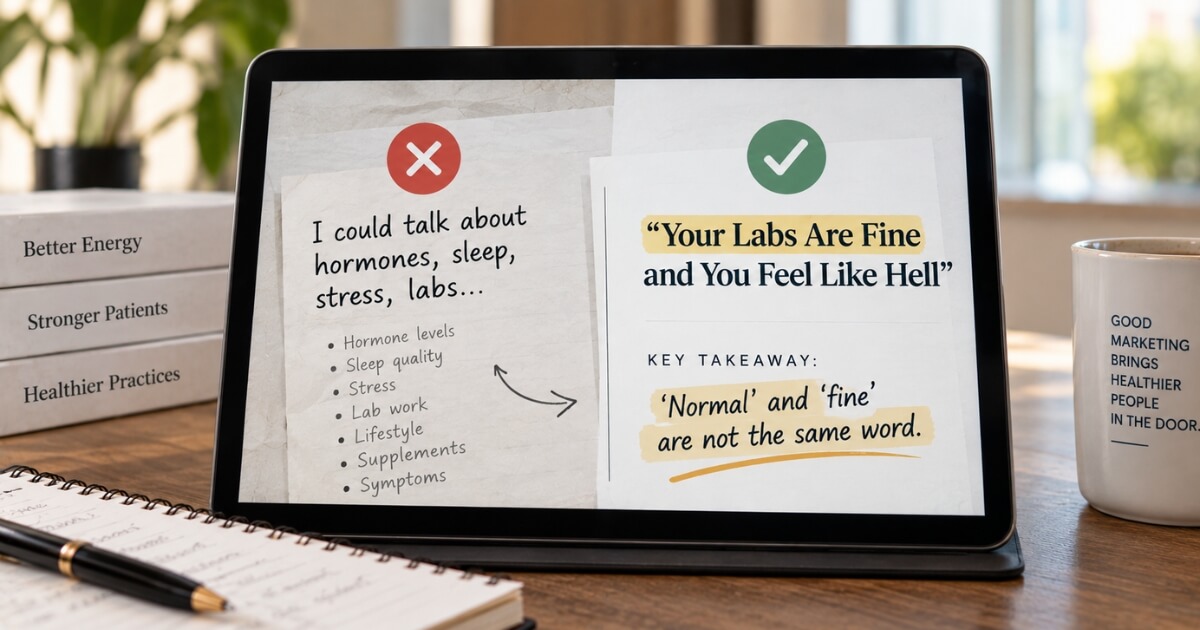
The weakest move on a fit call is “I could talk about a lot of things.”
It forces the host to do the work of designing the episode, and it’s forgettable.
We had our client hand the host a finished idea instead:
“Here’s the episode I’d want to make with you: ‘Your Labs Are Fine and You Feel Like Hell.’ The takeaway your listener walks away with is one sentence — ‘normal’ and ‘fine’ are not the same word. And the reason it matters for your audience specifically is that these are men who’ve already been dismissed by the system once, told to push through, and they’ve been carrying that alone.”
Pitch one primary idea, with at most one alternate in your back pocket.
Specificity is memorable.
It starts the real conversation and shows the host exactly how you think — which is what he’s actually evaluating.
How do I talk about myself on a fit call without sounding like a pitch?
Strike the qualifiers.
Hedged language about your own value makes the host unsure of you.
The polite hedges leak out exactly when you talk about yourself:
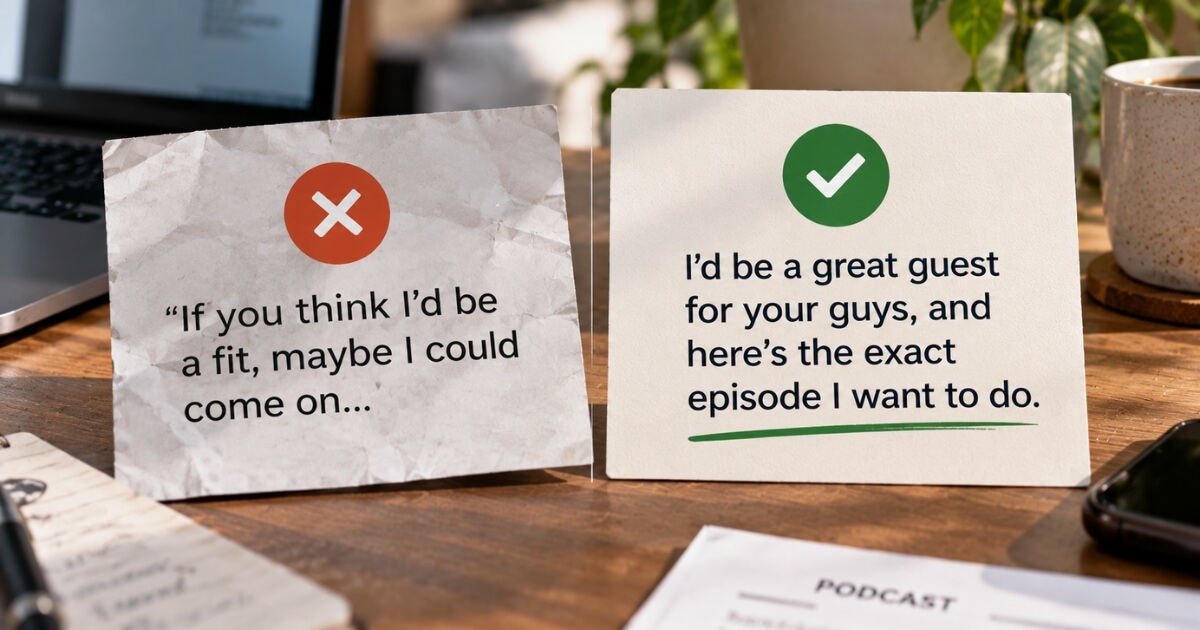
Wrong: “If you think I’d be a fit, maybe I could come on and we could try…”
Right: “I’d be a great guest for your guys, and here’s the exact episode I want to do.”
The qualifier signals you’re not sure — which makes the host unsure.
And on a fit call, how you say your one core belief is a live demo of how you’ll sound on his mic.
We had our client practice delivering his central conviction flat, with certainty:
Most men aren’t broken and they’re not weak — they’re running on empty, undercharged, not damaged, and nobody’s telling them that.
A host isn’t just hearing the idea.
He’s hearing whether you can hold a room with a single clear belief.
Certain is not arrogant.
Founders respect the difference.
What actually gets a physician booked — credentials or connection?
Connection.
The host decides whether you genuinely care about the same people he does. Then he listens for whether you can be human on a mic.
Credentials got you the call.
They won’t get you the booking.
Every physician who pitches has credentials. What most can’t do is let the real thing show.
The register we coached:
“It makes me angry, honestly. Good men — fathers, providers — running on empty for years because everyone told them they were fine and to suck it up. Nobody’s in that gap with them. That’s the whole reason I practice the way I do, and it’s why your show matters.”
Passion about the mission, not enthusiasm about the opportunity.
Then — and this is the half most doctors skip — stop talking.
After you’ve shown you understand the show and floated your episode, hand the host the floor.
Ask what makes an episode land for him, who he pictures listening, what to avoid, and about his format and timeline.
A guest who only transmits reads as a pitch.
A guest who transmits with conviction and receives with genuine interest reads as a partner.
This is the same skill that powers all founder-led medical practice marketing: talk to one person, not at an audience.
How should I end a podcast fit call?
With a clear next action that makes the yes easy — never “let me know what you think.”
“Let me know what you think” is a qualifier wearing a closing’s clothes.
The close we scripted:
“Here’s what I’d suggest: let’s lock the episode, I’ll send you three questions I’d love you to actually ask me on the mic, and we find a record date in the next few weeks. Does that work for you?”
That’s not pushy.
It removes friction and shows the host you’re organized and easy to produce.
Hosts are producers.
An easy-to-produce guest is a bookable guest.
Offering the three questions is the detail that lands: it tells him the episode is already half-built.
FAQ’s About Podcast Guesting for Clinic Founders
How do I find the right podcasts to pitch as a physician?
Match the audience to your patient avatar, not the size of the show.
A men’s mental health podcast whose episodes cover why men wait until crisis is a better stage for a men’s health physician than a bigger general-health show.
The host’s last ten episode titles tell you exactly what he wants more of.
Pitch into that.
Do I need a big following to get booked as a podcast guest?
No.
Hosts book guests who are human on the mic, specific about the episode, and easy to produce.
A finished episode idea, three suggested questions, and flexibility on record dates beat a follower count on a fit call.
Should I pitch several topic ideas so the host can choose?
No — pitch one hyper-specific episode with a title and a one-sentence takeaway.
Hold one alternate in reserve.
A menu forces the host to design the episode for you and makes you forgettable.
A finished idea starts the real conversation.
What if talking about myself with certainty feels like bragging?
Certainty about your one core belief isn’t bragging.
It’s the demo of how you’ll hold the room on the host’s mic.
Say what you believe flat and unhedged, then hand the floor back and listen.
Qualifiers like “maybe I could come on” don’t read as humble.
They read as unsure.
What should a physician do after the podcast episode airs?
Distribute it like you made it.
Clip 3–5 shorts for your own channels.
Embed the episode on your site with FAQ schema around the questions discussed.
Then route listeners to one clear next step — a quiz, a guide, or a booking link mentioned naturally on the mic.
What’s the next step?
If you run a cash-pay practice and you’re the best-kept secret in your market, borrowed audiences are the fastest fix.
And the skills are learnable in a week of prep.
The compounding version of this play is the one an HRT clinic used to grow from $1M to $4M a year while building a membership base of 250 patients: founder-led trust content feeding a practice built to convert it.
Book a strategy call.
In 60 minutes, we’ll map your patient avatar to the shows they already listen to, build your one-episode pitch, and script your fit call.
So the next host who takes your call books you before it ends.