
Why Are My Cash-Pay Patients Paying the Wrong Amount? (The Billing Reconciliation Audit That Caught a $500 Miss)
On a consulting call with a direct primary care and telehealth practice, the owners admitted something most cash-pay founders eventually whisper: they couldn’t say who actually owed them money.
Their EMR had been auto-sending patients a $100 urgent-care checkout on visits that should have billed at $300.
Patients, reasonably, paid the $100 and believed they were done.
Here’s the FAQ on the billing reconciliation audit we built live on that call: how the errors happen, how to find them, who should do the finding, and what it has to do with when you’re allowed to turn on ads.
Why are my patients paying the wrong amount for cash-pay visits?
Usually because your EMR is auto-sending a checkout tied to the wrong appointment type — and the patient has no way to know.
At this practice, the EMR auto-generated a $100 virtual urgent-care invoice on appointments that should have been $300 initial consults.
The culprit was a rogue appointment type buried in the scheduling setup that only one team member could even see.
It was quietly mis-labeling bookings.
Patients got a $100 checkout link, paid it, and considered the bill settled — because from their side, it was.
No one was stealing anything.
The system was just wired wrong, and every wrongly-wired week compounded.
That’s the uncomfortable truth about cash-pay billing errors: they’re rarely dramatic.
They’re a checkbox on an appointment type, an automation pointed at the wrong fee, or a booking link that skips the payment step.
Meanwhile, the practice can leak two-thirds of the visit price with no alarm going off anywhere.
How do I figure out which patients actually owe my practice money?
Export three reports — appointments by provider, patient payments, and memberships — and reconcile them line by line into one status sheet.
There is no automated report that answers “who owes us what” when the billing system itself is the thing you don’t trust.
The workflow we built on the call starts with the per-provider appointment report from the EMR.
Export it to CSV and dedupe it.
Then cross-reference every patient against the payment report and the membership report.
Mark each one outstanding, paid, or pending, include the amount owed, and color-code as you go.
It’s manual.
It’s also worth it immediately.
Within minutes of starting, the practice found a family membership that had paid September but missed August and October.
That was $500 owed by a single household that every report individually made look current.
They also found a patient who had created three duplicate charts for herself.
Her history and payments were split across records.
The fix: merge the charts through the demographics screen.
Multiply those two finds across a full patient panel, and the audit usually pays for the staff time many times over.

Who should run the reconciliation — my provider or my admin staff?
Admin.
Never the provider.
On the call, the practice’s nurse practitioner offered to work the reconciliation sheet on her off time.
We blocked it on the spot: providers generate revenue; a back-office hire runs the audit sheet.
Nearly all of this work is export-and-spreadsheet labor that can be done from home.
This practice assigned it to their new administrative hire as a work-from-home project her first month.
The second half of the rule: route every reconciliation question through one channel.
This team was scattering billing questions across text threads.
We moved it all into a single Slack channel — one place, visible to everyone, with nothing lost.
The audit produces dozens of small judgment calls.
For example: “do we honor the prepayment this patient made under the old billing system?”
This practice had exactly that case and honored it through March.
Those calls need a paper trail, not a text thread.
What do I do when my EMR’s billing support can’t help?
Get a ticket on record, then move what you can control out of the EMR.
When this practice tried to escalate the mis-billing, they discovered their EMR vendor had assigned them a single support rep.
That rep was on medical leave for two more months.
That’s not a support plan.
That’s a single point of failure attached to your revenue.
There are two moves.
First, file the support ticket anyway.
That puts the problem on record with a number attached instead of leaving it in one unreachable person’s inbox.
Second, shrink your dependency.
We rebuilt the practice’s recurring membership billing — $149/month individual and $249/month family — as recurring products and payment links in their CRM, GoHighLevel.
We also created reusable message snippets so a provider can drop an enrollment link into any patient conversation in seconds.
The EMR keeps the clinical record.
The system you can actually see into keeps the money and the patient communication.
The more of both that lives where you have full visibility, the fewer $100-on-a-$300-visit surprises survive a week.
When is a cash-pay practice allowed to turn on paid ads?
When the unit economics close.
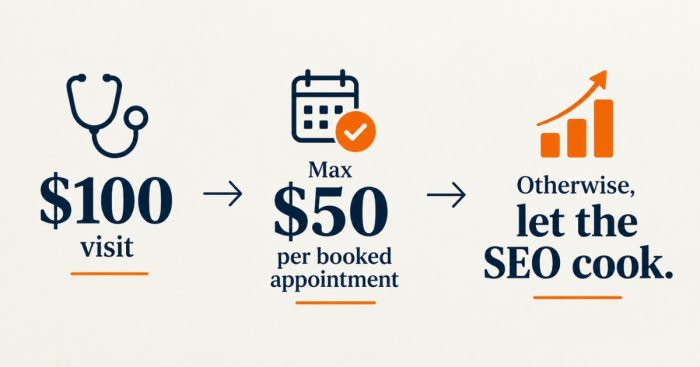
This practice’s rule was bookings under $50 — because a visit pays about $100.
Until then, let the SEO cook.
The owners asked the question every founder asks mid-cleanup: should we start running Google Ads?
The answer came straight from their own numbers.
The model only works if appointments book for under $50.
No campaign was going to hit that while the booking flow still had a rogue appointment type mis-billing visits.
Their organic pages were already ranking and producing bookings from non-referral sources.
So the directive was to let SEO compound and revisit ads when the funnel could be trusted.
And the higher-leverage fix cost nothing.
While we were on the call, the practice had an unworked website chat from a prospective patient saying they had COVID and wanted to book.
That lead needed a same-moment phone call, not an ad budget.
Fixing a patient acquisition process that answers its own inbound leads beats funding a leaky funnel every time.
It’s the same zero-ad-spend discipline that let Orthobiologics Associates generate $309,590 in cash-pay revenue in 10 months with a 79.4% lead-to-booking conversion rate before scaling anything paid.
When should a telehealth practice get licensed in another state?
On demand, not on speculation — this practice’s trigger is three patient requests from a state.
State licenses cost money and maintenance.
Speculative licensure is how telehealth practices bleed cash into markets that never materialize.
The rule this practice runs is simple: track where inquiries come from.
When three patients from the same state ask to be seen, pursue licensure there.
Demand signals first, fixed costs second.
It’s the same sequencing logic as the ads rule, applied to expansion.
FAQ’s About Cash-Pay Billing Reconciliation
How often should a cash-pay practice reconcile patient payments?
Monthly, minimum — and weekly while you’re actively fixing a known billing problem.
The practice in this story went months between checks.
That’s how one family’s membership fell $500 behind without anyone noticing.
Reconciliation stays manual until you’ve proven your billing automations trustworthy, not the other way around.
What causes most cash-pay billing errors?
Appointment types and automations tied to the wrong fee.
A mislabeled appointment type auto-sent $100 checkouts on $300 visits at this practice.
Audit every appointment type, its price, and the automation attached to it.
Pay particular attention to any type your staff didn’t knowingly create.
Can admin staff do billing reconciliation from home?
Yes.
It’s export-and-spreadsheet work: appointment report, payment report, membership report, and one status sheet.
Assign it to admin, never a revenue-producing provider.
Then route all questions through a single shared channel so decisions have a paper trail.
Should I bill memberships through my EMR or my CRM?
Bill recurring memberships wherever you have full visibility and working support.
This practice moved its $149 individual and $249 family memberships to recurring payment links in GoHighLevel.
They made the change after discovering their EMR’s billing was opaque and its only support rep was unreachable for months.
What’s a duplicate patient chart and why does it break billing?
It’s the same patient existing as two or more records.
One patient here had created three charts for herself.
That split her visit history and payments, so no single record showed what she owed.
Merge duplicates through your EMR’s demographics tools as part of every reconciliation pass.
What’s the next step?
If you can’t answer “who owes us money right now” in one report, you don’t have a billing problem — you have a visibility problem.
And it’s costing you invisible hundreds per week.
It’s also fixable fast, without new software and without the founder doing it personally.
The same operational cleanup is how Dr. Groysman grew monthly revenue by $40K+ while cutting insurance dependence in half — revenue found inside the practice, not bought outside it.
Book a strategy call.
In 60 minutes, we’ll map your billing flow end to end — appointment types, checkout automations, membership billing, and reconciliation cadence.
Then we’ll hand you the audit sheet your admin can start running this week.