
Why Isn’t My Stem Cell Clinic Getting New Patients With a Perfect 5.0 Rating? (Inside an Audit Where a TV Station Was Writing the Google Ads)
This month we audited a physician-led stem cell clinic in the Nashville suburbs.
The founder is a 25-year interventional pain physician who built an in-house cell-processing lab, helped pass a state law legalizing stem cell therapy, earned free TV news coverage of his patient stories, and holds a perfect 5.0 Google rating across 56 reviews.
His website gets 24 organic visitors a month.
Here’s the FAQ on how a clinic with the best story in its market stays invisible — and what we told them to fix first.
Why isn’t my stem cell clinic getting new patients when my reviews are perfect?
Because reviews are proof, not distribution — and proof nobody sees converts nobody.
This clinic had assets most practices never build.
The founder had a story worth a documentary: a career pain physician who walked away from the opioid model.
The clinic also had an in-house lab almost no competitor could match, TV news segments telling patient stories for free, and 56 five-star reviews with real velocity.
None of it was being distributed.
The website drew 24 organic visits a month across 16 ranked keywords.
Ahrefs estimated that traffic at three dollars.
The YouTube channel held 25 videos and had 9 subscribers.
One patient-story video reached six figures of viewers when a TV station aired it.
On the clinic’s own channel, it got 162 views.
That’s the pattern we see in most audits of practices with great reputations and flat growth.
The problem is almost never the product, the reviews, or the story.
It’s that the practice built the best story in its market and then put the marketing on autopilot.
Should a TV station or media company be running my clinic’s Google Ads?
No.
Nobody who doesn’t know your story should be allowed to write your ads.
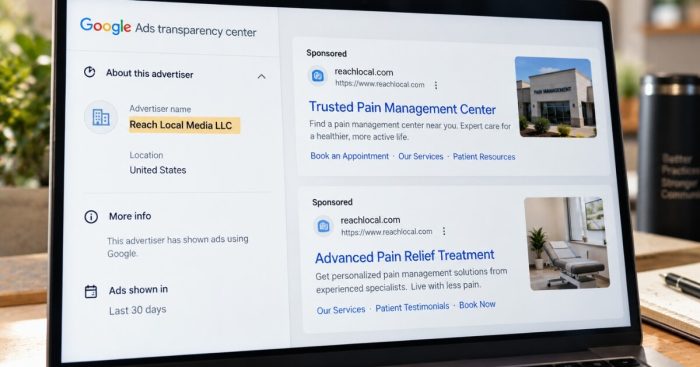
When we opened Google’s Ads Transparency Center for this clinic, the advertiser name on all eight active ads was a television broadcast group.
The clinic had bought a local-TV marketing package, and the station’s ad desk was running search ads as a throw-in.
The headlines were:
“Trusted Pain Management Center.”
“Sciatica & Back Pain Treatment.”
“Nerve Pain Relief Specialists.”
Not one ad mentioned stem cells.
Not one mentioned the in-house lab, the new state law, or a single patient story.
The founder spent 25 years escaping commodity pain management.
The bundled ad package repositioned him as exactly that — a generic pain clinic, in the most expensive auction in his market.
Meanwhile, the Meta Ad Library showed zero ads.
There was no TikTok presence at all.
The fix isn’t subtle.
Get the credentials, audit what the package actually costs and where the ads point, then either take the account in-house or fire it.
Whoever writes your ads must have sat in your lobby — figuratively at minimum.
How does a clinic with 56 reviews lose the Maps pack to a clinic with 5 reviews?
Because outside your immediate proximity radius, SEO plumbing — categories, review keywords, and landing-page relevance — beats raw review count.
This clinic ranked #1 in the Maps pack in its hometown of 85,000 people.
In the metro of 2 million next door — where the money is — it ranked behind a competitor with five reviews.
That competitor also held the #1 organic spot for the metro’s main search term.
Five reviews beating fifty-six isn’t a stronger practice.
It’s a weaker practice with better plumbing.
The plumbing problems were everywhere once we looked.
Proof was fragmented across profiles: 56 reviews on Google, 11 stranded on a directory listing, and an unclaimed legacy listing of the founder in another city.
Business hours disagreed between Google and the website.
Worst of all, Google’s “Book online” button — the highest-intent click that exists for a clinic — dumped patients onto a bare directory page.
It had gray placeholder avatars and no provider bios.
Years of reputation paid for that click, and the landing page looked abandoned.
The repair list is boring and worth six figures.
Use one consistent phone number and hours everywhere.
Add secondary categories.
Claim the legacy listing.
Point the booking button at the clinic’s own calendar.
And hold review velocity at 15 a month, with patients asked to name their condition and city.
What does a broken booking flow cost a cash-pay clinic?
Every high-intent lead who won’t wait to be “reached out to.”
And at $5,000–$10,000 a case, that’s the most expensive leak in the practice.
This clinic had no online scheduling anywhere.
Every “Schedule Your Consultation” button landed on a contact form that promised someone would reach out.
Their own materials showed three different phone numbers.
One appeared in the header, a second in the footer, and a third on a service page.
The structured-data code on the site published a number that contradicted the page it sat on.
A patient about to spend five figures avoiding a knee replacement does not submit a form and wait.
They keep googling.
And the next result is the competitor 0.4 miles away who advertises financing and answers the phone.
The math we walk every audit client through is straightforward.
Leads contacted inside 5 minutes convert at multiples of leads contacted in an hour.
The benchmark funnel for cash-pay practices runs 30–50% of inquiries reaching a human, 40–60% of those booking, 70–85% showing, and 20–40% closing.
Every gap below benchmark is money already paid to lose.
One additional orthopedic case per week at market rates is roughly $300,000–$500,000 a year.
That’s why fixing the close comes before buying any traffic.
It’s also why we build a predictable patient acquisition system before we ever scale a campaign.
That means a scheduler behind every CTA, missed-call text-back, and an instant auto-text with a booking link on every form fill.
Why does a regenerative medicine clinic need two marketing engines?
Because local orthopedic cases and fly-in systemic cases find you in completely different ways.
And most clinics fund neither properly.
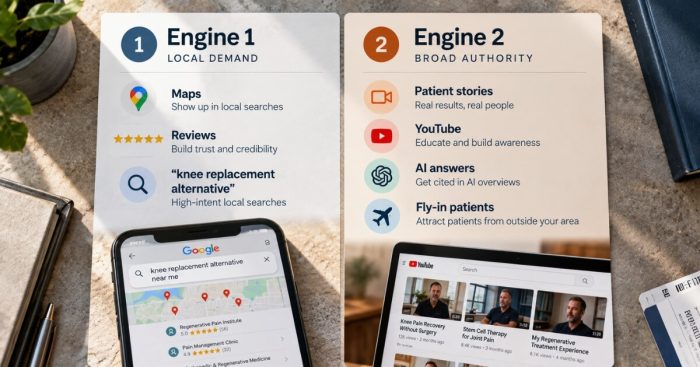
Engine 1 is the local volume engine.
That’s knees, backs, and shoulders — patients trying to avoid a replacement or a fusion.
It’s a local search game of Maps rankings, reviews, and “knee replacement alternative” queries.
Engine 2 is the destination engine.
That’s the systemic and neurological cases that fly in.
Nobody in a town of 85,000 is searching for your niche cell protocol by name.
Those patients run on story, national reach, and increasingly on AI answers.
When we checked this clinic’s AI visibility, it appeared in 3 Google AI Overviews.
It had zero citations across ChatGPT, Gemini, Perplexity, and Copilot.
The parent researching treatment options at midnight asks an AI assistant.
And this clinic wasn’t in the answer.
The frustrating part is that the clinic was already making the right content.
Twenty-five videos — team intros, patient testimonials, TV segments — is more than 90% of practices ever produce.
It just had no titles built for search, no thumbnails, no shorts pipeline, and no booking link in any description.
This is where stem cell clinic marketing lives or dies: distribution of proof, not production of more of it.
Orthobiologics Associates generated $309,590 in cash-pay revenue in 10 months from SEO and content alone, with zero ad spend — and this clinic has better raw material than most practices start with.
Should a stem cell clinic publish prices when competitors already do?
Yes — ranges plus financing, because silence loses every comparison shopper.
Twenty minutes from this clinic, a national franchise publishes stem cell therapy “starting at $5,500.”
It also hooks patients with a free consultation.
National franchise brands run hundreds of Google ads on exactly that publish-the-price playbook.
The fellowship-trained orthopedic surgeon 0.4 miles away advertises a financing partner by name.
The clinic we audited published no pricing anywhere.
It offered no financing option, and its front desk had no memorized answer to “what does this actually cost?”
When a five-figure patient can’t find your number, they don’t assume you’re premium.
They anchor on the competitor’s $5,500 and book the free consult down the road.
Price ranges, a financing partner, and a one-sentence differentiation answer can close that gap without discounting a dollar.
For example: “we process your cells in our own on-site lab — we count and document every cell that goes back into you.”
FAQ’s About Marketing a Stem Cell Clinic With Great Reviews
How many Google reviews does a stem cell clinic need to win the local Maps pack?
There’s no magic number.
The clinic we audited had 56 five-star reviews and still ranked behind a 5-review competitor in its metro pack.
Beyond proximity, Maps rankings run on categories, review keywords, and landing-page relevance.
Keep velocity at roughly 15 new reviews a month.
And ask patients to name their condition and city in the review text.
That’s what makes reviews rank you, not just reassure people.
Should I let a TV station or media company run my clinic’s Google Ads?
No.
Bundled media packages default to generic templates.
The clinic we audited was being advertised as a “trusted pain management center” with zero mention of stem cells or its in-house lab.
Audit what the bundle costs and where the ads point.
Then move the account to someone who knows your positioning, or take it in-house.
What’s the first fix for a clinic with a great reputation but no bookings?
Put a real scheduler behind every call-to-action.
Use one phone number everywhere.
Add missed-call text-back plus an instant auto-text with a booking link on every form fill.
Leads contacted inside 5 minutes convert at multiples of leads contacted in an hour.
Nothing else you fund matters until a lead can book without waiting to be “reached out to.”
Do AI assistants like ChatGPT recommend stem cell clinics?
Yes — and for destination patients researching conditions at midnight, AI answers are becoming the referral channel.
The clinic we audited had zero citations across ChatGPT, Gemini, Perplexity, and Copilot despite a 5.0 rating and TV coverage.
Crawlable FAQ content, consistent structured data, and earned-media links are what get a clinic into those answers.
What should a stem cell clinic publish on YouTube?
One patient story per month, titled for search.
“Stem Cell Therapy for ALS — Tennessee Patient Story” beats a date and a name every time.
Cut every long video into 3–5 shorts for YouTube, Instagram, and TikTok.
And put a booking link in every description.
The clinic we audited had 25 videos and 9 subscribers — production without distribution.
What’s the next step?
If your practice has the reviews, the outcomes, and the story — but the website traffic, the ad positioning, and the booking flow don’t match — the gap is distribution.
And it’s fixable in a quarter.
Dr. Joy Kong became the #1 stem cell expert on YouTube, hired four more doctors, and scaled herself out of the day-to-day on the strength of exactly this playbook: one story, distributed relentlessly.
Book a strategy call.
In 60 minutes, we’ll audit your practice the same way we audited this one — booking flow, Maps pack, ads, content, AI citations.
Then we’ll hand you the prioritized fix list, whether or not we ever work together.