
Why Patients Down-Sell Themselves at Your Clinic (And How Two Options Beat Five)
On a strategy call with a longevity and functional medicine clinic we consult with, the team told a story every cash-pay owner will recognize.
A motivated patient was presented the $8,000 program — and instead assembled $5,800 of a-la-carte testing on her own.
Nearly the full program price, none of the program.
The clinic got a good invoice and lost the six-month relationship.
Nobody did anything “wrong.” The pricing architecture did it.
Here’s how we rebuilt it.
Why do patients choose a-la-carte instead of enrolling in the program?
Because when a menu lets a motivated patient assemble the program piece by piece, she will.
And she’ll skip the parts that actually produce the outcome.
This patient bought almost all the testing included in the package, then asked, “what am I not getting?”
The honest answer: the visits, the supplement discounts, and — the part that matters — the six-month commitment.
As the provider put it, the program’s value is “let’s do all this stuff, let’s get the results” with structured follow-up.
A-la-carte buyers do the diagnostics and drift.
A $5,800 sale that feels like a win actually traded away the ongoing care that gets the patient a result.
And results, not invoices, are what make a clinic’s reputation compound.
The fix is not hiding the a-la-carte menu.
It’s pricing and presenting so the program is the obvious path — which the rest of this article covers.
How many pricing options should a clinic present to a patient?
Two, maybe three — total.
This clinic was juggling multiple six-month programs plus three membership tiers.
The team said it themselves: “If it was presented to me, I would be confused too.”
On the call, we cut the menu.
We kept two longevity programs: one high-ticket at $9,999 for six months with all testing included, and one lower-ticket option.
We also kept two membership tiers, killing the weakest $99/month tier entirely.
Underpriced options don’t just lose money.
They give confused patients a place to hide from the decision that would actually help them.
Then match the presentation to the patient before the consult.
An intake question like “we have options ranging from comprehensive programs to simple monthly memberships — which sounds more like what you’re looking for?” tells the provider which two options to present.
Nobody should ever hear all five choices in one sitting.
That’s how you generate “let me think about it” — decision fatigue dressed up as politeness.
This is a core principle of functional medicine and longevity clinic marketing: high-consideration offers convert when the choice is small.
How do you structure tiers so patients actually choose the higher one?
Check the math your patient will do — because she will do it.
Reviewing this clinic’s tier handout live, we found the tell.
The top tier’s own savings line read “save $517,” while the tier below said “save $462.”
An extra consult and an extra lab round — roughly $550 of added value — divided across twelve months looked like almost nothing.
Any patient comparing columns concludes the upgrade isn’t worth it.
And she’s right.
Every step up a tier ladder must deliver obviously bigger value than the step below.
That value needs to be visible on the page, without a calculator.
If the increments are thin, don’t pad the copy.
Restructure the tiers or collapse them.
Two strong tiers beat three where the middle one exists to make a spreadsheet look complete.
What actually makes a patient choose the bigger program?
Speed.
People pay more for the perceived likelihood of the result — not for a longer feature list.
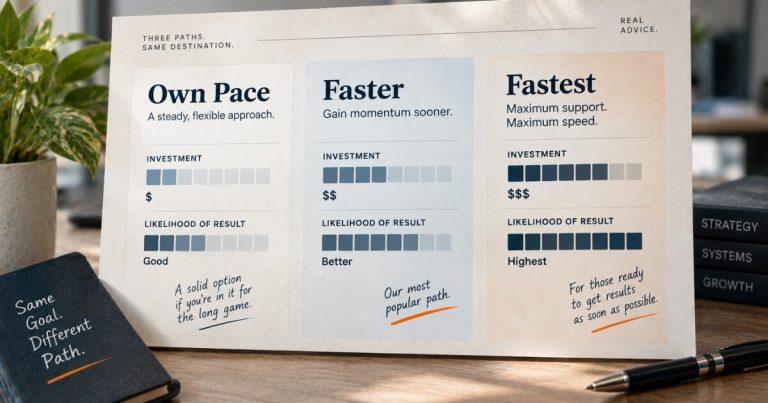
The best pricing presentation we’ve ever experienced as a patient ran three speeds:
“If you want to go at your own pace, start with supplements and testing — here’s what that looks like. If you want to increase the likelihood you feel better sooner, here’s that investment. And if you want everything working for you at once, here’s the full protocol.”
The patient chooses a pace, not a package.
The features are identical either way.
What’s being sold is confidence and time-to-result.
Frame every tier that way, and the premium option stops feeling expensive and starts feeling fast.
That’s the psychology behind clinics that scale on high-ticket programs.
VYVE Wellness, a longevity and functional medicine clinic, grew website leads 900% and inbound calls past 100 a month in four months with an offer patients could say yes to quickly.
Should you present programs and memberships over the phone?
No.
Get the first visit booked — $300 labs plus a $300 consult — and let the program conversation happen after the patient has experienced the practice.
We call it the first-date rule: “I want them to come into the clinic first, have an experience with us — take us on a first date. Then they choose whether to keep seeing each other.”
Presenting a $9,999 program to a stranger on the phone triggers every defense a buyer has.
Presenting it after labs, a thorough consult, and a plan built on her actual data is a different conversation entirely.
That’s especially true when the $300 consult fee credits toward the program if she enrolls, so the first step never feels wasted.
And when the caller opens with “how much is it?” — remember she’s trying to disqualify herself.
Answer warmly, then regain the conversation: “We have affordable options for everybody. Are you currently taking anything, or would this be your first time?”
Serve first, quote later, book the first date.
How do you move existing patients onto new, simpler pricing?
In person, at their next visit, framed as a benefit — never as an ultimatum.
The script we set for this clinic’s January transition:
“All the things you’re already paying for, we’re now including in this monthly membership. You can keep paying a-la-carte, or you can save money annually by enrolling.”
Patients can’t be forced into a structure.
But when the math visibly favors the membership, most walk themselves into it.
That’s the exact opposite of the down-sell problem this article started with.
One supporting policy: patients who disappear for six-plus months pay the full initial fee again.
That quietly makes the membership’s always-connected pricing make even more sense.
Done consistently, this is how practices build the recurring base that compounds.
The HRT clinic we grew from $1M to $4M a year runs on 250 members paying $1,000 a month, every one of them enrolled because the structure made staying obviously smarter than leaving.
FAQ’s About Patients Down-Selling and Pricing Presentation
Why do patients say yes to testing but no to the full program?
Because a menu lets them assemble the tangible parts — labs and scans — while skipping the intangible ones.
Those include visits, follow-up, and commitment, which actually drive outcomes.
If a patient can rebuild 70% of your program a-la-carte for a similar price, the pricing architecture — not the patient — is the problem.
How many options should I show a patient in a consult?
Two, occasionally three, selected in advance using an intake question about their goals and preferred pace.
Presenting every program and tier you offer produces decision fatigue.
Fatigued buyers default to the cheapest visible option or to “let me think about it.”
What’s wrong with a cheap entry-level membership tier?
If it’s underpriced — like the $99/month tier this clinic cut — it attracts patients into a version of care too thin to produce results.
It also cannibalizes the tiers that fund real outcomes and gives hesitant buyers a place to hide.
Fewer, stronger tiers convert better and serve patients better.
Should the consult fee count toward the program price?
Yes.
Charging $300 for labs and $300 for the consult filters for seriousness.
Crediting the consult fee into the program on enrollment also removes the “wasted money” feeling.
The first visit becomes a down payment on the outcome rather than a sunk cost.
How do I raise or restructure prices for existing patients?
Face to face at their next appointment, framed as new value.
Show them that what they already buy is now bundled for less than a-la-carte.
Give them the choice, show the annual math, and let the structure sell itself.
Email announcements of new pricing read as threats.
In-person presentations read as upgrades.
What’s the next step?
If patients keep cherry-picking your menu, stalling at “let me think about it,” or choosing your weakest tier, the problem is almost never the patient.
It’s the architecture of the choice.
Book a strategy call.
In 60 minutes, we’ll audit your programs, tiers, and consult flow.
We’ll cut the menu to the options that convert and rebuild the presentation around the one thing patients actually pay a premium for: the likelihood of the result.