
Why Your Clinic’s Ads Are Sending Patients to Your Competitors (The “You Don’t Exist” Problem)
Most clinic owners get into business with the same plan: “I’ll just run ads for IVs, or weight loss, or hormones, and fill my clinic with those ads.”
Then the ads run, the leads trickle, and something invisible happens between the click and the booking.
The patient researches the clinic — and finds out it barely exists online.
Here’s what that costs, and the order to fix it in.
Why do clinic ads fail even when people are seeing them?
Because the patients who see your ads research you before they book.
And if they find out you don’t exist online, they book somewhere else.
The ad did its job: it provoked the problem, got attention, and created intent.
But no one spends $500 to $5,000 on a cash-pay treatment off a single ad impression.
They Google the clinic.
They look for reviews, a real website, and a provider they can size up.
When that search comes up thin, the patient doesn’t abandon the problem.
They’re now emotionally involved in solving it.
They just solve it at a different clinic.
One that does exist.
What actually happens after a patient sees my clinic’s ad?
A research moment you don’t see and can’t track in your ad dashboard.
The sequence is consistent.
The ad provokes a problem the patient already half-knew they had — low energy, stubborn weight, chronic pain.
The patient gets emotionally involved in solving it.
Then they do their diligence.
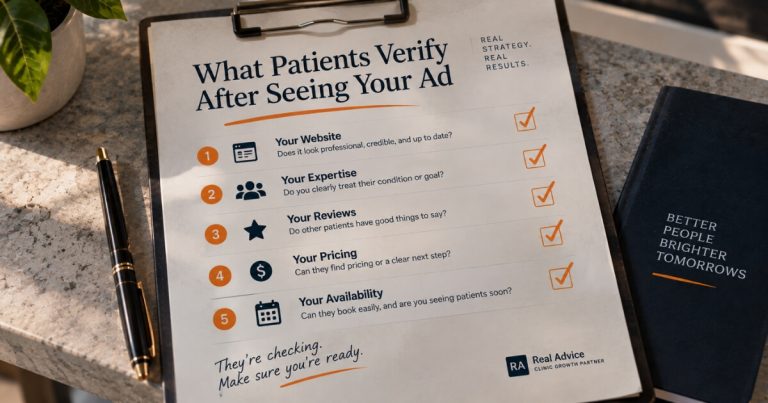
They search your clinic name, scan your reviews, click your website, and maybe look for the provider on social.
Every gap they find transfers their trust — and their booking — to whichever competitor filled those gaps first.
So what you’re really doing, running ads without the front-end legwork, is spending your advertising dollars to send business to other clinics.
Your ad budget becomes your competitor’s patient-acquisition channel.
What does “existing online” actually mean for a cash-pay medical practice?
It means that when a provoked, motivated patient researches you, everything they find confirms the decision to book.
Five things carry most of that research moment:
- A complete Google Business Profile with recent reviews.
- A website that actually explains the treatment, the pricing logic, and who it’s for.
- Visible patient results and testimonials.
- A provider who shows up as a credible human — bio, photos, ideally video.
- Enough content depth that you look like the authority on the exact problem the ad provoked.
That’s the reputation legwork.
It’s the foundation of a medical practice marketing system that converts attention into booked patients instead of leaking it to competitors.
None of this requires a massive budget.
It requires doing the unglamorous front-end work before scaling the glamorous ad spend.
Should my clinic stop running ads until the brand is built?
Scale down, don’t shut off — but fix the research moment before adding another dollar of spend.
Ads and brand aren’t rivals.
They’re a sequence.
Brand-building without ads is slow.
Ads without brand is expensive charity for your competitors.
The right order is simple: make sure the research moment confirms the booking decision, then scale spend into it.
Every improvement to reviews, website, and content raises the conversion rate of every future ad dollar.
That means the same budget buys more patients every month it runs.
The proof that organic presence carries real revenue on its own: an HRT clinic we work with grew SEO traffic from 80 to 1,000+ visitors a month and now generates $1.7M a year in memberships from SEO alone.
That’s what a built-out brand does before ads ever enter the picture.
How do I build my clinic’s reputation before scaling ad spend?
Work the checklist in order of what patients check first.
Start with reviews — volume, recency, and responses — because they’re the first thing a researching patient reads.
Then the website.
Build one page per core treatment that answers the questions a motivated patient actually types, written like an expert talks.
Then focus on provider visibility.
Use bios, photos, and short videos that make the person behind the treatment real.
Finally, publish consistent content that proves authority on the problems your ads will later provoke.
Do the legwork, and ads stop being a gamble.
Same playbook, right order.
FAQ’s About Clinic Ads and Online Reputation
Why are my clinic’s ads getting clicks but no bookings?
Almost always because the research moment fails.
Patients click, then Google your clinic — and find few reviews, a thin website, or no visible provider.
They stay motivated to solve the problem your ad provoked.
But they book with a competitor whose online presence confirms the decision.
The ad dashboard never shows you this step.
Do ads work for cash-pay treatments like IVs, weight loss, and hormones?
Yes — but only as the amplifier, not the foundation.
High-ticket cash-pay decisions get researched before they get booked.
Clinics that build reviews, website depth, and provider credibility first see ads convert.
Clinics that run ads alone effectively pay to educate patients who then buy elsewhere.
What should patients find when they Google my clinic?
A complete Google Business Profile with recent, responded-to reviews.
They should also find a website that explains each treatment and who it’s for, along with visible patient results.
In addition, they should see a credible, human provider presence.
Finally, there should be enough content depth to position you as the authority on the exact problem they’re trying to solve.
How long does it take to build enough online presence for ads to convert?
The first layer takes weeks, not months.
Start by cleaning up the Google Business Profile, activating a review-generation process, and tightening the core treatment pages.
Deeper authority content and SEO compound over months.
Most clinics can meaningfully improve their ad conversion rate within 60 to 90 days of starting the legwork.
Isn’t brand-building too slow compared to running ads?
Brand and ads work on different clocks, which is exactly why you need both.
Ads produce demand this week.
Brand determines what percentage of that demand you keep.
Skipping brand doesn’t make you faster.
It makes every ad dollar permanently less efficient, forever subsidizing competitors who did the work.
What’s the next step?
If you’re running ads for IVs, weight loss, or hormones and the leads aren’t turning into patients, the problem probably isn’t the ads.
It’s what patients find when they research you afterward.
Book a strategy call.
In 60 minutes, we’ll run the same research moment your prospects run.
We’ll show you exactly where the trust leaks are and map the order to fix them before you scale another dollar of spend.