
How Do I Compete With the $99-a-Month Weight Loss Membership Down the Street? (A Teardown of One With 390 Members)
A cash-pay weight loss and hormone practice we work with kept losing prospects to a competitor twenty minutes away running a $99-a-month membership.
Roughly 390 people were signed up on a six-month commitment.
Our client’s instinct was to drop prices.
We pulled the competitor’s offer apart line by line first — and what we found changed the response entirely.
The competitor wasn’t winning on price. They were winning on how the price reads.
How do I compete with a $99-a-month weight loss membership down the street?
Don’t match the price.
Match the structure — then price your version at the number your economics actually support.
The mistake almost every clinic owner makes when a discount competitor shows up is to treat it as a price war.
It isn’t.
A $99 monthly membership and a $300-per-month medication charge can collect similar money over a year. They just feel completely different at the moment of decision.
One reads as a small recurring commitment.
The other reads as a large repeated expense.
Same patient, same wallet, different psychology.
So before you touch a single number, write out exactly what the competitor includes.
Then determine what each included item would cost standalone and what commitment they require in exchange.
That inventory almost always reveals that the headline price is not the offer.
It’s the entry fee to the offer.
What’s actually inside a $99-a-month weight loss membership?
In the one we tore apart: one office or telehealth visit per month, a complimentary injection at signup, and 15% off everything else.
A six-month commitment held it all together.
Line by line, here’s what that membership carried.
First, one monthly visit, either in the office or by telehealth.
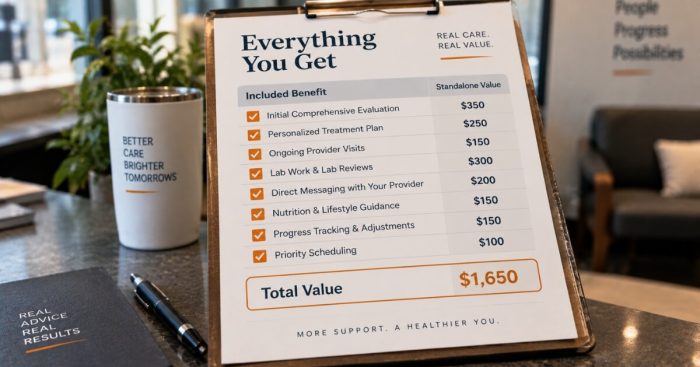
The same practice charged $100 for that visit as a standalone service. So the visit alone nominally covers the membership fee.
Next, patients received a free lipotropic injection when they signed up.
That converts the decision into an immediate reward.
Then came 15% off the actual profit center: vitamins, lipotropic injections, weight loss injections, peptides, supplements, and NAD.
And there’s one piece everyone forgets to notice: a six-month commitment.
That membership isn’t $99.
It’s $594 with a monthly payment schedule, and the patient agreed to it in one sitting.
Their medication prices weren’t dramatically lower either.
Tirzepatide was roughly $425 at the entry dose, compared with our client’s $500.
Semaglutide was about $325, compared with our client’s $300.
On the drug itself, our client was competitive and, in one case, cheaper.
What our client didn’t have was the frame that made those numbers feel small.
Should I lower my medication prices to match a discount competitor?
Almost never.
Lowering the medication price cuts your margin on the only recurring product you have. More importantly, it doesn’t address why the other offer feels cheaper.
Look at the comparison honestly.
Their tirzepatide was around $425. Ours was $500 — an 18% gap.
Their semaglutide was around $325, while ours was $300.
That means we were already less expensive on that molecule.
If price alone drove the decision, the clinic with the cheaper semaglutide should have been winning those patients.
It wasn’t.
What the discount competitor bought with $99 wasn’t a lower price.
It was a lower barrier to the first yes, a monthly relationship instead of a transaction, and a six-month runway to sell everything else.
The 15% off list is where the real revenue lives.
A member who’s already committed for six months buys peptides, NAD, and supplements from you rather than from Amazon.
Practices that build serious GLP-1 and weight loss clinic marketing figure out early that the medication is the reason people come.
The surrounding program is the reason they stay.
Discounting the reason people come, to compete with someone who monetizes the reason they stay, is the wrong end of the problem.
How do I make my price feel lower without actually lowering it?
Split the same collected dollars into a membership plus a credited product price.
The patient hears the membership number. Your revenue doesn’t change.
Here’s the exact mechanic we built for this practice.
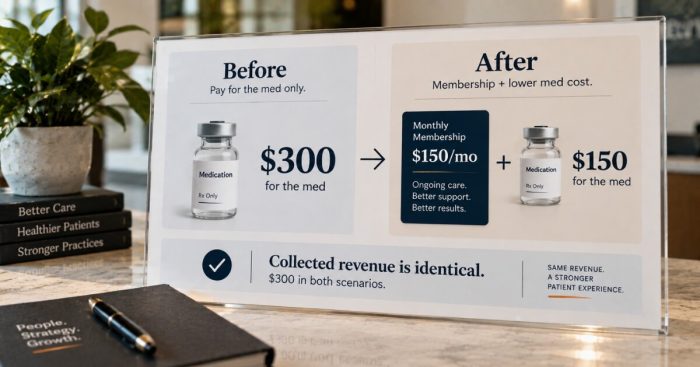
Semaglutide was $300 a month.
Instead of quoting $300 for the medication, we introduced a $150-a-month membership credited toward the cost of the medication.
The patient’s total is still $300.
But the conversation shifts from “semaglutide is three hundred dollars” to “membership is a hundred and fifty a month, and it comes off the cost of your medication.”
That isn’t a trick.
The membership genuinely carries benefits, and the credit is real.
It’s a framing decision about which number leads.
It works for the same reason a $99 competitor works. Patients evaluate the recurring commitment, then evaluate the incremental purchase against a smaller mental baseline.
The critical constraint is that your collected revenue has to stay flat.
If you build the membership and then also discount the medication, you’ve just given away margin to solve a positioning problem.
Set the membership so the math is identical to what you collect today.
Then compete on the structure rather than the total.
Is my own intake paperwork killing deals my state doesn’t even require?
Frequently, yes.
Audit every info sheet, form, and web page for requirements you invented — especially lab work you don’t legally need.
This one cost our client a live deal while we were on the call.
A prospect had inquired about a peptide protocol. The clinic’s own peptide information sheet said the first month included lab work.
In that state, labs are not required before prescribing for weight loss or peptide therapy.
The clinic had added a step, a cost, and a delay to its own funnel.
The prospect walked because of a sentence nobody had reread in a year.
Do this audit quarterly.
Read every patient-facing document as if you were a skeptical buyer with a competitor’s website open in another tab.
Then flag anything that adds a hurdle.
That includes required labs you don’t need, “consultation required before pricing,” multi-visit sequences that could be one visit, or paperwork that has to be printed.
Every one of those is a place where a competitor with a walk-in model beats you before either of you has said a word about price.
To be clear: if labs are clinically indicated for a specific patient, order them.
This is about default requirements published to every prospect, not clinical judgment on an individual.
Before I change my offer, how do I know the offer is even the problem?
Look at where leads are stacking in your pipeline.
If they pile up in the second and third follow-up stages, you have a staffing problem, not a pricing problem.
This is the diagnostic that saves clinics from rebuilding an offer that was fine.
In this practice, the follow-up system existed and worked.
It had a pipeline with day-one, day-two, and day-three stages — exactly the cadence you’d want.
Leads entered stage one cleanly.
Then they sat.
Stage two and stage three were full because the only person actually working those stages was the owner.
Meanwhile, the owner was drawing medication, giving injections, checking patients out, and answering the phone.
That’s not a system failure.
Nobody needs a better CRM to fix that.
The fix was a role: a dedicated person whose only job is same-day lead response and phone sales, at a wage the practice could sustain.
The remote admin kept the tasks that tolerate a two-day gap — payroll, reconciliation, weekly reporting, and chasing failed membership payments.
The daily work that cannot wait went to someone in the building.
Run the check before you touch your pricing.
If your first stage is clean and your later stages are full, changing your offer will change nothing.
An HRT practice we work with runs 250 active members at $1,000 a month — that kind of membership base is built by consistent daily follow-up long before it’s built by pricing cleverness.
FAQ’s About Competing With Discount Weight Loss Memberships
Should I match a competitor’s $99 monthly weight loss membership?
No.
Match the structure, not the number.
A recurring membership lowers the barrier to the first yes and creates a relationship you can sell into.
However, the price should reflect your own economics.
Copying a competitor’s number without copying their volume, cost base, and delivery model is how clinics end up busy and unprofitable.
What makes a $99 membership profitable for the clinic offering it?
The commitment and the discount list.
A six-month commitment turns $99 into roughly $594 of contracted revenue.
Meanwhile, the included monthly visit is a delivery cost the clinic already carries.
The margin comes from what members buy at 15% off — injections, peptides, vitamins, supplements, and NAD.
Those are products they now buy from that clinic instead of somewhere else.
How can I lower my perceived price without cutting revenue?
Split the same collected total into a membership fee plus a product price the membership credits against.
If you currently collect $300 a month for a medication, a $150 monthly membership credited toward that medication keeps your collected revenue at $300.
Meanwhile, the number the patient evaluates first drops to $150.
Do not stack a discount on top of it.
Otherwise, you have given away margin to solve a framing problem.
Do I need to require lab work before prescribing weight loss medication or peptides?
That depends on your state’s rules and your clinical judgment for the individual patient.
However, many clinics publish a blanket lab requirement their state does not impose, and it costs them deals.
Audit every patient-facing document for requirements you added yourself.
Then remove default hurdles that are neither legally required nor clinically necessary for that specific patient.
How do I know whether my problem is pricing or follow-up?
Look at where leads accumulate in your pipeline.
If they enter cleanly and then pile up in the second and third follow-up stages, the offer is not the constraint.
Nobody is working those stages.
That is a staffing decision, not a CRM or pricing decision. Rebuilding your offer will not fix it.
What’s the next step?
If a discount competitor is taking patients you should be winning, the answer is almost never to become the discount competitor.
It’s to restructure how your price is presented, remove the hurdles you added to your own funnel, and make sure someone is actually answering the leads you’re already paying for.
On a 60-minute strategy call, we’ll tear apart your closest competitor’s offer the way we tore apart this one.
We’ll model a membership structure that keeps your collected revenue flat and identify where your pipeline is leaking.
A med spa we work with added $6,708,600 in revenue and 3,727 new patients in a single year without becoming the cheapest option in its market.