
Should I Give My Marketing Agency Admin Access to My Clinic’s Facebook Page? (I’ve Watched 40 Ad Accounts Die at Once)
A partner agency asked me for admin access to a client’s Facebook page.
My answer was no — and not because I didn’t trust them.
I’ve had 40 ad accounts shut down simultaneously. When you run advertising in verticals like stem cells, hormones, and weight loss, enforcement doesn’t stay contained to the account that triggered it.
It travels along the connections.
Here’s the access structure that protects a clinic, and why the convenient version is the dangerous one.
Should I give my marketing agency admin access to my clinic’s Facebook page?
No.
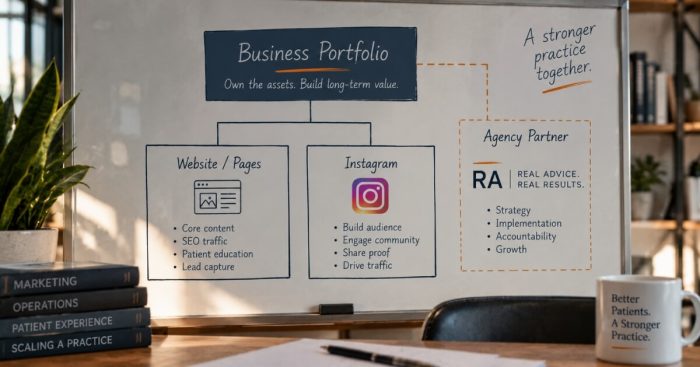
Give asset-level partner access through your business portfolio instead. Keep ownership of the page and the ad account with your practice.
Page admin is the request agencies make because it’s the fastest thing to set up.
It’s also the version that entangles your assets with theirs.
Once a vendor’s personal profile or business entity is directly attached as an admin on your page, platform enforcement actions against that vendor can have a path to your assets.
The same applies to enforcement against another client of that vendor.
The correct structure is boring and takes ten extra minutes.
Your practice owns a business portfolio. That portfolio owns the Facebook page and the Instagram account.
Then, add the agency as a partner with permissions on specific assets.
You can revoke it in one click. You never transfer ownership.
And when the relationship ends, you don’t need anyone’s cooperation to take your accounts back.
Any competent agency will not only accept this — they’ll prefer it, because it protects them too.
Can my clinic’s ad account really get banned because of somebody else’s ads?
Yes.
Enforcement follows connections between accounts, payment methods, and people, and it is not gentle about it.
I’ll be blunt about my own exposure because it makes the point better than a hypothetical: I run speculative advertising.
In regenerative medicine, hormone therapy, and weight loss, the compliance line moves. Sometimes you discover where it is by crossing it.
If I run stem cell ads and an account gets banned, every account associated with me is now associated with that enforcement.
I’ve watched 40 accounts go down in a single action.
That’s why I don’t want admin access to a client’s page.
It isn’t humility — it’s that giving me that access converts my risk into their risk.
A clinic that loses its Facebook page loses its review history, its follower base, and its ad account. Often, it loses its Instagram in one motion too.
Appeals in the health category are slow and frequently unsuccessful.
Practices doing serious stem cell clinic marketing should treat platform risk the way they treat malpractice exposure: structural separation first, trust second.
A regenerative physician we work with became the leading stem cell voice on YouTube and hired four additional doctors — an asset like that takes years to build and one enforcement action to lose.
What exactly should I share, and what should I never share?
Share assets.
Never share your password, and never make a vendor an owner of anything.
Share the Facebook page as an asset, the Instagram account as an asset, the ad account as an asset, and analytics access.
Assign each one individually with the minimum permission level that lets the vendor do the job.
Don’t share ownership of the business portfolio, your personal profile credentials, your two-factor device, or admin rights on the page itself.
If an agency tells you asset-level access isn’t sufficient for what they need to do, ask them to name the specific task.
There are one or two legitimate cases. There are far more cases where it’s simply faster for them.
One more rule saves relationships: document who has what, in writing, at the start.
Most access disputes at the end of an engagement aren’t malice.
The problem is usually that nobody wrote down which of four people at the agency held which permission. Meanwhile, two of those people may have since left.
How does my agency pull analytics if they don’t have admin access?
Through assigned analytics permissions in almost every case.
When a platform genuinely doesn’t support delegated read access, use a time-boxed credential handoff and rotate the password immediately after.
The practical version: give the password, let them pull and screenshot what they need within a two-hour window, then change the password.
It’s not elegant, but it’s bounded.
It’s also dramatically safer than leaving a shared credential live for the length of an engagement.
Do this at the start of the relationship specifically, because that’s when you want a baseline.
Before any campaign begins, capture 30-day, 90-day, and six-month snapshots.
Capture both front-end metrics — reach, followers, traffic — and back-end metrics — leads, booked appointments, revenue.
Think of it as the before X-ray.
Without it, six months later nobody can prove what changed. Every performance conversation becomes an argument about memory.
How do I set up social accounts so my agency never needs my personal logins?
Create a dedicated marketing email address for the practice and register every new platform account under it.
This is the single highest-leverage administrative decision a clinic can make, and it takes fifteen minutes.
Set up an address like [email protected].
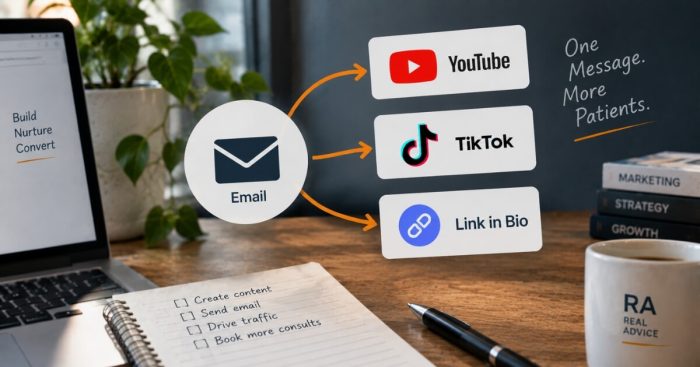
Register YouTube, TikTok, your link-in-bio tool, your scheduling tool’s public pages, and any new platform under that address.
Give the agency access to that mailbox, or forward it to whoever manages the relationship.
This eliminates the endless login loop.
Your agency tries to log into something, a verification code goes to the owner’s personal phone at 9pm, and the owner is in clinic.
Then a scheduled post misses by two days.
It also means that when staff or vendors change, you rotate one mailbox. You don’t have to track down eleven accounts registered to a former employee’s Gmail.
The accounts stay yours. The email stays yours.
Access becomes a permission rather than a favor.
Why don’t my clinic’s social videos show up in Google or AI answers?
Usually because the scheduling tool that published them stripped the metadata — no custom title, no description, no thumbnail.
As a result, there’s nothing for a search or answer engine to index.
This is a quiet, widespread problem.
Social videos increasingly surface in Google results. What shows up in Google search also increasingly feeds AI-generated answers.
But that only works if the video carries indexable text: a real title, a real description, and a thumbnail that signals what it is.
Most scheduling tools have gaps here.
Some can’t set custom thumbnails at all. Others publish reliably but don’t return backend analytics.
The result is that a clinic produces twenty good videos a month and publishes twenty untitled files.
The fix is unglamorous.
Publish through your scheduler, then go back into each platform and add the title, description, and thumbnail manually.
Budget a few minutes per video.
That small manual step is the difference between content that exists and content that can be found.
It’s the same discipline that makes an article citable in an AI answer rather than merely published.
FAQ’s About Giving a Marketing Agency Access to Clinic Social Accounts
Should a marketing agency be an admin on my clinic’s Facebook page?
No.
Add them as a partner with asset-level permissions through your own business portfolio instead.
Page admin access entangles your assets with the vendor’s. That matters because platform enforcement can follow connections between accounts and people.
Asset-level access does the same work and can be revoked in one click without transferring ownership.
Can my ad account be banned because of another business the agency works with?
It can.
Enforcement on advertising platforms follows connections between accounts, payment methods, and individuals.
Agencies running restricted health categories — stem cells, hormones, weight loss — carry elevated risk.
Structural separation limits how far an action against one account can travel into yours.
What should I do before an agency starts working on my accounts?
Capture baseline screenshots at 30 days, 90 days, and six months.
Include front-end metrics like reach, followers, and traffic. Also capture back-end metrics like leads, booked appointments, and revenue.
Without a baseline, nobody can prove what changed later.
Every performance review becomes an argument about memory.
How do I stop my agency from needing my personal two-factor codes?
Create a dedicated marketing email address for the practice.
Register every platform account under it — YouTube, TikTok, link-in-bio tools, and anything new.
Verification codes then go to a mailbox the team can access rather than the owner’s personal phone.
When staff change, you rotate one mailbox instead of hunting down accounts registered to a former employee.
Why don’t my clinic’s social videos appear in Google or AI-generated answers?
Usually because the scheduling tool that posted them didn’t attach a custom title, description, or thumbnail.
That leaves nothing indexable behind.
Publish through your scheduler, then return to each platform and add that metadata manually.
It takes a few minutes per video. It’s the difference between content that exists and content that can be found.
What’s the next step?
If you can’t currently say who owns your Facebook page, who owns your ad account, and which vendor holds which permission, that’s the project — before anything else.
Access architecture is unglamorous.
It’s the thing that determines whether a bad month is a bad month or the end of five years of audience building.
On a 60-minute strategy call, we’ll map your current access across every platform.
We’ll identify where ownership actually sits and restructure it so your practice owns its assets while vendors hold revocable permissions.
An orthopedic surgical practice we work with added $2 million in revenue from Facebook ads — that only compounds when the account survives.