
What Do I Say When a Patient Calls and Immediately Asks How Much Tirzepatide Costs? (The Word-for-Word Ladder)
Every cash-pay weight loss clinic loses the same call.
The phone rings, the caller opens with “how much is tirzepatide,” someone quotes a number, the caller says thanks, and the call ends. The team logs it as a price shopper.
It usually wasn’t.
Below is the word-for-word ladder we built with a weight loss practice’s sales team on a live coaching call — including exactly what to say about insurance.
What do I say when a patient calls and immediately asks how much tirzepatide costs?
Don’t answer with a number.
Acknowledge that you have it, reassure on affordability, and ask about dose.
The exact words: “We do have tirzepatide. We have affordable payment plans for just about everybody. What dose are you looking for?”
That reply does three things in nine seconds.
It confirms you can help, which is what the caller actually wanted to know.
It removes price as a barrier without naming a price, so there’s nothing yet to compare.
And it moves the conversation onto clinical ground — dose — where you’re the expert and they aren’t.
Start the call correctly too, because the first two seconds decide whether the rest happens.
Say who you are and why you’re calling or answering, immediately: “Hello, this is Maria with [Clinic Name], weight loss specialists, how can I help you?”
The version that fails sounds like fumbling: “Hello? Yes, hello there. Hello, Diane? Diane?”
You have about two seconds before a caller decides this is a wrong number or a telemarketer.
What if they push and just repeat “how much is it”?
Reassure again, then ask a different question.
This time, ask about what they’re doing today.
The words: “We have affordable options for all doses. What are you currently taking, or would this be your first time?”
That single question splits your callers into the two groups you need to handle differently.
First-timers need education, candidacy, and reassurance. Price is genuinely the last thing they need.
People already on a GLP-1 are shopping, and shopping means something isn’t working where they are.
If they’re already on treatment, walk the ladder: what dose are you on, what are you paying now, and is anything else included with that?
Then ask the one most teams never do: “Is there anything else you’re paying for that you’re not getting?”
If you still can’t find the gap after all of that, ask it flat out: “Why do you want to change then? It sounds like you have a good program. Why do you want to change?”
That question feels like it gives the call away.
It does the opposite.
Nobody calls a new clinic about a program they’re happy with. When you ask plainly, they tell you exactly what’s wrong.
Maybe they can’t get refills without an appointment. Perhaps they never speak to their provider. They might be unable to get dose increases or receive no support between visits.
Fill that need and you have a patient.
Practices with mature GLP-1 and weight loss clinic marketing generate plenty of these calls.
The difference between clinics is entirely what happens in the ninety seconds after the phone is answered.
How do I answer “is this covered by insurance?” without losing the patient?
Answer warmly and put the problem on the insurance system rather than on the patient.
Offer the real help you can give, and then reclaim the call with a question.
The words: “Gosh, it’s not that we don’t want it to be covered by insurance. It’s just that for most people, insurance doesn’t deem it medically necessary and won’t cover it. We’ll work with you to provide a letter of medical necessity and a superbill for your insurance company, and some patients have had success with that. What was it specifically you were looking for?”
Three deliberate moves are in there.
The opening sound — “gosh” — signals you’re on their side, and the delivery matters more than the words.
The instruction we give teams is: endearing, concerned for them.
Say the same sentence with irritation in your voice and it lands as a brush-off.
The middle offers something real.
A letter of medical necessity and a superbill are genuine help. They cost you almost nothing, and being honest that only some patients succeed with them buys you enormous credibility.
Never promise coverage.
The end reclaims the conversation.
“What was it specifically you were looking for?” moves you off the insurance topic and back onto their goal.
That’s where a decision can actually be made.

What should my team understand about selling cash-pay care?
Three rules, in this order — and they’re the reason the scripts work rather than sounding manipulative.
Rule one: your job is to help the customer make the best decision possible for them.
Not to sell, not to convince, not to persuade.
If the honest answer is that your program isn’t right for this person, saying so is the job.
Teams that internalize this stop sounding like salespeople. That’s precisely when they start converting.
Rule two: the change they want is almost always outside their comfort zone.
Nobody calls a weight loss clinic because their current life is working.
They’re asking to be changed, and change is uncomfortable.
Rule three: that same person will fight like hell to stay inside the comfort zone anyway.
It’s too much money. I can’t get to the gym that often. I can’t eat like that.
Those objections aren’t lies, and they aren’t really objections.
They’re the sound of somebody standing at the edge of a decision they want to make.
Once your team understands rule three, they stop taking objections personally.
Instead, they treat objections as the expected middle of the conversation rather than the end of it.
A pain and regenerative practice we work with added $2,095,039 in revenue in ten months largely by getting the cash-pay conversation right at this exact point.
Why does my sales rep sound like an FAQ machine?
Because they’re answering without asking.
Every answer needs to end with a question, or the caller runs the call.
The failure pattern is easy to hear on a recording.
Caller asks a question, rep answers. Caller asks another, rep answers.
Ten minutes later, the caller says “okay, let me think about it” and hangs up.
They gathered everything they wanted while giving up nothing.
Your rep was helpful and learned nothing — no goal, no history, no timeline, no reason.
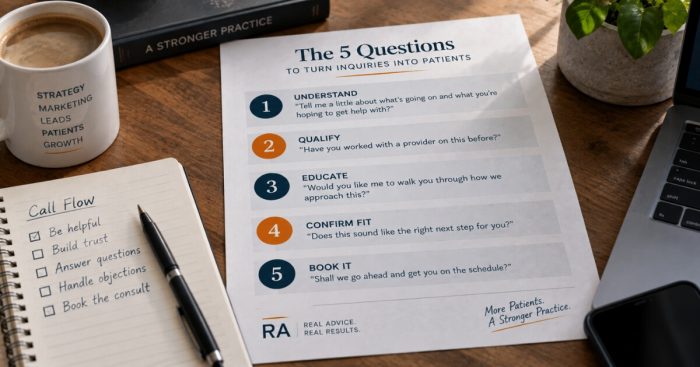
The fix is one rule: answer succinctly, then ask.
Every time.
The questions should be curious rather than clinical. Deliver them with genuine interest and an upward inflection.
“So tell me a little bit about what’s going on?”
“And what have you tried to lose weight recently?”
That tone — childlike curiosity, not interrogation — is what makes a stranger tell you the real reason they called.
The structural version of this is routing.
New patient calls and existing patient calls are completely different jobs. Putting them on one line means your best closer spends the day rescheduling appointments.
A simple two-option phone menu solves this.
Press one if you’re a new patient. Press two for everything else.
That sends new patients to whoever converts best and everyone else to the front desk.
Record the new-patient line.
You cannot coach calls you can’t hear. This is the highest-leverage part of patient acquisition that most clinics never touch.
How do I coach these calls without micromanaging my team?
Let the rep pick the call.
Have them send you the name or number of any conversation they weren’t happy with. Then review the recording together.
This inverts the usual dynamic, and it’s the reason it works.
When a manager pulls calls at random, the rep experiences it as surveillance and defends.
When the rep flags their own call, they’ve already identified something they want to fix. They arrive coachable.
Keep the script in a shared document the rep can edit.
The lines above are a starting point, not scripture. The person on the phone all day will find better phrasings than you will.
A script the rep helped write is a script the rep uses.
And keep the feedback narrow.
One behavior per session — the opening, the price deflection, or ending answers with questions.
Not seven things.
A med spa we work with added $6,708,600 in revenue and 3,727 new patients in a single year — at that volume, a two-point improvement in phone conversion is worth more than any change you could make to the ad account.
FAQ’s About Price Objection Scripts for Cash-Pay Weight Loss Clinics
What should I say when a patient asks how much tirzepatide costs?
Don’t lead with a number.
Say something like: “We do have tirzepatide. We have affordable payment plans for just about everybody. What dose are you looking for?”
That confirms you can help and removes price as a barrier without giving them a figure to comparison-shop.
It also moves the conversation to clinical ground where you can qualify the caller.
How do I handle a caller who insists on knowing the price immediately?
Reassure once more and redirect with a different question.
“We have affordable options for all doses. What are you currently taking, or would this be your first time?”
That splits callers into first-timers, who need education rather than pricing, and current patients.
Those current patients are shopping because something isn’t working where they are.
What do I say when a patient asks if weight loss medication is covered by insurance?
Be warm, be honest, and offer real help.
For example: “It’s not that we don’t want it covered. For most people, insurance doesn’t deem it medically necessary and won’t cover it. We’ll work with you to provide a letter of medical necessity and a superbill, and some patients have had success with that. What was it specifically you were looking for?”
Never promise coverage.
Always close with a question that returns the call to their goal.
How do I find out why a patient wants to switch clinics?
Ask directly: “Why do you want to change then? It sounds like you have a good program. Why do you want to change?”
It sounds like you’re arguing against yourself, but nobody calls a new clinic about a program they’re happy with.
Asked plainly, patients name the gap.
Maybe refills require appointments. Perhaps they never speak to their provider. They might not get dose increases or support between visits.
Why does my front desk sound like an FAQ line on the phone?
Because they answer without asking.
Every answer should end with a question. Otherwise, the caller controls the conversation and hangs up after learning everything while giving up nothing.
Pair that rule with a two-option phone menu.
Route new patients to your strongest closer and everyone else to the front desk.
Then, record the new-patient line so calls can be coached.
What’s the next step?
Pull five recorded calls from last week where someone asked about price.
Listen for one thing: did your team give a number, or did they ask a question?
That single data point usually explains a bigger gap between your lead volume and your patient count than anything in your ad account.
On a 60-minute strategy call, we’ll listen to your inbound calls and adapt this ladder to your treatments and pricing.
We’ll also set up the routing and coaching loop that keeps it improving after we’re gone.