
Why Are My Med Spa’s Google Ads Disapproved — and How Much Is That Quietly Costing Me? (We Found $1,155 Authorized and $3.47 Spent)
We took over a med spa’s ad accounts and opened Google first. The status column read: all ads disapproved, all asset groups limited by policy.
The daily budget had been raised to $165. Over seven days, that authorizes $1,155 of spend. The account had spent $3.47.
Nobody had noticed, because a disapproved account doesn’t send you an invoice for the money it failed to spend. It just quietly stops working while you keep waiting for leads.
Why are my med spa’s Google Ads disapproved when my ad copy doesn’t mention anything restricted?
Because Google reviews the destination, not just the ad.
If your website mentions semaglutide, tirzepatide, HRT, or TRT anywhere, the ads pointing at that domain can get blocked. That can happen no matter how clean the ad text is.
This is the single most common reason a cash-pay aesthetics or wellness practice sits with a fully disapproved Google account and no idea why.
The owner reads the disapproval notice and assumes it’s about wording. They rewrite the headline three times and resubmit.
Nothing changes.
The ad was never the problem.
Google’s system crawls the landing page and the site it belongs to. Prescription weight-loss and hormone content on the destination domain can poison ad-level approval for the whole account.
That includes campaigns for services that have nothing to do with those treatments.
That’s why Google can block a med spa from advertising lip filler because of a semaglutide page it built two years ago.
The filler ad is compliant. The domain it points to isn’t.
There’s a second version of this trap that’s just as expensive: running ads straight to your website with no dedicated landing page at all.
It’s common and it’s costly.
Your homepage carries every service you offer, which maximizes the surface area Google can object to. It also gives the visitor eleven things to do instead of one.
How much money am I actually losing to disapproved ads without knowing it?
Run this arithmetic: daily budget × days the campaign has been live = authorized spend.
Compare that to actual spend. The gap is your invisible loss.
In the account above, the numbers were $165 a day × 7 days = $1,155 authorized, against $3.47 delivered.
That’s not underperformance. That’s an account that is switched off while reporting itself as active.
The owner had been evaluating the channel and deciding whether Google “works” for her practice. But she was making that decision based on an account that had never actually run.
Do this audit before you fire an agency, change platforms, or conclude that paid search doesn’t work in your vertical.
It takes two minutes and reframes the entire conversation.
Most owners look at leads and cost per lead. Almost nobody looks at whether the money they authorized actually left the account.
The related number is worth knowing.
When this account had been delivering, a single Google lead had cost $225.
So the practice wasn’t just missing spend. It was missing the several patients that spend would have produced across a week.

Will rewriting my ads fix a policy disapproval?
No.
If the disapproval is destination-based, you can rewrite the ads forever and nothing will change. You have to change where the ads point.
The fix is a clean, single-offer landing page that lives outside the contaminated site.
Typically, we build it in your CRM so the lead lands in the same system that will follow up with it.
One offer, one call to action, and no mention of restricted treatments anywhere on the page.
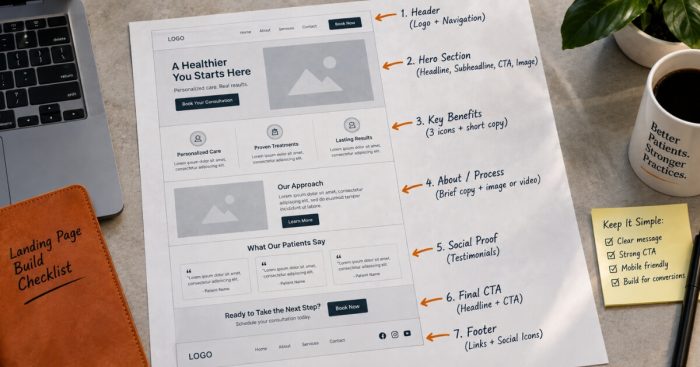
That structure looks like this, in order: the headline offer, a short “why us” block, “how it works” in three steps, and “who this is for.”
Then comes the form and a submit button that names the offer rather than saying “submit.”
Finally, send the visitor to a confirmation page that thanks them and gives them a way to call immediately.
Nothing else. No navigation to your GLP-1 page. No service menu.
There’s a compounding benefit most practices miss.
The lead now arrives inside your CRM rather than through a website form that emails somebody. As a result, your conversion tracking finally works.
A well-built med spa marketing program lives or dies on being able to say which campaign produced which patient.
You can’t do that when the form emails the owner and the owner forwards it to the front desk.
Should I put my GLP-1 and hormone services on the same website as my aesthetics services?
You can — but not on the domain you advertise from.
Keep the advertised destination clean and separate.
This is a structural decision, not a copy decision.
Practices that run GLP-1 and weight loss clinic marketing alongside injectables and lasers eventually hit the same wall.
The treatments that are hardest to advertise are also the ones sharing a domain with everything else you’d like to advertise.
Two clean options exist.
Either keep the main site as your organic and SEO asset while advertising exclusively to purpose-built landing pages, or split the restricted services onto their own domain entirely.
What doesn’t work is hoping the crawler misses it.
It doesn’t, and each rejected resubmission adds friction to the account’s history.
Should I add a new ad to my best-performing campaign or start a new campaign?
Start a new campaign.
Adding creative to a campaign that already has a winner just makes your new ad compete against your best ad for the same budget.
This came up in the same account.
The TikTok side was working: $277 spent over six days produced 11 leads. Nine of those eleven came from a single offer — $600 off PRP microneedling with collagen.
One clear winner was carrying the campaign.
A second ad in that campaign was actively stealing delivery from the winner, so we paused it mid-call.
The rule we apply: a winning ad gets its own campaign and its own budget.
Every new creative gets a separate campaign. That way, the two compete on equal footing instead of cannibalizing each other inside one budget pool.
The related trap is a budget misread.
On most platforms, the daily budget is set at the campaign level, not per ad.
This owner believed she was spending $150 a day because she had three ads under a $50/day campaign.
She was spending $50.
If you think you’re spending three times what you’re spending, every performance conclusion you draw is wrong.
Why am I getting leads from two hours outside my service radius?
Because social platforms deliver through the social graph, not just the geographic filter.
As a result, your ad can reach friends and followers of the people who saw it, wherever they live.
Aesthetics owners see an out-of-area lead and immediately assume the targeting is broken.
Usually it isn’t.
If someone in your city engages with your ad, the platform can show that ad to their connections. Some of those connections may live across the country.
This is normal on short-form video platforms and much less common on search.
The right response isn’t to panic about targeting.
Instead, layer additional qualification — income targeting, tighter radius, and a landing page that names your city plainly.
Then, treat the occasional distant lead as noise rather than evidence of a broken campaign.
While you’re auditing lead quality, check one more thing that has nothing to do with ads: what happens when someone calls after hours.
In this practice, the phone rang at least ten times before anything happened. Meanwhile, abandoned calls appeared in the CRM as if leads had vanished.
The CRM was only the tracking number on the front end. The actual cause was a ring-timeout setting in the phone system.
Shortening it fixed a lead leak that looked, on the dashboard, exactly like an advertising problem.
A regenerative practice we work with converted 79.4% of its leads into booked appointments — a number that is impossible if the phone is quietly dropping callers.
FAQ’s About Google Ads Disapprovals for Med Spas and Cash-Pay Clinics
Can Google disapprove my ads because of content on my website rather than in the ad?
Yes.
Google reviews the destination page and the domain it belongs to, not just the ad text.
Prescription weight-loss and hormone content — semaglutide, tirzepatide, HRT, TRT — appearing anywhere on the destination site can trigger disapprovals and policy limits.
That can affect the whole account, including campaigns for unrelated services like injectables or laser treatments.
How do I check whether my Google Ads account is actually spending its budget?
Multiply the daily budget by the number of days the campaign has been live.
Then, compare that figure to actual spend in the account.
If actual spend is a tiny fraction of the authorized amount, the account is throttled or disapproved rather than underperforming.
In one med spa account we audited, $1,155 was authorized over seven days and only $3.47 was delivered.
What should a compliant landing page for a med spa offer contain?
One offer and nothing else.
Include the headline offer, a short why-us block, a three-step how-it-works section, a who-this-is-for section, and the form.
The submit button should name the offer. Follow it with a confirmation page that includes a click-to-call option.
Build the page in your CRM so leads land in the system that follows up with them.
Do not link out to restricted service pages from it.
If one ad is winning, should I add more creative to that campaign?
No.
A new ad inside a campaign that already has a winner competes against that winner for the same budget. Usually, that suppresses the winner.
Instead, launch new creative in its own campaign with its own budget. This allows the two to run against each other on equal footing.
Also confirm whether your daily budget is set per campaign or per ad.
Misreading that is a common way owners believe they are spending three times what they actually are.
Why do I get leads from far outside my service area on TikTok or Meta?
Because delivery follows the social graph as well as your geographic settings.
When someone local engages with your ad, the platform can serve it to their connections regardless of where those people live.
Layer income and radius targeting and name your city on the landing page.
However, treat occasional distant leads as noise rather than proof of broken targeting.
What’s the next step?
If your ads are disapproved, or your account has been “running” for weeks without spending its budget, you are not evaluating a marketing channel.
You are evaluating a switch that’s in the off position.
Fix the destination first, then judge the channel.
On a 60-minute strategy call, we’ll open your ad accounts with you and run the authorized-versus-actual spend audit.
We’ll identify which pages on your site are blocking approval. Then, we’ll map the landing pages that would let you advertise your highest-margin services without touching the restricted ones.
A med spa we work with added $6,708,600 in revenue in a single year on multi-channel paid ads — none of which is possible from an account that can’t spend.