
Why Do My TikTok Ads Work in One State and Get Zero Leads in the Next State Over? (A $370 Twin Test)
A multi-state women’s hormone practice we work with ran the same creative, the same offer, and the same daily budget in two neighboring states. One state spent $370 and produced a single lead. The other spent $370 and produced eleven.
Nothing in the ad account explained it. Here’s the diagnostic we ran, what we found, and what we did with the money — because the wrong conclusion here costs clinics thousands of dollars a month in budget they think is “just underperforming.”
Why do my TikTok ads work in one state and get almost no leads in the next state over?
Because performance on a social platform is partly a function of how the people in that state feel about the platform itself. And that is a variable you cannot see inside the ad account.
Here’s the actual data.
We ran identical campaigns for a cash-pay women’s hormone practice across three states. In North Carolina, $370 in spend produced one lead.
In South Carolina — one state south, same creative, same landing page, same offer, same bid strategy — the same $370 produced eleven.
Not eleven percent better. Eleven leads versus one.
When an ad account shows you that, every instinct says the problem is inside the account. The audience is too narrow, the creative fatigued, or the bid strategy is wrong.
But the twin test rules all of that out.
If the creative, offer, landing page, and budget are identical and the only variable that changed is the state line, the cause is outside the account.
In this case, the likeliest explanation we found was state-level hostility toward the platform itself. An environment where the app is politically contested, restricted on government devices, and blocked in schools produces a different user base.
That user base may be smaller, older, more skeptical, and less likely to hand a health-related lead form its phone number.
We are not going to pretend that’s a scientific finding. It’s a hypothesis that fit the evidence.
But the operational lesson holds regardless of the cause: when one geography dies while an identical twin thrives, stop optimizing and start reallocating.
You are not going to creative-test your way out of a state that doesn’t want to be on the platform.
How much should I spend in a new state before I decide it’s dead?
Roughly $300 to $400, run against an identical campaign in at least one comparable state at the same time.
The single spend number is meaningless on its own.
$370 with one lead sounds terrible. However, $370 with one lead when your other state produced eleven on the same money is a decision.
The twin is what makes the number readable.
This is why we launch multi-state clinics at a modest per-state daily budget — around $50 a day per state. We do this rather than pooling the budget nationally and letting the platform decide where to spend it.
Pooled budgets hide geography. Split budgets expose it.
Give it enough days to clear the learning phase and enough spend to produce a statistically meaningful gap.
Then read three things: total leads, cost per lead, and whether any leads at all converted to a booked appointment.
In this account, the winning creatives were producing leads at $10 to $15 apiece in the healthy states.
A state sitting at $370 per lead isn’t “slightly behind.” It’s a different market.
Practices that run a predictable patient acquisition system instead of a single national campaign catch this in week one.
Practices that don’t will run a dead state for six months because the blended account average still looks acceptable.
What should I do with the budget from a state I just killed?
Move it the same day — half into your best-performing state, half into a different channel in the state you just turned off.
Killing a geo and pocketing the money is the mistake.
The demand in that state didn’t disappear; the channel did.
In this account, we turned North Carolina off on TikTok and immediately did two things.
First, we reallocated the freed budget across the two states that were working. We took each from $50 a day to $100 a day, keeping total monthly spend near $3,000.
Second, we relaunched North Carolina on Google at $50 a day. Search demand for hormone therapy exists in every state regardless of how that state feels about a social app.
That second move is the one most clinics skip.
A dead geo on one platform is a live geo on another. You already have the creative, the offer, and the landing page built.
The marginal cost of testing the same state on a second channel is close to zero.
More importantly, the information you get back is worth more than the ad spend. Does this state have demand at all, or just no demand here?
Is five appointments from thirty leads a good book rate for a cash-pay clinic?
It’s roughly average. It’s also the number most owners misread as an ad problem when it’s a phone problem.
Thirty leads produced five booked appointments in this account — about a 16% book rate.
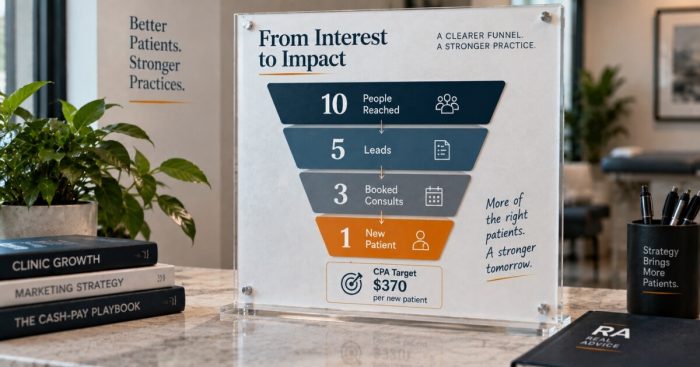
That sounds low until you run the funnel math we use with every cash-pay client. You will call ten leads, you will actually speak to five, you will book three, and one will buy.
That ladder assumes someone is calling fast and calling repeatedly. It falls apart entirely if leads sit in a CRM overnight.
The math that matters is the one at the bottom.
With a target cost per acquired patient under $300 and roughly $3,000 a month in spend split across two states, this practice needs about ten new patients per state per month.
That’s the number the ad account is being held to — not cost per lead, not click-through rate, not video views.
Cost per lead is a leading indicator. Cost per acquired patient is the scoreboard.
Also worth knowing: expect only one to three percent of your total leads to call you directly from the ad.
Everyone else is a lead form submission that has to be worked.
If your front desk is treating inbound calls as the real pipeline and form fills as a nuisance, your book rate will sit at 16% permanently.
Why does my scheduling page produce appointments nobody shows up for?
Because a “request a time slot” form is not an appointment. There’s no calendar object behind it, so you can’t build anything on top of it.
This is the quietest lead leak in cash-pay medicine.
A patient fills out a form asking for “Tuesday afternoon.” Someone on staff eventually calls to confirm, and the practice counts it as a booking.
But no appointment object exists. As a result, no reminder chain can fire, no confirmation link exists, and no calendar sync happens.
You cannot build reminders around a preference.
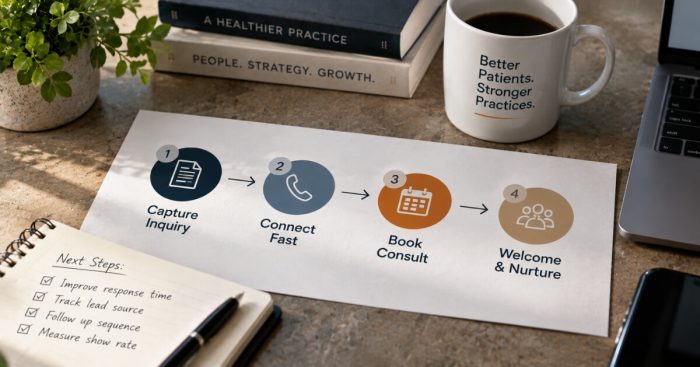
The stack that actually holds a show rate starts with an opt-in page. Then, the patient reaches a real calendar page where they pick a live slot.
Next comes card capture at the point of booking. A confirmation text and email then deliver a short educational video before the visit.
After that, reminders go out at two hours, thirty minutes, and ten minutes before the appointment. Each reminder includes a confirm-or-cancel option.
Finally, sync the practice calendar to a shared Google or Outlook calendar. That way, staff never have to log into the CRM to see their day.
One more detail quietly kills conversion.
If your team texts patients from one number and calls them from another, patients don’t recognize you and don’t answer.
Calls should originate from the same system the texts do.
Should I use Google Performance Max instead of Search for treatments Google restricts?
Often yes — Performance Max lets you describe the intent you’re after through search themes when the exact clinical phrase is constrained in a standard Search campaign.
Health advertising is one of the most heavily policed categories on Google. Cash-pay practices routinely find that the phrase patients actually type is the phrase they’re least able to bid on cleanly.
Performance Max approaches the problem differently.
Instead of a keyword list, you feed it search themes and asset groups. Then, you let the system find qualified intent across Search, Display, YouTube, Gmail, and Maps.
The trade-off is patience.
Performance Max has a longer learning period than a tight Search campaign. It will also spend inefficiently while it figures out your audience.
Budget for that.
Launch at a modest daily spend, expect a slower ramp than TikTok, and don’t judge it on week one.
Before you launch anywhere, get the plumbing right.
Link the ad account through your agency’s manager account rather than handing over a password.
Then, create a new, distinct lead source in your CRM for the new channel so attribution doesn’t blend. Clone your existing automation and map it to that new source.
A regenerative practice we work with generated $309,590 in cash-pay revenue in ten months with no paid ads at all — proof that channel choice is a strategy decision, not a default.
The point isn’t that ads are optional. The point is that each channel is a separate hypothesis, tested separately, with its own source tag.
FAQ’s About State-by-State TikTok Ad Performance for Cash-Pay Clinics
How do I tell the difference between a bad ad and a bad market?
Run the same ad in two comparable markets at the same time with the same budget.
If both underperform, it’s the ad. If one performs and the other doesn’t, it’s the market — and no amount of creative testing will fix it.
This twin test is the only clean way to separate the two variables.
Sequential testing lets seasonality, algorithm changes, and creative fatigue contaminate the result.
What is a good cost per lead for TikTok ads for a hormone or weight loss clinic?
In the accounts we manage, winning creatives produce leads in the $10 to $15 range.
An account still in creative testing will average higher.
But cost per lead is only a leading indicator. The number that decides whether the channel survives is cost per acquired patient.
For most cash-pay practices, that ceiling sits around $300.
A $12 lead that never books is more expensive than a $40 lead that does.
Should I split my ad budget by state or run one national campaign?
Split it by state if you operate in more than one.
A pooled national budget lets the platform allocate spend wherever it finds the cheapest impressions. That hides geographic failure inside a blended average.
Separate campaigns with separate daily budgets cost you a little efficiency. However, they buy you the ability to see and act on a dead market within a week.
If a state doesn’t work on TikTok, should I give up on that state?
No. Turn the channel off, not the market.
Search demand for cash-pay treatments exists in every state regardless of how that state’s population feels about a particular social app.
Relaunch the same offer and landing page on Google in that geography.
Then, treat it as a separate test with its own budget and its own learning period.
How many leads do I need before the numbers mean anything?
Enough spend to produce a readable gap against a twin — usually $300 to $400 per market.
You also need at least one full follow-up cycle on every lead generated.
Before judging a market, your team should call each lead ten times, speak to half of them, and book what it can.
Otherwise, you’re judging your follow-up, not your advertising.
What’s the next step?
If you’re running paid ads across multiple states and your blended cost per lead looks acceptable while your patient count doesn’t move, the problem is almost certainly hiding inside the average.
One geography is subsidizing another, and you can’t see it from the account summary.
On a 60-minute strategy call, we’ll pull your campaigns apart by geography.
We’ll show you which markets are actually producing acquired patients versus leads. Then, we’ll map which of them belong on a different channel entirely.
An HRT practice we work with grew from $1M a year to $4M a year by getting this kind of channel-by-market clarity before increasing spend, not after.