
How Do I Stop Patients From Quitting My 6-Month Program Before I Break Even? (Churn Clusters at Day 30 and Day 90)
If you sell a six-month program at a cash-pay clinic, your costs are front-loaded and your revenue is not. The supplements ship in month one. The labs run in month one. The payment arrives in twelve to twenty-four small pieces. That gap is where practices lose money on patients they successfully sold — and it closes only if the patient stays. Here’s the FAQ on where six-month programs actually break, and what to build so they don’t.
Why do patients quit a 6-month cash-pay program before it’s finished?
Because they haven’t felt anything yet, and the program asked them to be patient with their own money.
A six-month program is a promise about the future.
Every week that passes without a felt change, the patient quietly re-runs the math on what they’re paying.
Nothing dramatic happens.
They don’t storm out. Instead, they stop taking the supplements, push the next appointment, go quiet, and eventually cancel.
The clinical reasons owners give — “they weren’t compliant,” “they weren’t ready” — usually describe the symptom rather than the cause.
The cause is time-to-value.
In a working session with a functional medicine and longevity practice we work with, the question stayed deliberately narrow: what can we do to increase the value the patient gets and shorten the amount of time it takes them to get it?
Not “how do we lock them in.”
Lock-in doesn’t survive six months of feeling nothing. Front-loaded results do.
That reframe changes what you build.
If you believe patients quit because of weak commitment, you build contracts and cancellation fees.
If you believe they quit because value arrived too slowly, you build a first thirty days that delivers something they can feel.
That might be a symptom that moves, a number that changes, or a question that finally gets answered.
Then you put the cheapest, fastest wins at the front of the protocol instead of the middle.
When does a six-month cash-pay program actually break even?
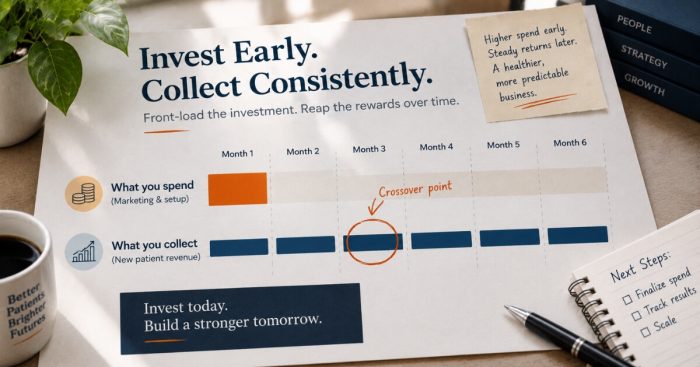
Usually month three or four — not month one.
The practice above supplies three months of supplements inside the enrollment kit.
It also runs full labs and delivers a long initial consult during the first few weeks.
Meanwhile, the patient pays only a fraction of those costs in the first month or two.
As the owner put it during the call, they don’t break even until the patient stays at least three or four months.
If a patient leaves after one month while holding three months of supplements, that’s not a lost sale.
It’s a negative one.
This is the number most owners have never calculated, and it changes every downstream decision.
Until you know your break-even month, you can’t tell a retention problem from a pricing problem.
A clinic that breaks even in month four and loses a third of its patients at day 90 is not running a marketing problem.
It is running a program that is structurally unprofitable at its current retention rate.
More lead flow does not fix that. It just funds the problem faster.
Run the arithmetic once, honestly.
Add the cost of goods you ship up front, provider hours in the initial consult, lab and testing spend, and staff time in weeks one through four.
Then divide by the monthly collection.
The month where the line crosses is the month your entire retention design has to protect.
When does patient churn actually happen in a six-month program?
Two windows: around day 30 and around day 90.
Almost nobody quits in week two, and very few quit in month five.
Day 30 is the first payment that arrives with no novelty attached.
The enrollment excitement is gone, the kit has been opened, and the second charge hits a patient who hasn’t yet decided the program is working.
Day 90 is the halfway audit.
By then, the patient has paid real money and consciously asks whether the change they’ve felt justifies three more months.
The practical consequence is simple: these two windows deserve most of your attention.
Get a patient past the first thirty days and you will very likely get them to ninety.
Get them past ninety and they usually finish.
So the staffing question isn’t “how do we support patients for six months?”
It’s “what happens in weeks one through four, and what happens in week twelve?”
The practice we worked with answered the first question with a call cadence.
Their patient coordinator calls every new program patient weekly for the first three weeks.
Not a text. Not an automated check-in.
A call from a person whose name the patient already knows.
Three calls.
That’s the entire intervention on the highest-risk window, and it costs less than an hour of staff time per patient.
That base exists because patients stayed, not because more of them enrolled.
Should my doctor see program patients every four weeks or every six weeks?
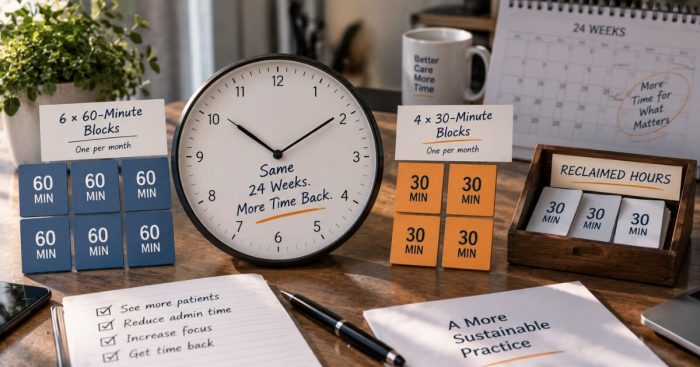
Every six weeks, in a 30-minute visit, is usually better for the patient and dramatically better for the schedule.
This sounds like a downgrade and isn’t.
The practice above moved from hour-long monthly consults to 30-minute consults every six weeks.
In the owner’s words, that doubled or tripled the physician’s availability.
Across a 24-to-25-week program, that’s four physician touchpoints instead of six, at half the length.
That creates room for new enrollments without hiring another provider.
The clinical argument is more interesting.
An hour with a physician connecting labs, history, symptoms, and protocol creates a lot of information at once.
The estimate on that call was that patients walk out having registered about 20% of what they were told.
A tighter rhythm with one clear focus per visit can produce better implementation than a long session the patient can’t hold in their head.
Two things make the six-week cadence work instead of feeling like abandonment.
First, someone other than the physician fills the gaps — a nurse practitioner, coordinator, or coach.
Second, the physician’s reasoning has to be documented well enough that whoever fills the gap can answer the patient without escalating.
The more of the doctor’s thinking exists as a written protocol instead of instinct, the more of the program can run without the doctor in the room.
How do I give program patients more access without adding visits to my schedule?
Offer the access as an entitlement they can use, not as a visit you have to schedule.
Every clinic that tries to solve mid-program silence by adding another mandatory appointment creates two problems.
First, the schedule may not be able to absorb it.
Second, no-show rates rise when patients are booked into visits they never asked for.
The alternative is to publish the access and let the patient pull it when needed.
In this practice’s program, that reads as “as-needed 20-minute consults with our nurse practitioner.”
Not booked in advance.
Not on the calendar until the patient wants it.
Owners often assume this gets abused.
Usually, it doesn’t.
A handful of patients will use every minute available to them. Those are often the patients with a real unresolved issue, which you want surfaced anyway.
Most patients use it once or twice and mainly value knowing it’s there.
The perceived value of unlimited-feeling access is much higher than its actual utilization.
That is exactly why it can be one of the cheapest retention features you add to a program.
Two guardrails keep it honest.
First, cap the length out loud.
“20 minutes” is a real number the patient can hold you to. So is “up to 24 sessions a year” instead of the word “unlimited.”
Second, route the access to the right person.
An as-needed consult with a nurse practitioner is a feature.
An as-needed consult with the owner-physician is a schedule you can lose control of by month two.
What happens when a patient finishes the program — how do I keep the revenue?
You need a maintenance tier that exists before they finish.
It also needs to be priced far enough below the program that saying yes feels easier than saying goodbye.
The practice above runs a program in the high hundreds per month and a single maintenance tier at $349 a month.
The gap is the point.
A patient six months into feeling better is not choosing between $349 and nothing.
They’re choosing between $349 and losing the thing that got them here, at a fraction of what they were already paying.
That is an easier decision when maintenance is presented as the natural next stage.
It becomes much harder if you introduce it during the last visit as a brand-new sale.
The mechanic is to name the stage before the patient reaches it.
Map the whole program as stages — enrollment, consult one, consult two, consult three, consult four, maintenance.
Then let staff and automations reference “moving to maintenance” from month two onward.
By the final consult, it feels like a transition rather than a pitch.
Also, build the path back.
One patient at this practice declined maintenance, then rejoined three or four months later.
That only happens if patients who decline stay on a list, keep getting the newsletter, and receive a check-in that isn’t a sales call.
Deciding not to continue is not the same as leaving.
Clinics that treat those two things identically write off revenue that may have returned on its own.
FAQ’s About Six-Month Cash-Pay Program Retention
When does a six-month cash-pay program break even?
Most break even in month three or four because the costs are front-loaded and the revenue is not.
Supplements, labs, and the long initial consult all land in the first weeks.
Meanwhile, the patient pays in monthly installments.
So a patient who leaves after month one while holding three months of supplements costs the practice money rather than earning it.
When do patients most often quit a six-month program?
Churn clusters around day 30 and day 90.
Day 30 is the first payment that arrives after the novelty wears off.
Day 90 is the halfway audit, when the patient weighs their results against another three months of payments.
Very few patients quit in week two or month five.
That is why retention effort belongs mainly in those two windows.
How do I reduce churn in the first 30 days of a patient program?
Shorten time-to-value and add human contact.
Put the fastest, most noticeable wins at the front of the protocol so the patient feels something before the second payment.
Then have a named staff member call every new program patient weekly for the first three weeks.
Not text.
Call.
That is roughly an hour of staff time per patient spent on the single highest-risk window in the program.
Is it better to see program patients every four weeks or every six weeks?
Six weeks in a 30-minute visit can work better than four weeks in an hour.
One practice that made this change doubled or tripled its physician’s availability across a 24-week program.
Patients also implemented more of the plan because the visits became more focused.
The clinic’s own estimate was that patients retained only about 20% of an hour-long, dense clinical explanation.
The six-week model works only if the gaps are covered by a nurse practitioner or coordinator and the physician’s reasoning is documented.
How do I offer more patient access without overloading my schedule?
Offer it as an entitlement rather than a scheduled visit.
For example, use as-needed 20-minute consults with a nurse practitioner that patients book only when they need them.
Utilization is usually lower than owners fear.
The perceived value is high, while the actual schedule burden stays manageable.
The guardrails are simple: name a real time cap and route the access to a mid-level provider rather than the owner-physician.
What’s the next step?
If you sell a six-month program and you’ve never calculated the month it breaks even, that’s the first hour of work.
That number usually reframes everything you thought was a marketing problem.
Book a strategy call and we’ll map your program against the two churn windows, identify where value is arriving too late, and show you what the first thirty days should look like for your specialty.