
How Many Location Pages Does My Clinic Website Actually Need?
Almost every clinic owner who asks this question already has a number in their head, and it is almost always between five and fifteen. The real answer is an order of magnitude larger, and once you see how it’s built it stops sounding absurd. Here’s the FAQ on how many service and city pages a clinic site actually needs, which cities deserve one, and how long it takes to work.
How many pages does my clinic website need to rank in nearby cities?
Far more than most owners expect.
On a build we scoped for a med spa we onboarded, the plan was thirty cities by seven services. That meant adding roughly 210 to 220 pages to a website that had only a handful.
That number comes from a grid, not from a wish.
One axis is your service list.
Every distinct treatment a patient searches for by name gets its own page. Someone searching for one service is not the same person as someone searching for another, and a combined page may satisfy neither.
The other axis is geography.
Every city in your catchment that a patient would actually type into a search box gets its own version of the relevant service page.
Multiply the two and you have your page count.
Seven services across thirty cities is 210.
Add the service overview pages, the home-city set, and the supporting pages, and you are at roughly 220.
Owners hear that and assume it is padding.
It isn’t.
People search for a treatment plus a place.
If your one service page only names the town where your building sits, you have entered one square of a grid with hundreds of squares.
Every relevant square you don’t build is one someone else may already occupy.
One category of page needs a different decision path.
On compliance-sensitive service lines — pages about compounded weight-loss medications, for example — some clinics choose to publish the page but leave it out of the main navigation while they take the question to their attorney.
That is a pattern we have seen clinics adopt, not advice.
Whether a given page or claim is permissible is a legal question for a healthcare attorney who knows your state and pharmacy relationships.
Answer that question before the page is written, not after.
Which cities should I build service pages for?
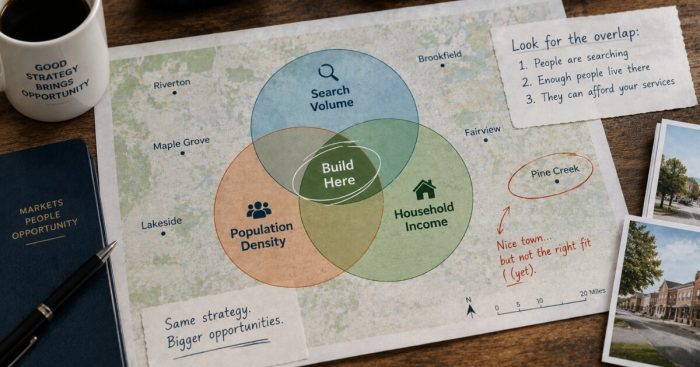
Search volume, population density, and income — in that order — not proximity.
The default instinct is to draw a radius on a map and build outward from the nearest towns.
That can produce pages nobody searches for.
A town fifteen minutes away with almost no search volume for your services and low household income may be a worse investment than a town thirty-five minutes away with real query volume.
The farther town may also have a patient base more likely to pay cash for elective treatment.
Distance is the fourth filter, not the first.
So run the selection process the other way.
Pull search volume for each service across the cities in a wide ring around you.
Then overlay population density.
Volume in a dense area can convert into repeat visits more easily than the same volume spread across a rural county.
Next, overlay household income.
Cash-pay aesthetics, hormone therapy, weight loss, and regenerative services are elective purchases. A page is more valuable when the market can realistically buy what the clinic offers.
The output is a ranked list.
That ranking dictates the build order.
You do not commission 220 pages on day one.
Start with the service overview pages for the city where you are physically located.
Get those ranking, then replicate the pattern outward city by city.
That sequence matters for two reasons.
First, it proves the template works before you multiply it thirty times.
Second, your earliest wins come from the geography where your conversion rate is likely strongest anyway.
How long before new location pages start ranking?
Some pages start moving in about six weeks. The compounding takes quarters.
That six-week figure is the expectation we set on this build, and it is worth being precise about what it means.
It does not mean position one in six weeks.
It means new pages may get crawled, indexed, and start appearing for lower-competition service-plus-city phrases inside roughly six weeks of going live.
Head terms in bigger cities can take much longer.
The pages that eventually win those terms often benefit from the smaller pages around them establishing broader topical and regional relevance.
This is why the timeline conversation and page-count conversation are the same conversation.
A ten-page site has ten pages available to earn visibility and limited internal-linking depth.
A two-hundred-page grid creates a much larger search footprint.
Over time, more pages can cross into rankings, while internal links connect related services and locations across the site.
The curve can look slow for a quarter before the cumulative effect becomes more visible.
What that curve can look like at maturity is the part owners underestimate.
That did not come from one brilliant page.
It came from a broader search footprint bringing in people already looking for what that clinic sells.
Do boosted Instagram posts bring in med spa patients?
They can buy you followers, and followers are not patients.
That’s fine as long as you are honest about which one you are paying for.
This came up almost verbatim on the onboarding call.
The owner defended boosting Instagram posts with “it gives me followers.”
Our answer was blunt: when you ask us in three months how the SEO is doing, we are going to say, we’re getting your followers.
Boosted posts buy an audience metric.
Service-by-city pages target search intent.
Those are different products, not competing versions of the same thing.
Search pages put you in front of someone actively looking for the treatment and deciding who provides it.
The test is not whether a channel feels like it’s working.
The test is whether it produces tracked leads.
If it isn’t producing tracked leads, don’t automatically count it as a patient-acquisition channel.
Treat it as a brand expense and name it that way in your budget.
Plenty of clinics should spend on brand.
Very few should spend on brand while believing they are spending on acquisition.
The clearest symptom of that confusion here was the booking data.
Online self-bookings were under twenty a month and mostly came from returning patients.
That is the profile of a website serving people who already know the clinic’s name while generating little new discovery traffic.
Followers don’t solve that problem. Many of those followers already know the name too.
This is the core of how we approach med spa marketing: build the intent channel first, then let brand ride on top of it.
Why does my phone number change every time my website reloads?
Because someone installed dynamic number insertion, usually through a call-tracking vendor.
We found exactly this on the site during the audit.
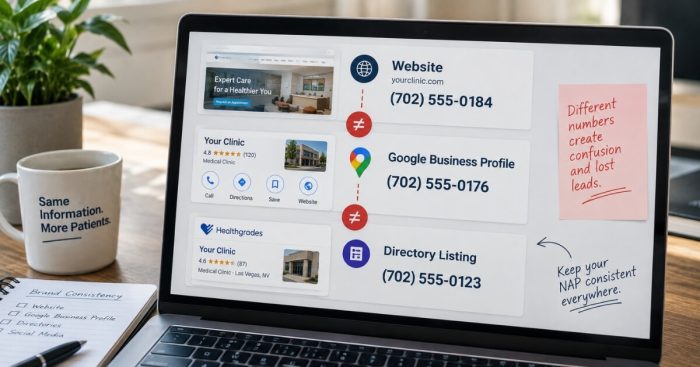
Refresh the page and the displayed phone number changed.
The first reaction was “who did that and why.”
The second was that we wanted to know what it cost, because the setup did not appear to be helping this particular build.
Call tracking has legitimate uses.
However, you need to understand exactly how dynamic numbers interact with your website, local listings, tracking setup, and user experience.
For local SEO, the underlying business information should remain clear and consistent to search engines and directories.
The human experience matters too.
A patient who saves a tracking number on Tuesday should still be able to reach the practice when they call it on Friday.
Is it worth building 200 pages if I only have one location?
Yes, because organic pages have no per-lead media cost, and the patients they bring in can multiply.
Here is the math the clinic on this call was working with.
Referrals turn one new patient into three or four.
If you spend $200 to acquire one patient and that patient ultimately brings you four, you are happy with the $200.
Now hold the multiplier constant and change the acquisition cost.
An organic page that ranks does not charge you for every click or lead it generates.
It can bring in the same patient, who brings in the same three or four, without another media charge every time someone finds the page.
That is the argument for the page count.
Two hundred pages represent an upfront and ongoing content investment in an asset that can keep producing visibility.
Paid media, by contrast, requires continued spend to keep buying traffic.
This clinic also had a strong free-consult show rate — around 80% of booked consults showed up.
So the constraint was never conversion.
Not enough new people were finding them.
The single-location objection misunderstands what the pages are for.
They are not claiming you have thirty offices.
Instead, they answer the question a patient in each of those towns is actually typing — a treatment plus their own town.
Then they give the honest answer: here is the clinic that provides this service, here is where it is, and here is how to book.
The same principle drives every medical practice marketing build we run: you cannot be the answer to a question you have not written a page for.
FAQ’s About Location and Service Pages for Clinic Websites
How many location pages does a clinic website need?
Usually far more than owners expect.
A local SEO build we scoped for a single-location med spa came out to thirty cities by seven services — roughly 210 to 220 pages.
The count comes from a grid.
Every distinct service is one axis, and every city in your catchment that patients actually search is the other.
Multiply them to get the potential page count.
How do I choose which cities to build service pages for?
Rank cities by search volume, population density, and household income rather than distance alone.
A closer town with almost no relevant search volume may make a worse page than a slightly farther city with meaningful demand.
For cash-pay treatments, the economics of the local market matter too.
Use those signals to prioritize the cities worth building first rather than creating pages for every nearby town indiscriminately.
How long does it take for new city and service pages to rank?
Some pages can start moving in about six weeks, while the compounding takes quarters.
On the build discussed here, roughly six weeks was our expectation for new pages to get crawled, indexed, and begin appearing for some lower-competition service-plus-city phrases.
Larger head terms can take much longer.
Those harder rankings often come later as the site develops a broader footprint around the service and region.
Do boosted Instagram posts get med spa patients?
Boosting can build followers and awareness, but that is different from capturing search intent.
Service-by-city pages target people actively searching for a treatment in a specific market.
So judge the two channels against different objectives.
If boosted posts are meant to acquire patients, track whether they actually produce leads and booked appointments.
If they’re primarily producing reach and followers, treat that spend as brand marketing rather than assuming it is patient acquisition.
Why does my clinic’s phone number change when the page reloads?
That is usually dynamic number insertion from a call-tracking system.
Call tracking itself can be useful, but the implementation matters.
Your core business information should remain consistent across your website, Google Business Profile, and important directory listings.
At the same time, any tracking number shown to a patient should remain functional if they save it and call later.
Audit the setup before expanding the site so you know which number is canonical, how tracking works, and whether old vendor configurations are still necessary.
What’s the next step?
If you have never counted the squares in your own service-by-city grid, that is the first hour of work.
It often explains why a site that looks fine is producing almost no new patients.
Book a strategy call and we’ll map your services against the cities that actually have volume, density, and income.
Then we’ll set the build order so your home city proves the template first.
We’ll also audit the phone and Business Profile consistency before a single new page goes live.