
Should I Launch My Clinic’s Google Ads During Black Friday Week? (Wait Until Wednesday)
On the Monday of Thanksgiving week last year we sat on a campaign review call with a cash-pay hormone, regenerative and weight-loss practice we work with. The campaign was built. The ad copy was approved. The tracking was live. Everything was ready to turn on that afternoon — and we deliberately didn’t. Here’s the FAQ on why launch timing matters more than launch readiness, and what to actually do in the first three weeks after you do go live.
Should I launch a new Google Ads campaign for my clinic during Black Friday week?
No — hold it until the Tuesday or Wednesday after Cyber Monday.
The exact words on that call were: “We should wait until, like, Tuesday or Wednesday of next week… After Black Friday. And Cyber Monday. More importantly, Cyber Monday.”
The reasoning is not superstition. It’s auction economics.
Retail advertisers concentrate an outsized share of their annual budget into that four-day window.
Google Ads is an auction. When a large volume of well-funded bidders floods it at once, cost per click can rise — even in verticals that have nothing to do with retail.
A brand-new campaign is poorly positioned for a more expensive auction.
It has no click history, quality signals, or conversion data of its own yet.
As a result, you risk paying more per click for less-qualified traffic than you might pay after the retail spike clears.
There is a second, less obvious cost.
A new campaign’s first days give the platform important early data about who clicks and who converts.
You don’t want that founding data collected during an unusually distorted auction.
Otherwise, you may spend the following weeks making decisions against a baseline that was never representative.
When is the right time to launch a new clinic ad campaign?
The right start date is the first normal week after an artificial demand spike.
But the more important correction is that you should never be picking an end date at all.
The most common framing we hear is some version of “let’s run ads for the holidays” or “let’s try this for 90 days.”
That framing quietly sets the wrong expectation because it treats paid search as a promotion rather than a channel.
As we put it on that call:
“You should not run ads with the intention of only running them for a certain period of time. You should run ads with the intention of we are going to figure out how to use this as a new patient acquisition channel.”
Seasonal timing is about picking the start date.
It is not about picking an end date.
The pull to launch anyway is real, and it’s an operator’s bias.
The consultant on that call said it out loud: “I wanted to launch it because it was built and ready to go, but it’s definitely a better idea to wait.”
Built and ready is a project-completion feeling.
It is not a market condition.
If you’re already inside the window with a finished campaign sitting paused, nothing is lost.
Use those days to tighten ad copy against the keyword list.
Also confirm that your call tracking and form routing actually fire.
That work has to happen anyway and costs nothing in ad spend.
How often should I be adjusting a brand-new Google Ads campaign?
Look at it every 48 hours. Restructure it far less often than that.
This is a genuine tension, and we’d rather present it as one than pretend there’s a clean rule.
A new campaign needs enough time and stable data before you make major structural judgments.
Owners who rebuild their campaigns every few days never establish a useful baseline.
But “leave it alone” is not the same as “don’t look at it.”
The working cadence we use is “every 48 hours going in and looking to see where we are wasting spend and where spend is being utilized properly.”
The specific thing you’re hunting for is obvious waste.
As we put it on the call: “there will be keywords that will be like not very high intent, like just curious keywords. And we don’t really want to bid on those.”
A search that is clearly informational rather than someone looking for a provider is money you can stop spending today.
You don’t need to rebuild the campaign to do it.
So the working rule is simple: negative keywords and obvious waste every couple of days.
Bidding strategy, budget reallocation, and ad group restructuring should wait until the campaign has told you something useful.
One is pruning.
The other is replanting.
While you’re in there, the highest-leverage copy fix is relevance.
Keep the ad text tight to the keyword rather than simply describing your practice.
As the consultant put it, make it “as relevant to the ad and keyword as possible, so you can get a stronger ad rank.”
Relevance contributes to ad quality and Ad Rank, so tighter alignment can improve how efficiently you compete for a position.

How long before a new clinic campaign should produce its first leads?
About a week — and the realistic expectation is one or two leads, not a pipeline.
The benchmark we set on that call was deliberately small:
“If we didn’t have one or two leads by Monday of next week, this is a weird week.”
One or two.
That was the expectation for this particular new cash-pay medical campaign in its first seven days.
Setting that expectation before launch is one of the cheapest ways to stop an owner from killing a potentially viable campaign in week two.
The failure mode here is emotional, not technical.
An owner who expects fifteen leads and gets two may conclude the channel doesn’t work.
They cut the budget and never reach enough volume for the data to become readable.
An owner who expects two and gets two lets it run.
Same campaign, opposite outcomes.
The corollary is that volume can compound once the channel is understood rather than merely tested.
None of that happens if you judge the campaign entirely on its first seven days.
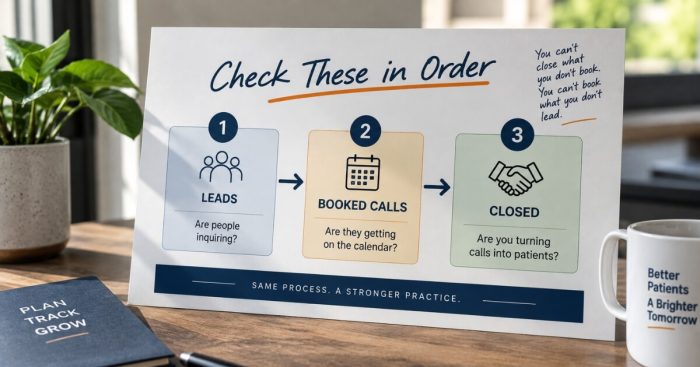
My ads are running and nothing is booking — what do I check first?
Check in this order: leads, then your discovery-call booking rate, then pricing and closing.
Most owners skip straight to blaming the offer.
That sequence is one of the most useful things that came out of the call because problems in a paid funnel appear in a logical order.
First, find out whether the ads produce leads at all.
If they do, check the booking rate — the percentage of leads who actually get onto a discovery call.
Only after that do you reach “the normal problems of presenting pricing, closing.”
Diagnose out of order and you can end up rewriting an offer that was never the problem.
The booking-rate stage is where many cash-pay clinics lose opportunities.
Two structural things help.
First, use a multi-step form rather than one long form.
The funnel on this campaign was framed as a quiz, which functionally worked as a multi-step form.
The client asked whether calling it a quiz mattered. Across several markets, it hadn’t been an issue for us.
What matters is the mechanic.
Each question a prospect answers can increase their commitment, making a multi-screen experience less intimidating than one long page.
Second, speed matters.
A lead that sits for a day is a different lead.
Then there’s the offer.
Here we’d rather model the right internal conversation than pretend we had a great one.
Our assessment of this campaign’s offer was:
“I have enough data to say that it’s a good idea to run it… Do I feel that it is the strongest offer that we could come up with? No. But we’re kind of limited on the money-off things. Like the only thing we can incentivize them on at this stage of customer acquisition is labs or consult… basically we’re saying free consult right now.”
That’s the reality in many cash-pay medical campaigns.
You often cannot discount the way a retailer can.
That means your top-of-funnel offer may look weak next to a Black Friday promotion — and it should.
The fix is downstream.
A free consult that doesn’t convert may be a booking-rate or consultation-script problem, not simply a discount problem.
Why is my weight loss cost per lead so much higher than my hormone leads?
Because you’re measuring cost per lead against a benchmark instead of against lifetime value.
Those two verticals can have completely different retention profiles.
A prior campaign for this practice spent roughly $3,000 on compounded weight-loss ads and produced a cost per lead the team described as very high.
The instinct in that moment is to call the channel broken.
It isn’t necessarily.
The number is meaningless until you put it next to what that patient is worth over time.
A weight-loss patient and a hormone patient are not the same asset.
One may stay on a protocol for a defined stretch.
The other may remain on a membership for years.
As a result, the same cost per lead can be a bargain in one vertical and a loss in another.
That can happen in the same practice, during the same month, from the same ad account.
So the correct comparison is cost per lead against lifetime value per vertical.
Don’t compare cost per lead only against an industry benchmark.
And don’t compare one service line’s cost per lead against another without considering patient value.
Practically, separate your campaigns by vertical so the numbers stay legible.
Then do the lifetime-value arithmetic once per service line before deciding what is too expensive.
FAQ’s About Launching Clinic Google Ads Around Black Friday
Should I launch a new Google Ads campaign during Black Friday and Cyber Monday?
No.
Retail advertisers concentrate significant budget into the Black Friday and Cyber Monday period, which can make the auction more competitive.
A brand-new campaign also has little campaign-specific click or conversion history to work from.
Launching during an unusually competitive period can therefore give you a distorted early baseline.
Waiting until the retail spike clears gives you a cleaner starting point for judging performance.
How long should I wait after Cyber Monday to launch clinic ads?
Until the Tuesday or Wednesday immediately after Cyber Monday.
That gives the retail spike time to clear without unnecessarily delaying the campaign deeper into December.
Use the paused days to tighten ad copy against your keyword list.
Also confirm that call tracking and form routing work correctly.
That costs nothing in ad spend and has to happen anyway.
How often should I optimize a brand-new Google Ads campaign?
Review it every 48 hours, but restructure it rarely.
A new campaign needs enough stable data before you make major structural judgments.
However, that doesn’t mean ignoring obvious waste.
Every couple of days, review the search terms and add negative keywords for clearly irrelevant or low-intent searches.
Meanwhile, give larger decisions more time.
Bidding strategy, budget reallocation, and ad group restructuring should wait until the campaign has produced enough useful data to justify them.
How many leads should a new clinic Google Ads campaign produce in the first week?
For the campaign discussed here, we set the initial expectation at one or two leads.
That was a reasonable first-week benchmark for this specific cash-pay campaign, not a universal rule for every clinic.
Setting the expectation before launch matters.
An owner expecting fifteen leads and getting two may kill the channel before it produces readable data.
An owner expecting two and getting two is more likely to give the campaign enough time to prove itself.
Is a high cost per lead on weight loss ads a reason to stop running them?
Not on its own.
Cost per lead only becomes meaningful when you compare it with patient value in that specific vertical.
Weight-loss and hormone patients can have very different retention profiles.
Therefore, the same cost per lead may be profitable in one service line and unprofitable in another.
Separate campaigns by vertical and calculate lifetime value for each service line before deciding whether the acquisition cost is sustainable.
What’s the next step?
If your campaign is built and the auction is about to be flooded, the highest-return decision available to you this week may be to not press go.
Book a strategy call and we’ll look at your launch window, keyword intent, booking rate, and cost per lead against lifetime value by service line.
We’ll look at them in that order because that’s the order the problems actually appear.