
Should I Put My Membership Prices on My Clinic Website, or Make People Call?
This question stalls website launches for months, and it usually gets answered with somebody’s blanket opinion about transparency. On one consulting call, a physician who owns three brands under one roof made the opposite decision for two of them — prices published on one site, withheld on another — and both calls were correct. Here’s the reasoning, so you can run it on your own clinic instead of borrowing someone else’s rule.
Should I put my prices on my clinic website?
It depends entirely on how your buyer decides — not on whether transparency is good, which is the wrong question.
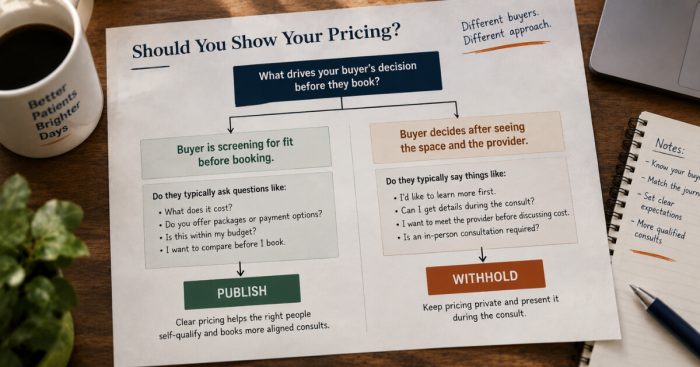
The right question is whether your prospective patient makes the decision before they meet you or after.
If they decide before, the price belongs on the page. Withholding it just filters out people who refuse to book blind.
If they decide after, the calculation changes.
They may need to see the space, meet the provider, and feel the difference between your clinic and the one they walked out of.
In that case, a number on the homepage has no context yet. It becomes the only fact the visitor has, so they decide on it alone.
The physician on this call runs a men’s hormone and TRT clinic, a direct primary care practice, and a women’s health practice.
Same owner. Same building. Same marketing budget.
He publishes price on one and not on another, and he can explain why in one sentence per brand.
That’s the standard to hold yourself to.
If your answer to “why is the price hidden” is “everyone in our space hides it,” you don’t have a strategy. You have a habit.
When does publishing prices actually help a cash-pay clinic?
When your prospective patient screens for fit before spending an hour of her time.
It also helps when the provider’s calendar is the scarce resource, not the patient’s willingness to buy.
On the women’s health brand, price went on the site deliberately.
That patient researches and compares options before deciding whether the practice is right for her.
She doesn’t want to waste time on a consult that ends with a number she was never going to accept.
The provider doesn’t want to waste her time either.
Publishing the price does the filtering for both before anybody sits down.
That’s a difference in buying behavior and consideration level — not a difference in the patients themselves.
Two conditions make published pricing the better call.
First, the service needs to be well understood enough that a number means something to the reader.
If she already knows roughly what this category costs, hiding your number can read as evasive rather than intriguing.
Second, the visit itself needs to be expensive to give.
Think of a long, provider-led appointment you can only do a few times per day.
When both conditions are true, an unqualified consult isn’t a lead. It’s a cost.
The tell is in your own drop-off data.
If a meaningful share of consults end when price comes up, you’re already paying to disqualify people.
Publish the number and let the page do it for free.
When should I keep prices off the site and sell the experience first?
When the decision is emotional and environmental.
Sometimes, the patient needs to be inside the clinic and have a different experience than expected before a number can land properly.
On the men’s hormone brand, price stays off the site.
The owner’s rule was flat: establish the value in what you’re selling before you go to price. Don’t make it a price decision.
His analogy was a car dealership.
You get them to drive the Corvette before you tell them how much it is, so they’re emotionally involved in the decision to join.
The site’s job is to get a man through the door for a low-friction first visit.
He walks in, sees the clinic is nothing like the appointments he’s used to, and decides he wants in.
Then he hears the number.
If your differentiator is the room, the staff, the time, and the way the visit feels, a pricing table communicates none of it.
Instead, it invites comparison against a telehealth subscription competing on exactly one axis you will always lose.
The counter-analogy from that same call is worth keeping.
A dating profile that opens with “wants to be married within two years, wants kids within three years” may be true and honest. But it is completely wrong for the moment.
All I want to know is whether he’s fun to hang out with.
Your homepage has the same job.
It answers “is this the kind of place I want to walk into,” not “here are the terms of a twelve-month commitment.”
What should I put on the page instead of a price?
Give people a reason to come in that costs them almost nothing.
Then provide enough proof of what the visit is like that the low price of entry doesn’t feel like a trap.
The men’s brand on this call used a free walk-in offer as the entire conversion mechanism.
That is the substitute for a price: a concrete, immediate, low-commitment next step.
Not “request a consultation.”
Not a contact form promising somebody will call.
Give the patient something he can act on today, with a clear picture of what happens when he shows up.
Around the offer, put the things price was standing in for.
Explain what happens at the first visit, step by step.
Show who he’ll actually see and how long the visit takes.
Show what the clinic looks like using real photographs of your space, not stock images of a stethoscope.
Each detail reduces the perceived risk of walking in.
That’s the only decision the page has to win.
And if compliance allows, say something honest about the range without publishing the entire table.
“Membership starts in the low hundreds per month” is a filter, not a price list.
Should my website answer “what if I can’t afford it”?
Yes — especially on a primary care site, where a published policy on reduced-cost care can convert a money objection into a trust signal.
This one surprises owners.
Putting “what if I can’t afford it” on the page feels like inviting the problem in.
It does the opposite.
It tells a reader who was already worried that you’ve thought about them.
Meanwhile, it tells everyone else you’re the kind of practice with an answer instead of a shrug.
The question gets asked either way.
The only variable is whether it gets asked on your website, where you control the answer, or during a phone call that ends before it starts.
There are two cautions.
First, publish a policy you actually run.
A page promising flexibility that your front desk was never trained on is worse than saying nothing.
Second, clear the specifics internally first.
The mechanics of any reduced-cost program, and what you call it, are decisions for the owner and whoever advises them.
They aren’t decisions for the copywriter drafting the FAQ.
That brings up the real risk with pricing pages: they become the thing that stalls the launch.
The FAQ copy on this project had already gone through three rounds of drafts with eight people weighing in.
The consultant’s call was to ship it.
Even as it is, it’s definitely better than the existing site.
So get to minimum viable product and implement.
Will hiding my prices cost me leads?
Less often than owners fear.
And the volume problem is almost never caused by the price question either way.
Look at the actual numbers from this practice.
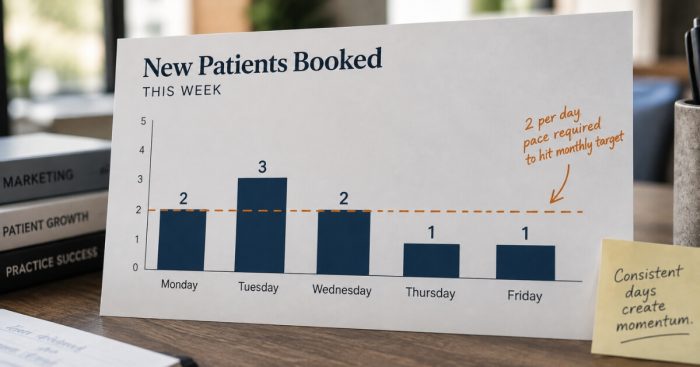
A week of scheduled new patients ran two on Monday, three on Tuesday, two on Wednesday, one on Thursday, and one on Friday.
The target was roughly 30 to 40 a month — which, as the owner framed it, is two established patients a day across 20 working days.
Of 12 Google Ads leads that month, four or five had booked so far.
Nothing on that list gets fixed by adding or removing a pricing table.
It gets fixed by bringing more qualified people into the funnel and following up faster with the ones already there.
Owners conflate the two constantly.
That’s because the pricing decision is sitting in front of them on a website draft while the acquisition math is invisible.
The channels that move the number aren’t always digital either.
This clinic put out eight yard signs around town and immediately ordered a quote for 50 more.
The signs prompt a text, so each lead lands in the CRM as a trackable source, just like a paid click.
What else should never go on a clinic website?
Individual staff members’ personal email addresses.
Use reroutable aliases only, and in most clinics you need exactly two: info and billing.
Publish those addresses and route them wherever they need to go today.
Then, whenever the team changes, update the routing instead of editing a live page.
That way, no former employee’s name sits in your contact section getting scraped.
The other issue is a systems trap rather than a page problem.
This owner wanted to swap his patient-chat widget for the chat tool inside his CRM.
The consultant talked him out of it.
Doing so would force the nurses to work in a separate account for each brand.
That would fragment one team across two systems just to gain one feature.
Instead, the practice kept the existing widget.
Whoever catches the chat enters the lead into the CRM manually.
A slightly manual step inside one system beats an automated step that splits your team across two.
The men’s hormone practice whose memberships grew to 250 active members at $1,000 a month runs on that kind of discipline, not on tool count.
FAQ’s About Publishing Membership Prices on a Clinic Website
Should I put membership prices on my clinic website?
It depends on when your patient decides.
If they screen for fit before booking and compare options on their own, publish the price.
That filters unqualified consults before they consume provider time.
If the decision happens after they experience the clinic in person, keep the price off the page.
Instead, put a low-friction first visit there.
A number with no context can become the only thing the visitor evaluates.
Why do some cash-pay clinics hide their prices?
Because their differentiator is the experience, and presenting price first can prevent the buyer from ever seeing it.
The rule one physician we work with uses is to establish the value in what you’re selling before you go to price.
His analogy is a car dealership.
You get them to drive the car before you tell them how much it costs.
That way, they’re emotionally involved in the decision before the number arrives.
Can one practice publish prices on one site and hide them on another?
Yes, and it is often the correct answer.
One owner we work with runs three brands under one roof.
He publishes price on the women’s health brand while withholding it on the men’s hormone brand.
The women’s health patient screens for fit before spending an hour of her time.
So the price does the filtering up front.
The men’s brand converts by getting a man into the clinic first.
Therefore, that page sells the visit instead.
What should a clinic website show instead of a price?
Show a concrete, low-commitment next step and enough detail to make walking in feel safe.
That might include a free or low-cost first visit.
Explain step by step what happens during that visit, who the patient will see, and how long it takes.
Also, use real photographs of your space.
If your compliance posture allows it, you can provide a general range.
For example, “membership starts in the low hundreds per month” can filter mismatched expectations without turning the homepage into a comparison tool.
Does hiding prices reduce the number of leads a clinic gets?
Rarely enough to explain a volume problem.
One practice we work with scheduled two, three, two, one, and one new patient across a week.
Its target was about 30 to 40 a month.
Meanwhile, four or five of that month’s 12 Google Ads leads had booked so far.
None of that is caused by a pricing table being present or absent.
It is a patient acquisition and follow-up problem.
Treating it as a website copy decision only delays the actual fix.
What’s the next step?
If your website launch is stuck on the pricing page, the decision is smaller than the argument around it.
Answer one question: does my patient decide before or after they meet us?
The rest follows.
Book a strategy call and we’ll look at your offer, your consultation drop-off, and where your leads actually come from.
Then we’ll tell you whether your page should carry a price or an invitation.
After that, ship it — a live imperfect site collects data, while a perfect draft collects comments.