
Should I Run Google Ads on My Own Practice Name?
Branded search is the most argued-about line item in a clinic’s ad account, and both of the usual positions are wrong. It is not free money, and it is not automatic waste. What it reliably is, is flattering — it makes an account look healthier than it is, and it can hide for months the fact that nothing in your marketing is generating new demand. Here’s the FAQ on when to bid on your own name, what happens when you stop, and how to read the report properly.
Should I run Google Ads on my own practice name?
Sometimes — but you should never run it in the same campaign as everything else, because that’s what stops you from answering the question.
Here’s the account that prompted this.
A multi-location med spa we audited had roughly $7,000 in spend and two good conversions over the previous thirty days. A second, near-dormant account carried about $1,400 in spend and had a payment method that could no longer be charged.
Spend was split across two accounts that nobody was reconciling.
That is its own finding, and a common one.
The larger discovery was where the money in the live account was going: most of it sat in a branded campaign bidding on the practice’s own name.
The owner already suspected something was off.
In her words, “a lot of the people that were clicking on the ads were my existing patients.”
She had also heard from an outside opinion that bidding on people who already search for you by name is largely buying traffic you would have received anyway.
That critique is not wrong.
Someone typing your practice name into Google has already been converted by something else — a referral, a review, a past visit, or a billboard.
Paying to be the first result for that query can mean paying for a click your organic listing would likely have received for free.
Before you run any of this analysis, confirm that you actually own the ad account.
In this case, the access level was read-only and the incumbent agency held ownership.
The check takes thirty seconds: Google Ads, then Admin, then Access and security, then Managers.
The right ask of an incumbent is a link request, not a takeover.
The language that gets it accepted is simple: please accept the linking request, I have no intention to touch or click anything.
What happens if I turn off my branded campaign?
Usually a drop — and the size of the drop is the diagnosis, not the verdict.
This owner had already run the experiment.
She removed the branded campaign and, as she put it, “I barely got anyone. So that’s why I said this is ridiculous, it’s not working.”
Most people read that collapse as proof the branded campaign was doing the work and should be turned back on.
It isn’t.
Read it the other way.
If turning off ads on your own name removes almost all your leads, then most of those leads came from people who already knew your name.
The account had never produced meaningful non-branded demand.
Nobody was arriving from a treatment search, symptom search, or comparison search.
The branded campaign had been concealing that weakness by keeping the topline lead count respectable.

That is the honest, uncomfortable finding, and it changes what you do next.
The branded line item is not the main problem.
The problem is that there is nothing underneath it.
Turning branded off before building the non-branded engine only makes the collapse visible. It does not fix it.
That is why sequence matters.
Build demand generation first. Prove it can produce leads on its own. Then decide how much of your own name you still want to keep buying.
How do I tell whether my ads are creating demand or just harvesting it?
Split branded and non-branded into separate campaigns and read the two numbers apart.
That is the whole method.
A blended report cannot answer this question, yet blended reports are what many clinic owners receive.
Branded queries convert at a high rate and cost very little because the person searching has already decided.
Non-branded queries — the treatment, the condition, the “near me” — usually convert at a lower rate and cost more.
That is what acquiring a stranger costs.
Average those two groups together and you get a cost per lead that looks acceptable but tells you very little.
It’s the arithmetic equivalent of counting returning patients as new ones.
Once the campaigns are separated, the diagnostic reads itself.
Non-branded volume and cost per acquired patient tell you whether your marketing creates demand.
Branded volume tells you how much demand already exists.
If branded volume grows month over month while your spend stays flat, something upstream is probably working because more people are searching for you by name.
If you cannot see those two numbers separately, you cannot distinguish an acquisition machine from an expensive redirect to your own front door.
That distinction is the difference between an ad account and a growth channel.
Volume like that is not produced by capturing people who already knew the name.
It comes from campaigns aimed at people who didn’t.
Why are my existing patients seeing my new-patient discount ads?
Because your existing patients are the people most likely to search your practice by name.
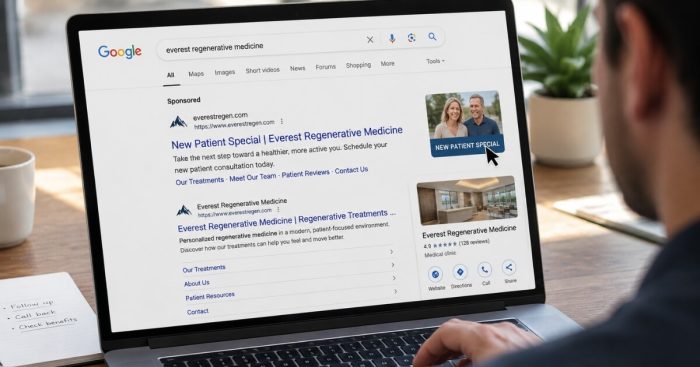
So a branded campaign carrying a new-patient offer serves it heavily to people who already know you.
This is the second-order damage owners rarely price in.
The branded campaign is not just buying clicks you may have earned anyway.
If it carries a discount, it can show that discount to your most loyal, best-paying, already-converted patients at the exact moment they were trying to book with you at full price.
Do that for a few months and you can train your best patients to check for a promotion before every visit.
When does bidding on your own brand name actually make sense?
In three situations, and it’s worth being honest that they’re real rather than pretending branded is always waste.
First, when competitors are bidding on your name.
If a rival clinic buys your brand term, the top of the page for your own name can belong to them unless you show up.
That is a defensive purchase, and you should evaluate it as one.
Check whether anyone is actually bidding before you assume they are.
Second, branded ads make sense when you have a genuine offer for returning patients.
If the campaign is meant to reach people who already know you, and the message is built for them, the audience and message match.
Then the spend is doing something intentional.
Third, branded ads can help when directories and aggregators push your organic listing down the page.
In some markets, a brand-name search returns two directory sites and a review aggregator before it returns the practice.
Each one gives the patient another chance to find a competitor.
Paying to sit above them is buying back your own front door.
What none of those situations justify is running branded as the default and calling the result performance.
This is the audit we start every engagement with as a med spa marketing agency.
We separate the campaigns, confirm who actually owns the account, and remove dormant vendor manager access.
On this account, old vendors still had manager-level permissions long after those relationships ended.
Then we look at what the non-branded numbers say with the flattering line removed.
Should my surgical service line have its own website and Business Profile?
Positioning-wise, it can be defensible.
However, a separate domain does not overcome a saturated market. It just gives you two things to rank instead of one.
The practice on this call had split its surgical service line onto its own domain with its own Business Profile category.
The reasoning was that people don’t want to go to a med spa for that kind of procedure. A separate domain could also give the service more credibility.
Both points are real.
Patients do read category signals, and a dedicated site can carry a more serious clinical tone than an aesthetics brand can.
However, the split listing was the underperformer.
The positioning logic wasn’t necessarily wrong. The bigger problem was that the local market for the procedure was saturated.
A new domain with a new Business Profile starts from zero authority in a category where established competitors have years of it.
You have taken a hard ranking problem and given yourself a second, weaker site to solve it with.
So the test before you split is not “does this feel more credible.”
Ask whether you have the budget and patience to run two full builds.
That means two sets of service pages, two review programs, two Business Profiles, and two link profiles.
You also need to determine whether the competitive density in that procedure’s local market leaves room for a new entrant at all.
A second asset is only worth it if you can fund it to maturity.
FAQ’s About Branded Google Ads for Medical Practices
Should a medical practice run Google Ads on its own name?
Sometimes, but never blend branded search into the same campaign as everything else.
Someone searching your practice name has already been converted by something else.
So paying for that click often buys traffic your organic listing would have earned for free.
You can only answer the question properly when branded and non-branded sit in separate campaigns that you can read independently.
What happens when you turn off a branded Google Ads campaign?
Leads usually drop, and the size of the drop is the diagnosis rather than the verdict.
One clinic removed its branded campaign and lead flow nearly vanished.
That did not prove the branded ads were creating demand.
Instead, it showed that the account had generated almost no non-branded demand, while the branded campaign had concealed that weakness for months.
How do I know if my ads are creating demand or just harvesting it?
Segment branded and non-branded into separate campaigns and read the two numbers separately.
Branded queries convert cheaply because the person already decided.
Non-branded queries usually cost more because acquiring a stranger costs more.
Blend them together and you get a cost per lead that may look acceptable but tells you little about whether your marketing creates new patients.
Why do my existing patients see my new-patient discount ads?
Because existing patients are among the people most likely to search your practice by name.
A branded campaign carrying a new-patient offer can therefore show that promotion to people who already know you.
Over time, you risk training loyal, full-price patients to look for a promotion before booking.
Exclude existing-patient audiences from branded campaigns, or keep the new-patient offer out of those campaigns entirely.
When does bidding on your own brand name make sense?
In three cases.
First, it can make sense when competitors bid on your name and would otherwise sit above you.
Second, it works when you have a genuine offer aimed at returning patients.
Third, it can help when directories and aggregators push your organic listing down and create opportunities for patients to find a competitor.
Outside those situations, justify branded spend rather than assuming you need it.
What’s the next step?
If you have never seen your branded and non-branded numbers on separate lines, that is the first thing to fix.
Doing so can reframe an account that looked fine into one that has never acquired a stranger.
Book a strategy call and we’ll confirm who actually owns your ad account.
Then we’ll split the campaigns so the report tells the truth, strip new-patient offers out of branded, and build the non-branded engine that needs to exist before turning branded down is safe.