
Should My Cash-Pay Clinic Market to Patients Over 65? (Ask Your Attorney Before You Buy Ads)
On an onboarding call with a concierge, direct primary care and hormone practice we work with, the owner raised the most reasonable idea in the world: the 65-to-75 cohort in their market is affluent, has time, and looks exactly like the ideal membership buyer. “If we target that 65 to 75 age demographic, we would probably have some success.” We agreed it looked good on paper. Then we stopped and sent it to counsel. Here’s the FAQ on why, and what we changed downstream once the answer came back ambiguous.
Should my cash-pay clinic market to patients over 65?
Not before you have a written answer from healthcare counsel about your own providers’ enrollment status.
And often not even then, for reasons that have nothing to do with regulation.
To be clear about who’s talking: we are marketers, not compliance counsel, and nothing here is legal advice.
This is one of the few questions where we stop a launch and send the client to an attorney before a dollar of spend goes out.
The consultant’s posture on that call is the one to copy: “If there’s one insurance I don’t mess with, it’s Medicare.”
He declined to answer on the spot and pushed the research to a later meeting.
That it feels slow is the point.
The second reason has nothing to do with rules.
This practice’s flagship convenience feature was virtual urgent care, and adoption drops sharply with age.
The illustration on the call was a 67-year-old being walked through booking a virtual visit and asking: “what is that? Like, how do they do that over the Zoom?”
That’s not a problem you fix with better ad copy.
If your core differentiator is a delivery mechanic a segment doesn’t use, that segment is not your market regardless of how much money it has.
Can a concierge or DPC practice take cash from a Medicare patient?
Put this question in front of healthcare counsel because the answer turns on your specific providers’ enrollment status and differs by practice.
Here is the general shape of the issue, as it was described to us and as we’d want any owner to check independently.
Where a practice’s physicians participate in Medicare, they generally must bill Medicare for covered services. Narrow, documented circumstances may allow different arrangements.
That is a summary of a live question, not a rule we are stating.
Enrollment status determines the answer.
Get it in writing from someone qualified to give it.
This framing also explains something owners constantly misread.
The practice saw a local competitor doing concierge-style work for that exact age group. Reasonably, the owner concluded it must be permissible.
It turned out the competitor was simply billing Medicare — “that’s the difference.”
Two practices can look identical in their marketing while running completely different economic and regulatory models underneath.
Competitor observation is a terrible substitute for enrollment-status review.
The practical sequence is straightforward.
First, confirm each provider’s enrollment status in writing.
Then take that information to a healthcare attorney along with the specific services you intend to sell.
Only after that should you decide what your ads can say and whom you should target.
What age range should a direct primary care or hormone practice actually target?
For this practice, 30 to 60 — “I think our ideal patient is probably 30 to 60.”
That is not a universal number.
Your answer depends on your provider enrollment situation, services, and market.
What is universal is the reasoning.
A 30-to-60 patient is likely paying out of pocket already and comfortable with a virtual-first model.
This patient also has the acute-care and hormone needs a membership actually solves and sits outside the enrollment question entirely.
That combination makes a segment marketable, not household income alone.
The part most owners get wrong is treating this as only a billing decision.
It isn’t.
An upstream compliance constraint should change four things downstream.
Your targeting has to change, including ad platform age ranges, lookalike seeds, and geographic weighting.
Your ad copy also has to change. The pain you lead with for a 42-year-old parent differs from the pain you’d lead with for a 68-year-old.
Next, your landing pages need to change. That includes the photography, the objections you answer, and the reading level of the pricing block.
Finally, adjust your intake script.
The front desk needs a clean, non-awkward way to handle an older caller who is genuinely interested.
That last one deserves its own line.
“We can’t take you” is a terrible thing for a receptionist to improvise.
Write the sentence.
Decide in advance who you refer to, what you say, and what you record.
That way, a call you can’t convert still ends with a good impression instead of a confused one.

What do I say when a new patient asks how much a membership costs?
Give two clear numbers, then remove the risk on the one they’d hesitate over — in that order, in one breath.
The script this practice uses is worth stealing verbatim:
“It’s $300 for the initial consultation, $300 for lab work. In the event that you decide to move forward, your $300 initial consultation investment is prorated off your first month’s membership.”
They also offer an annual paid-in-full direct primary care option at $3,000.
Look at the structure rather than the numbers, because your numbers will differ.
First, state two specific figures plainly and without apology.
Vagueness at this moment can sound like either shame about the price or an intent to upsell. Both can cost you the call.
Second, apply the risk reversal to exactly one thing: the consultation fee.
That is the amount the caller must spend before knowing whether they want this.
The lab fee stays fixed because it represents a real cost that buys real information.
You are not discounting.
You are removing the specific hesitation the caller actually has.
Third, notice “investment” and “in the event that you decide to move forward.”
That framing puts the decision in the patient’s hands after the consult, not before it.
The ask is small, reversible, and clearly scoped — the only kind of ask that converts a cold caller into a paying membership.
How do I track which of my brands a phone call came from?
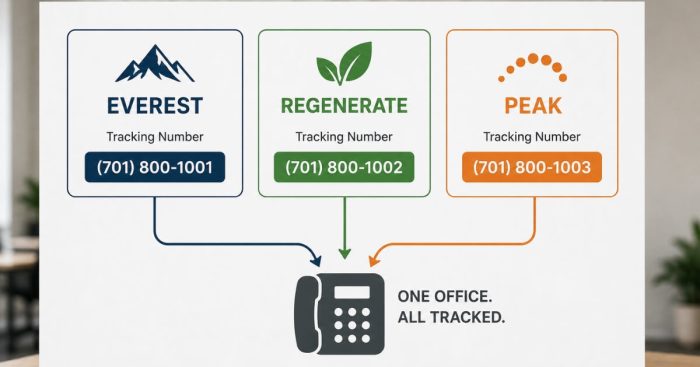
Give every brand its own call-tracking number and forward them all to the same office line.
This practice runs several brands out of one operation.
So we set up three separate tracking numbers — one per brand — and forwarded all three to the single office phone.
The staff has no new workflow to learn.
Nothing changes operationally.
However, every inbound call now carries an unambiguous label showing which brand and piece of marketing produced it.
Owners who run multiple brands through one phone number are guessing.
Usually, they guess in favor of whatever they spent the most on.
Then they cut a channel that was quietly producing calls because they attributed those calls to nothing.
Two things matter here.
First, route each number to the same destination. Otherwise, you create a staffing problem in the name of measurement.
Second, use each brand’s tracking number consistently across its website, ads, and listings.
One stray hard-coded office number in a footer can weaken the data in a way you may not notice for months.
Why aren’t the patients my doctor texts showing up in our CRM?
Because they’re being handled on a personal cell phone, and anything that happens off-system is invisible to everyone trying to help you grow.
The line from that call is blunt, and we repeat it constantly:
“Patients who text the doctor’s cell phone directly do not end up in the CRM… If you text patients off your cell phone, nobody can help you.”
Not won’t — can’t.
Those conversations produce no record, attribution, follow-up automation, or visibility for the staff member covering tomorrow.
You have a pipeline leak that doesn’t appear in any report because the leak happens before the reports can capture it.
The fix is not a lecture about discipline.
Instead, make the in-system path easier than using a personal cell phone.
Give the doctor a real texting number inside the CRM that works like normal texting on their phone.
If the compliant route is slower than the shortcut, the shortcut wins every time. No policy changes that.
There is also a sequencing principle underneath this that applies to every system a practice builds.
As the consultant put it: “I’m not going to build the Great Wall of China if I don’t have somebody to walk across the wall.”
Automation and workflows should follow the operator who will run them, not the other way around.
Hire or assign the person first. Then build around how they actually work.
When that person arrives, resist the urge to script them on day one.
“I’m gonna let you sell the way that you intuitively know to sell. If I want you to do it better, I will tell you… I’m a big fan of trying the steak before you add salt to it.”
You cannot improve a process you’ve never watched run unaltered.
FAQ’s About Marketing a Cash-Pay Practice to Older Patients
Should a cash-pay clinic market its membership to patients over 65?
Not until healthcare counsel has reviewed your specific providers’ Medicare enrollment status in writing.
There is also a non-regulatory reason to be cautious.
If your core differentiator is a delivery mechanic like virtual urgent care, adoption may drop with age.
As a result, the segment may be a poor product fit regardless of how affluent it is.
We are marketers, not compliance counsel.
This is one of the few questions where we stop a launch and send the client to an attorney before any spend goes out.
Can a concierge or direct primary care practice accept cash from a Medicare patient?
Ask a healthcare attorney because the answer turns on each provider’s enrollment status and differs by practice.
The general shape of the issue is that Medicare participating providers generally bill Medicare for covered services.
Narrow, documented circumstances may allow different arrangements.
However, that is a summary of a live question, not a rule we are stating.
Get the answer in writing from someone qualified to give it.
What age range should a direct primary care or hormone practice target?
One practice we work with landed on 30 to 60 after reviewing the constraint.
That cohort is typically already paying out of pocket and comfortable with a virtual-first convenience model.
These patients also have the acute-care and hormone needs a membership actually solves.
In this case, they also sat outside the enrollment question.
Your answer depends on your providers, services, and market. However, the reasoning transfers better than the number does.
How should I answer when a prospective patient asks what a membership costs?
Give two clear numbers, then remove the risk on the one they would hesitate over.
One practice says it like this:
“It’s $300 for the initial consultation, $300 for lab work. In the event that you decide to move forward, your $300 initial consultation investment is prorated off your first month’s membership.”
The structure matters more than the figures.
State the price plainly.
Then apply the risk reversal only to the amount they must spend before they know whether they want this.
Finally, leave the decision until after the consult.
Why don’t the patients my doctor texts from his cell phone show up in our CRM?
Because anything handled off-system produces no record, attribution, follow-up automation, or visibility for anyone else on the team.
It creates a pipeline leak that never appears in a report because the leak happens before the reports can capture it.
Make the in-system path easier than the shortcut.
Give the doctor a real texting number inside the CRM, on their phone, that behaves like normal texting.
That works better than issuing a policy nobody follows.
What’s the next step?
If you’re about to buy ads aimed at an older cohort, the cheapest hour you’ll spend this quarter is the one with a healthcare attorney before the campaign is built.
Book a strategy call and we’ll map which segments your practice can actually market to.
Then we’ll determine what needs to change in your targeting, ad copy, landing pages, and intake script once that answer comes back.
We’ll also identify where your pipeline is currently leaking off-system.