
What Should I Call My Membership Program So It Doesn’t Feel Like an Expensive Gym?
Most cash-pay clinics build a genuinely good program and then describe it in words borrowed from the fitness industry. “Membership.” “Concierge.” “Unlimited.” Each one drags a comparison into the patient’s head that has nothing to do with medicine — and the comparison is always cheaper than you are. Here’s the FAQ on what to call a clinical program, from a line-by-line language audit we ran with a cash-pay practice.
Why does calling it a “membership” hurt my cash-pay clinic’s offer?
Because “membership” is a word your patient already owns. Everything they attach to it is cheaper and less personal than what you’re selling.
We sat in an offer redesign session with a functional medicine and longevity practice we work with.
The sharpest line came from their marketing lead: “the word membership to me did not make me feel like a VIP. It made me feel like I was in an expensive gym.”
That is the entire problem in one sentence.
A membership is something you buy access to and then feel guilty about not using. Think of a facility, a card, or a recurring charge you keep meaning to cancel.
None of that describes a physician-led program.
The team landed on “program” instead. Where it needed more weight, they used “personalized program.”
It sounds like a small edit. It isn’t.
“Membership” describes what the patient pays for. “Program” describes what the patient goes through.
One is a billing arrangement. The other is a clinical process with a beginning, a middle, and an outcome.
The second is much harder to compare to a gym or the med spa down the road.
There is a second-order effect too.
When a clinic calls its offer a membership, staff start selling it like one. They list what’s included each month instead of explaining what the patient will get to the other side of.
Should I sell prepaid packages or monthly programs?
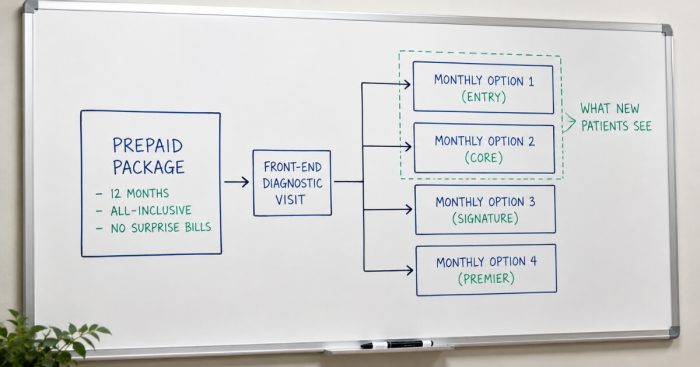
Monthly programs in tiers, with a paid diagnostic visit in front.
Prepaid all-inclusive packages break down on exactly the patients who need you most.
The practice above had sold all-inclusive prepaid packages, and two things kept going wrong.
First came sticker shock.
As someone put it on the call: “when you sell them a package, for some people, $7,500 is a lot of money.”
The second problem is structural.
You cannot scope a complex patient at intake, so an all-inclusive price becomes a guess.
When that guess is wrong, either the clinic eats the overage or the patient receives a bill they were promised wouldn’t come.
The new architecture starts with a $899 diagnostic visit.
The practice’s panel includes full labs, a saliva test, live blood analysis, and a 60-minute consult to connect the findings.
After that come four monthly tiers ranging roughly from $349 to $1,200, “depending on how much support you want.”
New patients only see tiers three and four.
Patients graduate into tiers one and two for maintenance after the intensive phase.
One maintenance option includes hormone pellets and costs $200 more per month, moving the price from $349 to $549.
Pulling diagnostics forward also helps commercially.
As explained on the call: “it’ll shorten the sales cycle, where the amount of time between inbound call to somebody starting on a membership or a program will shorten because you’re doing the labs and the testing sooner.”
After paying for testing and spending an hour reviewing the results, the patient is no longer deciding whether to trust you.
They’re deciding which tier.
Two pricing mechanics make this work.
First, explain what the front end includes and what it’s worth before naming the $899 price.
Second, let your top tier serve as a reference point.
As someone put it on the call, “you built tier four really just to be something that positions the rest of them.”
Few patients need to buy it for the tier to do its job. Its presence makes tier three look reasonable.
What should I actually call each part of my program?
Name every component after what the patient receives. Delete words that describe your billing system or industry.
Here is the actual swap list from that audit.
“Membership” became “program” or “personalized program.”
“Concierge” became “Unlimited VIP access.” Concierge describes the industry’s service model. VIP access describes how the patient experiences it.
“Member discount, 10%” became “discount on any additional services, 10%.”
It says the same thing without reminding anyone they’re a member of something.
Finally, the team stopped calling the front-end diagnostic visit “the intake.” They named it the Complete Health Reset Program.
Now the front desk has a named offer with a stated outcome instead of an appointment type.
The pattern underneath all four edits is the same.
Industry vocabulary describes the clinic’s internal structure. Patient vocabulary describes the patient’s experience.
Every time you use the first kind, the patient has to translate.
While they translate, they compare you to whatever else uses that word.
Run the audit literally.
Print your website page, price sheet, and consult script. Then circle every noun that names a category rather than a benefit.
Is it safe to use the word “unlimited” in a clinic membership?
Not for anything with a per-unit cost.
Cap every one of those services with a real number instead.
“Unlimited” is a promise a patient will hold you to, and they should.
On that call, the practice changed “unlimited” laser sessions to “up to 24 visits” a year.
Nothing about the offer got worse.
A patient using two sessions a month stays inside that cap all year. Meanwhile, the practice now has a defensible number instead of an argument.
Twenty-four is a quantity.
Unlimited is a feeling, and feelings get renegotiated at the front desk by the one patient who decides to test them.
There is a narrow exception.
The same practice deliberately kept “Unlimited VIP access.”
That phrase works because it describes the availability of a relationship — you can reach us — rather than a consumable service with a cost per unit.
Access has no inventory. Sessions, injections, and provider hours all do.
The rule is simple.
If the thing you’re describing costs you money every time someone uses it, give it a number.
Numbers read as generous when you state them upfront. They feel restrictive when they appear later because a patient asked for more.
The number isn’t the risk.
The timing is.
Should I publish how long my appointments are?
Yes.
Publish the number, then manage the experience so it doesn’t feel clocked.
This created the one genuine disagreement on the call.
The marketing lead objected because of how the language felt: “when I see 60-minute and 30-minute, I feel like I’m on a time clock… that’s for us to control with her. But that’s not for the patient to know or feel.”
That’s a fair read of the experience.
Nobody wants to sit down with their doctor while a countdown runs.
The physician disagreed for a different reason: “if we are not clear with the patients, they will come after us later on… they can manipulate the terms very well.”
An unstated visit length is not a generous one.
It’s an undefined one, and whoever has more motivation can define those terms later. Usually, that’s an unhappy patient.
So you do not need to choose between clarity and warmth.
Publish the duration in the program description, where it reads as substance.
A 60-minute consult is a selling point next to the rushed visits your patient is used to.
Then handle the warmth in the room.
That is a delivery problem, not a copy problem.

How do I keep visits from running over without making patients feel rushed?
Name the length out loud at the start of the visit, frame it as a privilege, and state the agenda.
The script we gave that practice has two steps.
First, the front desk sets the expectation verbally at booking. That way, the number never surprises the patient.
Then the physician opens by naming it:
“Hey, I’m so excited. We have a full hour together today. That’s an unusual amount of time… and what I’d love to be able to accomplish with you today is to review this, this, this, and this.”
Now the duration feels like a gift rather than a limit.
Meanwhile, the agenda tells the patient what the hour is for.
Patients “may even listen more closely because you’ve set that frame in their mind.”
That is the opposite of feeling rushed.
Now compare the alternative.
A physician in another state charges $200 when a patient runs more than about 15 minutes past their scheduled time.
Roughly 10% of patients run over, so the policy targets a small minority. It also holds the schedule.
However, the policy attaches a meter to every long conversation.
That is a strange thing to introduce into a relationship you’re charging a premium to make feel personal.
We prefer the frame to the fee.
A stated hour with a stated agenda buys goodwill. A surprise overage charge spends it.
FAQ’s About Naming a Cash-Pay Clinic Membership Program
Why does the word “membership” hurt a clinic’s program?
Because patients already own that word, and everything attached to it is cheaper and less personal than physician-led care.
As one practice’s marketing lead put it, “the word membership to me did not make me feel like a VIP. It made me feel like I was in an expensive gym.”
“Membership” names a billing arrangement.
By contrast, “program” or “personalized program” describes a clinical process with a beginning, a middle, and an outcome.
That makes it much harder to compare to a gym or subscription.
What should I call a clinic membership program instead?
Call it a program or a personalized program.
Then name every component after what the patient receives rather than your internal category.
In one language audit, “concierge” became “Unlimited VIP access.”
Likewise, “member discount, 10%” became “discount on any additional services, 10%.”
The team also turned the intake appointment into a named front-end offer with a stated outcome.
The test for every noun is simple: would a patient use that word to describe what they got?
Are prepaid packages or monthly programs better for a cash-pay clinic?
Monthly tiered programs with a paid diagnostic visit in front.
Prepaid all-inclusive packages can create sticker shock. As someone put it on the call, “for some people, $7,500 is a lot of money.”
They also create problems with complex patients because you cannot always scope their needs at intake.
As a result, either the clinic eats the overage or the patient gets an unexpected bill.
Running diagnostics first can also shorten the time between the inbound call and enrollment.
Should a clinic use the word “unlimited” in its program?
Only for access, never for anything with a per-unit cost.
One practice changed “unlimited” laser sessions to “up to 24 visits” a year.
That remains generous in practice while giving the clinic a defensible number in writing.
However, the practice kept “Unlimited VIP access” because access to a relationship has no inventory.
The working rule is simple.
If the thing you’re describing costs you money every time someone uses it, give it a real number.
Should a clinic publish appointment lengths like 60 minutes and 30 minutes?
Yes.
The argument against it is that a stated duration can make patients feel they are on a clock. That is a real experience risk.
However, clarity matters more.
If you leave terms unstated, someone will define them later, usually an unhappy patient.
Publish the number where it reads as substance.
Then manage the feeling in the room by presenting the time as a privilege and stating the agenda at the start of the visit.
What’s the next step?
If the person who built your program also wrote the program page, the language probably describes your structure instead of your patient’s experience.
That is a one-afternoon fix with a disproportionate effect on close rate.
Book a strategy call and we’ll run the same audit on your offer.
We’ll look at what each tier is called, which tiers new patients should see, where “unlimited” is exposing you, and what your front-end offer should cost.