
What’s the Right Order of Operations to Scale a Cash-Pay Practice?
A practice in West Fargo, North Dakota was collecting about $80,000 a month and had been for a while. Nine months later it had collected $1.44 million. Between those two points seven things got built, and the order they got built in is not a stylistic preference — it’s the mechanism. Most owners buy step five first, spend real money finding out that step five alone does nothing, and conclude that marketing doesn’t work. Here’s the correct sequence for scaling a cash-pay practice, and what breaks when you run it out of order.
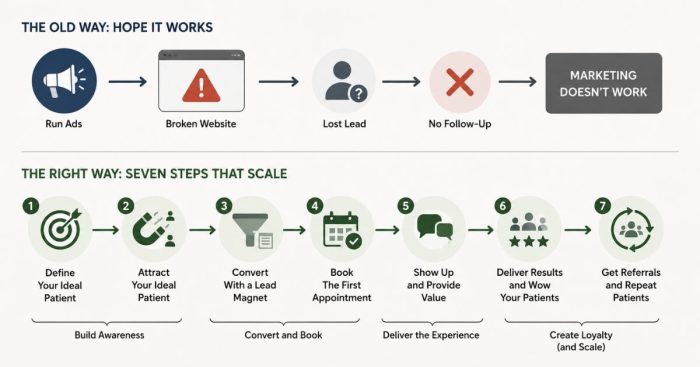
What’s the right order of operations to scale a cash-pay practice?
Audit and tracking first, then a conversion-focused website, then a CRM your staff actually uses. After that comes SEO, paid ads, memberships, and finally a weekly accountability meeting on the sales process.
The order matters because each step exists to make the next one worth paying for.
That is the exact sequence run at Everest Regenerative Medicine, a cash-pay regenerative medicine and longevity practice owned by Dr. Arden Beachy.
Step one was a comprehensive business audit and tracking setup. Step two was a conversion-focused website rebuild. Next came CRM implementation with staff training.
Step four was SEO built around how these patients actually research treatment. High-ticket Google Ads came fifth. Step six restructured the membership programs — Men’s HRT, Women’s HRT, and concierge primary care.
Finally, step seven introduced weekly accountability meetings focused on the sales process.
Over the nine tracked months, the practice collected $1.44 million. That equals roughly $148,000 a month against a baseline near $80,000.
Read the sequence as a chain of dependencies rather than a to-do list.
Tracking makes the website rebuild measurable. The rebuild makes traffic worth buying. Meanwhile, the CRM makes leads survivable.
SEO makes traffic free. Ads make it fast. Memberships make it recurring.
And the weekly meeting is the only thing that keeps the first six from quietly decaying.
Pull any link and the chain doesn’t simply run slower. It stops carrying load at that point. Everything downstream can then become a waste of money that still shows up on your credit card statement.
That is why sequencing is the first conversation in any regenerative medicine marketing engagement with a cash-pay clinic, before anyone talks budget or channels.
The channel question is downstream of the order question.
Why do most practices start with Google Ads instead?
Because ads are the only step that feels like it produces patients directly. Every other step feels like overhead you’re paying for on faith.
The logic is understandable.
You need patients this month, not next quarter. An ad account can be live in three days. Meanwhile, a website rebuild takes weeks, and a CRM rollout means retraining front desk staff who are already busy.
So the owner buys the one thing that looks like a patient machine and turns it on.
Here is what that actually buys.
Traffic arrives at a website built to describe the practice rather than convert a stranger. As a result, most visitors leave.
The small fraction that inquires lands in an inbox or voicemail with no CRM behind it. Follow-up then depends on whoever happens to check.
Nobody owns the outcome of that conversation because there is no weekly meeting where anyone has to answer for it.
Two months and a real budget later, the owner has a spreadsheet full of clicks and a handful of consults.
Then comes the firm conclusion: marketing doesn’t work for practices like mine.
The conclusion is wrong, but the evidence is real.
Ads were the correct step bought at the wrong position.
At Everest, ads were step five. They launched into a rebuilt site with a CRM catching leads and a trained team working them.
The budget then scaled from $1,300 a month to more than $4,400 because the spend was producing something worth increasing.
Same tactic, different position, completely different economics.
What breaks if you skip each step?
Every skipped step relocates the failure downstream, where it looks like a channel problem instead of a foundation problem.
Skip the audit and tracking, and you lose the ability to tell which change caused which result.
You’ll spend a year arguing opinions because you have no baseline to argue against.
The governing line from the case study is blunt: you can’t scale a practice you can’t measure.
Everest documented its baseline before anything was built: 5.5 website leads a month, 12.5 new patients, 50 first-time patient calls, and 263 total inbound calls.
Without those numbers, the same nine months of work would have felt like a vibe.
Skip the website rebuild, and you’re buying traffic for a page that converts poorly. Every channel above it is then priced against a broken denominator.
Skip the CRM, and leads decay in transit. The practice generates demand and then loses it in an inbox.
Everest tracked 631 opportunities in the CRM across nine months. That’s 631 chances that existed because something was built to hold them.
However, skip the staff training and you own a CRM nobody uses. That is effectively the same as not owning one, except more expensive.
Skip SEO and every patient stays rented. Paid traffic stops the day the card declines, while organic traffic compounds.
That is why Orthobiologics Associates produced $309,590 in cash-pay revenue in 10 months from SEO with zero ad spend.
Skip ads and you’re slow. SEO alone gets you there eventually, and eventually is a hard word to say to a practice with payroll.
Skip the membership restructure and you rebuild revenue from scratch every month instead of stacking it.
Everest enrolled 102 new members. Those members don’t have to be re-acquired in January.
Finally, skip the weekly meeting and all six previous steps start decaying inside a quarter.
Can I run several of these steps at the same time?
Some overlap is fine, but never launch a step before its upstream dependency exists.
The distinction is between building in parallel and launching in parallel.
Building SEO content while the CRM rollout finishes is reasonable. Nothing about that content depends on the CRM being live yet.
Likewise, drafting membership offers while the website is still in development is reasonable.
What is not reasonable is pointing paid traffic at a site that hasn’t been rebuilt and has no CRM behind it.
Now the ads depend on two things that don’t exist. Any money spent proving that is money you never get back.
The practical test is one question per step: what needs to exist upstream for this step to be worth what it costs?
Ads need a converting site and a CRM to catch what they produce. Memberships need enough new patient volume to enroll from.
Meanwhile, the weekly meeting needs tracked opportunities to review. The 631 Everest logged in nine months are what made that hour worth holding.
If the upstream requirement is missing, you are not running steps in parallel. You are running one of
them into a wall.
Why is the weekly sales meeting the step owners cut first?
Because it’s the only step with no deliverable. Nothing gets built, nothing goes live, and an hour disappears from a clinical schedule that was already full.
It’s also the step that compounds hardest, and the two facts are related.
Steps one through six create volume. The weekly meeting is where that volume gets converted.
Conversion is where a cash-pay practice makes or loses most of its money.
Everest went from 50 first-time patient calls a month to 173. Across nine months, 1,310 first-time calls came in.
Those calls do not convert themselves.
Somebody has to answer them a specific way and ask for the consult. When the patient goes quiet, somebody needs to follow up. Seven days later, someone must ask whether that follow-up happened.
That last clause is the whole point.
A weekly meeting on sales process is not a status update. It keeps the front desk’s phone habits, consult-to-treatment conversation, and follow-up on last week’s unclosed opportunities accountable to somebody.
The moment nobody reviews them, those behaviors begin to revert.
It doesn’t happen dramatically or all at once. That is exactly why it’s dangerous.
Lead response times stretch from minutes to hours. Soon, the day-seven follow-up call stops happening.
Nobody notices for a quarter. Then the revenue graph explains it to you.
It’s the cheapest step on the list and the first one to go during a busy month.
Protect it the way you’d protect a surgical block.
It’s also the one step on this list that cannot be fully outsourced to anyone, including us. The meeting has to include the people who actually talk to your patients.

How long does the full seven-step sequence take to produce results?
At Everest Regenerative Medicine, the tracked engagement ran nine months following two onboarding months. During that period, the practice collected $1.44 million against a roughly $80,000-per-month baseline.
Inside that window, the steps do not pay off evenly.
Expecting them to do so is how owners abandon the sequence in month three.
Tracking and website conversion can show movement quickly because they act on demand that is already arriving.
Website leads moved from a baseline of 5.5 a month to an average of 54. Meanwhile, new patients increased from 12.5 to 32 a month.
SEO and memberships are the slower half.
Organic content ranks on its own schedule. Membership revenue also becomes more obvious as enrollments stack.
That is why the 102 members enrolled matter more in month nine than they did in month four.
Ads sit somewhere in between. Their timeline is a function of position rather than patience.
At Everest, ads launched into a rebuilt site with a CRM behind it. The ad budget then scaled from $1,300 a month to more than $4,400 because the spend was producing something worth increasing.
Launched first, the same budget could have produced the conclusion many owners reach: marketing doesn’t work.
The sequence doesn’t make results instant. Instead, it makes each month of spend buy something the next month can build on.
Does this order work for a brand-new practice?
No. This sequence assumes an established practice with existing revenue, existing patients, and a local reputation.
A brand-new practice has to sequence differently.
Be honest about why the order works here.
Everest already had 263 inbound calls a month before anything was built. In other words, a real demand signal was already flowing through the practice.
Steps one through three were largely about stopping the leakage in that existing demand.
When volume is already there and being wasted, fixing measurement, conversion, and lead handling can pay quickly.
The nine-month result reflects that existing foundation. Website leads moved from 5.5 to an average of 54 a month, while new patients increased from 12.5 to 32 a month.
Those results reflect both the systems Real ADvice built and the practice’s own clinical and sales execution.
A practice in its first year faces a different problem.
There may be little leakage to fix because there is not enough flow yet. In that situation, offer definition and referral relationships come first.
Tracking gets built lean rather than comprehensive. Paid traffic may also move earlier out of necessity because you can’t wait out an SEO ramp with no revenue underneath you.
Memberships may move earlier too.
Recurring revenue matters more to a practice with three months of runway than to one already collecting $80,000 a month.
The principle survives even when the order changes: never buy a step whose upstream dependency doesn’t exist yet.
If you want the version of this sequence that produced the numbers in this article, the full breakdown is in the Everest Regenerative Medicine case study, $1.44 million collected in 9 months.
If you want to diagnose which step your own practice is missing, that’s usually a shorter conversation than most owners expect.
Patient acquisition problems are often foundation problems wearing a channel costume.
Ready to find out which step your practice actually needs next?
This is for owners of established cash-pay practices who have already bought at least one step out of order. The goal is to identify which foundation is missing before buying another.
The order is the strategy.
Tracking makes the rebuild measurable. The rebuild makes traffic worth buying. The CRM makes leads survivable.
SEO makes traffic free. Ads make it fast. Memberships make it recurring.
Finally, the weekly meeting stops the other six from decaying.
The fastest way to find out where you actually are in that sequence is a 60-minute strategy call.
We look at whether your tracking can answer basic attribution questions. Then we review your website’s conversion path from first click to booked consult.
Next, we examine what happens to a lead in the first ten minutes and what your membership offers look like.
We also determine whether anyone is accountable weekly for the sales process.
You’ll leave knowing which step you’re standing on and which one you were about to buy too early.