
The First System Every Clinic Must Fix to Grow (It’s Not Ads — It’s How Fast and How Accurately You Respond)
Clinic owners who want growth usually start shopping: a new agency, a new website, a bigger ad budget. But in every engagement we run, step one is the same unglamorous thing — the communication foundation. If you do nothing else but focus exclusively on making sure prospective patients are responded to quickly and accurately, you will grow your business. Here’s why that sentence is true, and how to build the system behind it.
What is the first system a clinic must fix before spending more on marketing?
The CRM — the foundation that lets the team communicate efficiently with prospects, new patients, and existing patients from one place.
Step one is always the CRM. Not because software is exciting, but because of what it creates: a foundation for the team to communicate efficiently with prospects, new customers, and existing customers.
The goal is to make sure every one of them gets a quick and accurate response. Every other growth lever sits on top of that foundation.
Ads produce inquiries — the foundation answers them. The website produces form fills — the foundation follows up. Referrals produce phone calls — the foundation makes sure none of them dies in a voicemail box.
Fixing this first is a sequencing decision, and it’s the one most clinics get backwards.
Marketing spend applied to a practice with a broken response system doesn’t produce growth. Instead, it produces expensive evidence of the leak.
The same spend applied after the foundation is fixed converts at a multiple. First the system, then the fuel.
Why does response speed decide growth before anything else?
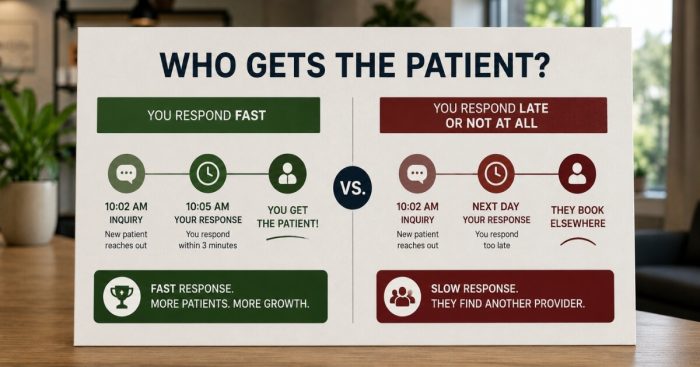
Because the prospective patient who inquired is deciding in minutes, not days — and the first credible response usually wins.
A person who fills out your form or calls about a consultation is at the peak of their motivation at that exact moment. They’re also, almost always, inquiring with more than one provider.
Respond in minutes and you’re having a conversation with someone ready to act. Respond tomorrow and you’re a voicemail in the life of someone who already booked elsewhere or talked themselves out of it.
This is why the promise holds: focus exclusively on responding to prospective patients quickly and accurately, and the business grows — with zero new marketing.
The inquiries already exist. Speed just stops donating them to competitors.
The volume compounds the effect. VYVE Wellness grew website leads by 900% and inbound calls past 100 a month in four months — and numbers like that are only worth celebrating if the response system underneath catches what comes in.
A hundred calls a month into a slow-response practice is a hundred chances to disappoint.

Why does accuracy matter as much as speed?
Because a fast wrong answer loses the patient too — the response has to be quick AND right.
Accuracy is the forgotten half of “quickly and accurately.”
It means the caller asking about pricing gets the same correct answer whether the office manager or the newest hire picks up. Likewise, the follow-up message should reference what the patient actually asked about, not a generic template for a different service.
Next steps also need to be stated concretely — what it costs, what happens first, and when they can come in — instead of “someone will get back to you.”
Inaccurate responses do quiet damage that never shows up in a dashboard. That includes the quoted-wrong price that turns into an awkward walk-back and the promised callback that never happens.
It also includes the patient told two different things by two staff members who each thought they were right.
In cash-pay medicine, the patient is paying out of pocket and comparing you against a free insurance visit. Therefore, sloppiness in communication can read as sloppiness in care.
Disciplined, accurate response handling is a pillar of the patient acquisition systems we install.
The practices that convert at the top of their market, like Orthobiologics Associates with its 79.4% lead-to-booking rate, win on the quality of the response as much as the speed of it.
Doesn’t this apply only to new leads?
No — the foundation covers new patients and existing patients too, and that’s where the compounding lives.
The system is explicitly for prospects, new customers, AND existing customers.
The new patient who just paid for their first program is at their most attentive. They’re also most likely to churn if the clinic goes silent between visits.
Meanwhile, the existing patient with a billing question or symptom concern is making a decision with every slow reply. They’re deciding whether this practice deserves their next year of membership.
One communication foundation handling all three groups means nobody falls into the gap between “marketing’s job” and “the clinic’s job.”
The same visibility that shows an unanswered lead also shows an unanswered member. And the revenue math favors the existing side: a recovered lead is worth one program, while a retained member is worth years.
Practices that only aim their response discipline at new leads build a leaky bucket with a polished faucet. The foundation exists so the whole patient relationship gets the same fast, accurate treatment — from first inquiry to fifth year of membership.
What does “fixed” actually look like day to day?
Every inquiry lands in one visible place, has an owner, gets answered fast in the channel it arrived in, and nothing depends on memory.
Concretely, phone, web forms, email, and texts flow into one system the whole team can see.
Every new inquiry is assigned — a name, not a department. Response happens in minutes during business hours. After hours, an auto-acknowledgment sets expectations.
Standard questions have standard answers the whole team uses, so accuracy doesn’t depend on who’s working.
Follow-up sequences run automatically for leads who don’t respond the first time. Meanwhile, the owner can see at a glance whether anything is sitting unanswered.
That’s important because what’s visible gets fixed. What’s invisible gets discovered three weeks later.
Notice that none of this requires a specific software brand. The CRM is the enabler, but the asset you’re building is the discipline: quick, accurate, owned.
Get that running and every marketing dollar you spend afterward lands on a practice that converts what it catches. That’s the whole reason step one is step one.
FAQ’s About Fixing Your Clinic’s Response System First
What system should a clinic fix before spending more on ads?
The communication foundation — a CRM that lets the team respond to prospects, new patients, and existing patients quickly and accurately from one visible place.
Marketing applied on top of a broken response system just produces expensive evidence of the leak.
How fast should a clinic respond to a new inquiry?
In minutes during business hours.
The inquiring patient is at peak motivation the moment they reach out and is usually contacting several providers. Therefore, the first credible response typically wins the booking.
What does responding “accurately” mean in practice?
The same correct pricing and next-step answers from any team member on any channel.
It also means follow-ups that reference what the patient actually asked and concrete statements of cost and process instead of “someone will get back to you.”
Does the response system matter for existing patients?
Yes — the foundation explicitly covers new and existing patients as well as prospects.
A slow reply to a member’s question erodes a relationship worth years of revenue. That’s a bigger loss than any single missed lead.
Will fixing response speed really grow a practice without new marketing?
Yes.
If you do nothing else but make sure prospective patients are responded to quickly and accurately, the business grows. That’s because the inquiries already being generated stop leaking to competitors and voicemail.
What’s the next step?
If you can’t say with certainty how many inquiries hit your practice last week and how fast each one was answered, the foundation is the work — before any new campaign.
Book a strategy call. In 60 minutes we’ll trace every channel an inquiry can enter through, find where responses are slow or inconsistent, and map the foundation fix that makes every future marketing dollar convert better.