
How Better SEO and Retention Systems Transform a Cash-Pay Practice (Especially When You Can’t Run Ads for Your Treatments)
Most cash-pay practice owners assume growth means ads. But for a lot of what these clinics actually sell — hormones, regenerative treatments, peptides — the ad platforms won’t let you run bottom-of-funnel campaigns at all. The practices that grow anyway follow a specific sequence: fix the website and SEO to win organic patients, build the brand and Google Business Profile to fill the funnel, then install a retention system that keeps every patient longer. Here’s how that sequence works and why it transforms practices that ads can’t help.
Why can’t my cash-pay clinic run normal ads for its treatments?
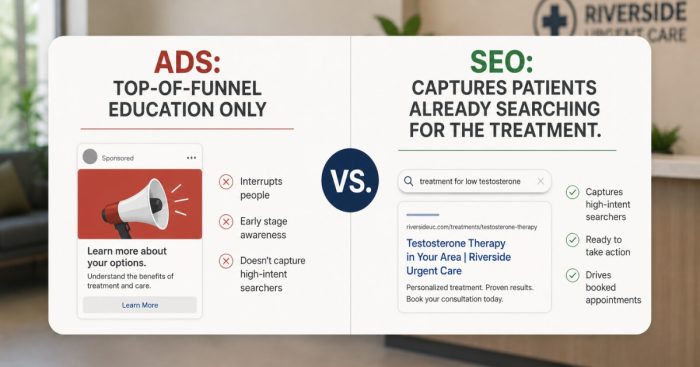
Because for a lot of what cash-pay clinics sell, the ad platforms only allow top-of-funnel educational campaigns — not bottom-of-funnel treatment ads.
A lot of the stuff we do for clinics, you simply can’t run ads for. At least, you can’t run bottom-of-funnel ads that name the treatment, the outcome, and the offer.
Hormone therapies, regenerative injections, peptides, and many wellness protocols trip ad-platform health policies.
What’s left is top-of-funnel educational content: awareness campaigns that can’t mention the specific things a ready-to-buy patient is actually searching for.
That creates a structural gap.
The patient typing “PRP for knee pain near me” or “testosterone clinic cost” into Google is the highest-intent prospect your practice will ever encounter.
Yet paid ads often can’t legally reach them at the moment of intent.
This is a well-known constraint in regenerative medicine marketing, where entire categories of treatment can’t be promoted directly.
The clinics that treat this as a dead end stall.
The clinics that treat it as a routing problem — intent goes to search, awareness goes to ads — transform.
What should a cash-pay practice build first to get more organic patients?
The website and the SEO — so the practice captures the patients who are already searching for its treatments.
In our growth sequence, working on the website and SEO is the step where we double down on getting more organic patients.
The logic is simple.
If the ad platforms won’t let you reach bottom-of-funnel patients, you have to be the answer when those patients go looking.
That means a website structured around the questions patients actually type — treatment pages, pricing questions, and condition pages. It also means content that earns its way into search results and LLM answers.
This isn’t a consolation prize for clinics that can’t advertise. In fact, it’s frequently the better economics.
Organic patients arrive pre-sold: they searched for the treatment, read the answer, and called.
No ad audience does that.
Where does Google Business Profile fit in the growth sequence?
Right behind the website: brand and Google Business Profile come second, to push more patients into the top of the funnel.
After the website and SEO foundation, we focus on the brand and Google My Business because we want more customers pushed into the top of the funnel.
The Business Profile is often the first impression a local patient gets.
The map pack shows up above the organic results for most “near me” and local treatment searches. Meanwhile, the profile’s reviews, photos, categories, and posts help determine whether the patient calls you or the clinic two miles away.
For a cash-pay practice, this compounds with the ad-restriction problem.
The map pack is prime bottom-of-funnel real estate that no health-policy restriction can take away from you.
A complete, active, review-rich profile paired with ranking treatment pages means the practice owns the moment of intent twice on the same results page.
Most clinics treat their profile as a listing to claim once and forget.
The ones that treat it as a channel — fresh reviews, updated services, and regular posts — pull measurably more calls from exactly the patients ads can’t target.
Why is patient retention a growth system and not just good service?
Because keeping new and existing patients longer multiplies the value of every patient acquisition.
And it’s a system you build, not a vibe you hope for.
The third focus in the sequence is retention: building out a system that keeps new and existing customers for a longer period of time.
Note the word system.
Retention isn’t “our patients love us.”
It’s structured follow-up after the first visit, scheduled check-ins, and protocols that turn one-time treatments into ongoing care plans. It also includes membership structures that give patients a reason to stay enrolled rather than re-decide every month.
The math is what makes this transformational.
If SEO brings you a patient for free but they come once and vanish, you’ve won a transaction.
If a retention system keeps that patient engaged for years, the same acquisition produces a multiple of the revenue.
That combination has produced real results, including SEO plus a membership layer that produced $1.44 million in nine months.
The SEO filled the funnel. The membership system made the funnel worth filling.
What order should my practice build these systems in — and why does the order matter?
Website and SEO first, brand and Google Business Profile second, retention system third. Each step makes the next one more valuable.
The order isn’t arbitrary.
Build retention first and you have a beautiful system with nobody in it. Build the Business Profile before the website and the clicks land on pages that don’t convert.
The sequence works because each layer feeds the next.
The website converts the searchers, the profile and brand widen the top of the funnel, and the retention system multiplies the lifetime value of everyone who enters.
This is also why “we tried SEO and it didn’t work” usually means the sequence was broken somewhere.
Traffic may have arrived at a website that couldn’t convert it. Or converted patients may have leaked out the back because no retention system existed.
When we structure a full medical practice marketing engagement, we audit all three layers before touching any of them.
That’s because optimizing one layer of a broken sequence just moves the leak.
A practice with all three layers working doesn’t just grow. It becomes progressively harder to compete with because every month of content, reviews, and member relationships compounds.
FAQ’s About SEO and Retention Systems for Cash-Pay Practices
Why is SEO more important for cash-pay clinics than for insurance practices?
Because many cash-pay treatments — hormones, regenerative medicine, and peptides — can’t run bottom-of-funnel ads under ad-platform health policies.
Search is the one channel where the highest-intent patients remain fully reachable.
As a result, organic visibility carries more of the acquisition load than it does for practices that can advertise freely.
How long does SEO take to produce patients for a medical practice?
Expect meaningful movement in months, not weeks — but the results compound.
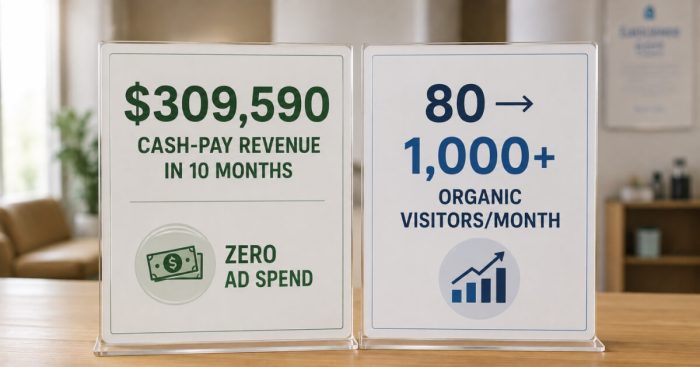
Orthobiologics Associates produced $309,590 in cash-pay revenue within 10 months from organic search alone.
Meanwhile, Eternity Health Partners grew from 80 to 1,000+ organic visitors a month over its engagement.
What makes a Google Business Profile actually generate calls?
Treating it as a channel instead of a listing: consistent new reviews, accurate services and categories, current photos, and regular posts.
The map pack appears above organic results for most local treatment searches.
It’s also bottom-of-funnel real estate that ad restrictions can’t touch.
What does a patient retention system include at a cash-pay clinic?
Structured post-visit follow-up, scheduled check-ins, care plans that extend beyond the first treatment, and membership or program structures that patients stay enrolled in.
That way, continuing becomes the default rather than a monthly re-decision.
Should I build retention before or after fixing my SEO?
After.
Retention multiplies the value of patients you’re already acquiring — website and SEO first, brand and Google Business Profile second, retention third.
Building retention first means building a system with nobody in it.
What’s the next step?
If your treatments are ad-restricted and your growth has been stuck at whatever referrals and word of mouth produce, the fix is the sequence above — not another attempt at a workaround ad campaign.
Book a strategy call. In 60 minutes we’ll audit your website, your search visibility, your Business Profile, and your retention structure, and tell you which layer is leaking and what to build first.