
How to Structure DPC Membership Pricing: Tiers, Consult Fees, and Add-Ons (A Real Pricing Teardown)
Last fall we sat on a consulting call with a two-physician DPC and virtual-care group we work with on the Gulf Coast. Their memberships sell for $300 to $400 a month — but their booking page was quietly sabotaging every sale. Patients trying to book a functional medicine consult were being auto-invoiced $100 for “urgent care.” Legacy members were sitting at $149 a month. And 50 of 129 memberships were past due. Here’s the exact pricing structure we rebuilt on that call, and the rules any DPC or virtual-care owner can steal.
How should I structure my DPC membership pricing?
One monthly price per household type — individual, couple, family — plus an initial consult priced at roughly one month of membership, plus a short add-on menu. That’s the whole architecture.
Most DPC pricing problems aren’t price-point problems. They’re structure problems: too many appointment types, a cheap consult that undercuts the membership, freebies patients can self-schedule, and legacy members grandfathered forever at rates that no longer make sense.
The clinic on this call had all four at once.
The fix wasn’t any single number. Instead, it was collapsing the menu into three household tiers, aligning the consult fee with the monthly rate, and moving everything else — medications, IV therapy, one-off urgent care visits — into clearly priced add-ons.
It’s the same tiered-program logic we push in functional medicine & longevity clinic marketing engagements. A patient should understand your entire pricing model in ten seconds.
What should a DPC initial consultation cost?
Price the initial consult at roughly your monthly membership rate. If your membership is $300 a month, the 60-minute initial is $300 and a 30-minute visit is $150.
This clinic’s programs all cluster around $300 to $400 a month, but new patients were paying $100 for their first visit.
If the consult is $100 and the program is $300 a month, the patient feels a 3× jump and pushes back.
However, if the consult is $300 and the program is $300 a month, the math “makes sense” in the patient’s head and the membership presentation gets dramatically less resistance.
The consult fee isn’t a revenue line — it’s an anchor.
It pre-sells the monthly number before anyone pitches it, and it filters out patients who were never going to join at your real price anyway.
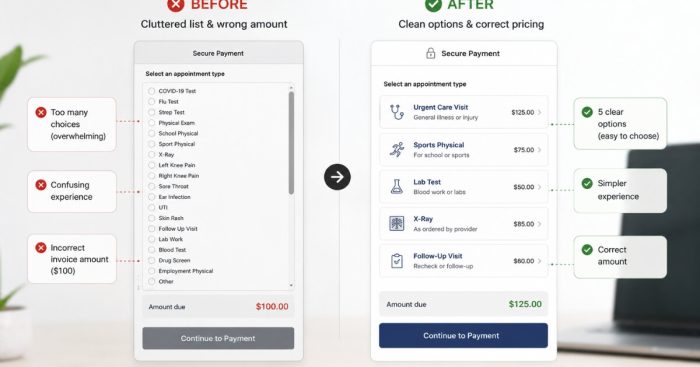
How many booking options should a DPC website show patients?
Five appointment types or fewer.
For this clinic: a $100 virtual urgent care visit, DPC initial, DPC follow-up, functional medicine initial, functional medicine follow-up. That’s it.
Here’s what too many options was costing them.
New patients booking their nurse practitioner kept landing in the default appointment type and receiving a $100 invoice that literally said “urgent care” on it for what was actually a functional medicine intake.
The fix was ruthless: delete every appointment type that didn’t map to a real service, take the NP off the urgent-care calendar, and cut her offering from three consult lengths to two prices — a 60-minute initial and a 30-minute follow-up.
Less is more.
Every extra button is another way for a patient to pay the wrong amount for the wrong thing, and every mislabeled invoice becomes a refund conversation for your staff.
Your pricing page is doing medical practice marketing whether you designed it to or not — so design it.
Should a DPC offer a free consultation?
Yes as an offer your team extends on a phone call — never as a button patients can self-schedule next to your paid options.
One physician on the call had just landed a $400-a-month member from a free consult. The patient admitted he “just wanted to see how it went” before committing.
That’s the upside.
The downside came from the same doctor’s free hour-long lab reviews. Most converted, but the ones who didn’t happily took 60 minutes of physician wisdom and walked.
When a free option sits next to three paid ones on a public booking page, everyone routes to free.
So the rule we set was simple: keep the free consult in the toolkit, remove it from the calendar.
If a prospect calls and is on the fence, the front desk can offer it.
Better yet, charge $300 for the lab review or initial and tell the patient the fee is waived when they convert to membership.
Now the freebie sells the membership instead of cannibalizing it.
What should be included in a DPC membership vs. priced as an add-on?
The membership covers access and primary care. Medications, IV therapy, and one-off visits for non-members get their own transparent add-on prices.
The clearest example from this clinic is GLP-1 weight loss medication.
Their pharmacy setup gives them a standard markup of about $200 a month and a promo markup of about $100 a month that one physician runs as a member benefit. That lands semaglutide around $249 a month and tirzepatide around $389 a month on promo pricing.
Those numbers live outside the membership fee, priced per medication per month. As a result, the core DPC tier never has to absorb drug costs, and members can see exactly what they’re paying for.
That separation matters for growth, too.
Weight loss add-ons are one of the highest-LTV attachments a membership practice can run.
a weight loss and wellness practice we work with added $6.7M in revenue in a single year with 3,727 new patients, and clean per-month medication pricing is part of what makes that offer easy to say yes to.
Bundle drugs into the membership and every pharmacy cost swing forces you to reprice the whole practice.
How do I raise prices on legacy DPC members without blowing up the practice?
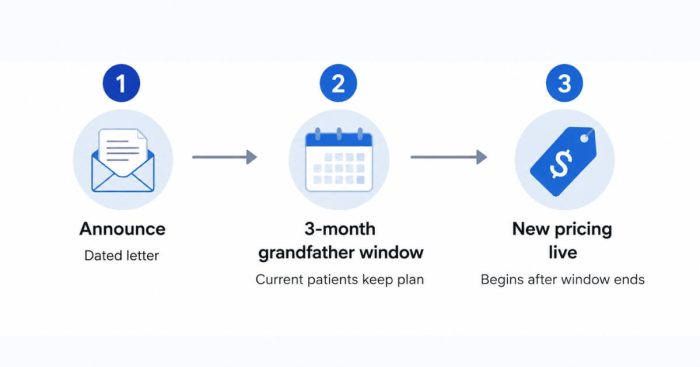
Announce a dated pricing change, show the new tiers, explain what’s new, and grandfather existing members for three months. Then migrate everyone.
This clinic had a pile of members at $149 a month — mostly early patients who came in through a booking marketplace — while current programs sell for $300 to $400.
The script we gave them on the call was straightforward: “Starting January 1st, this is what our new pricing looks like. Individuals: this. Couples: this. Families: this.”
Then explain the new features and why the change is happening. Give legacy members a three-month grandfather window at their old rate, and let them choose.
Will you lose some? Yes.
However, the owners’ own read was that the members most likely to leave at $149 were the highest-maintenance patients in the panel, the ones you’d want to bill $1,000 an hour but can’t.
Others, in their words, “should be at a higher level anyway and would respond favorably.”
A price increase done with a date, a reason, and a grace window isn’t churn — it’s a sorting mechanism that upgrades your average member.
What billing infrastructure does a DPC membership model need?
Recurring billing with automated payment reminders, decline handling, and easy card updates — built before you scale marketing, not after.
When we pulled this clinic’s numbers, they showed 129 active memberships and 50 past due.
Even if only a fraction of those flags were real, that’s recurring revenue silently leaking.
One family membership had gone three months unpaid — not because the family refused to pay, but because the portal wouldn’t let them clear their full past-due balance, and nobody was tasked with chasing it.
The structural answer is straightforward: run memberships through a CRM that fires payment reminders automatically, retries and flags declines, and lets patients update an expired card without calling the office.
Also, assign one staff member to work the past-due list weekly.
Pricing structure gets patients to yes. Billing structure keeps the yes collecting every month.
Get both right and cash-pay recurring revenue compounds.
a pain specialist we work with added $40K+ in monthly revenue while cutting insurance dependence in half on the back of clean cash-pay systems.
FAQ’s About DPC Membership Pricing Structure
How much should a DPC membership cost per month?
There’s no universal number, but the DPC and functional medicine programs at the clinics we work with cluster around $300 to $400 a month, with household tiers for individuals, couples, and families.
The more common problem isn’t the price point. Instead, it’s legacy members sitting at old rates like $149 a month while the current offer sells for more than double that.
Should my DPC initial consult cost less than my monthly membership?
No.
Price the initial consult at roughly one month of membership — for example, a $300 60-minute initial in front of a $300-a-month program.
A $100 consult in front of a $300-a-month membership creates a price jump that triggers pushback at the exact moment you present the program.
Should couples and families get their own DPC pricing tiers?
Yes.
Individual, couple, and family tiers are the cleanest way to structure DPC membership pricing because they match how households actually buy primary care.
Present all three in one view — “individuals this, couples this, families this” — so the patient can locate themselves in your pricing in seconds.
Should GLP-1 medications be included in the DPC membership price?
No — price them as transparent monthly add-ons.
One DPC group we work with prices promo semaglutide around $249 a month and tirzepatide around $389 a month on top of the membership, using a $100-to-$200 monthly markup depending on standard vs. member-benefit pricing.
Keeping medications out of the base tier protects your membership price from pharmacy cost swings.
What if members refuse to accept a DPC price increase?
Some will leave, and that’s usually fine.
Give legacy members a dated announcement, an explanation of what’s new, and a three-month grandfather window at their old rate.
The members who leave over a fair increase are disproportionately the lowest-paying, highest-maintenance patients. Meanwhile, the ones who stay upgrade your average revenue per member.
How do I reduce failed and past-due membership payments?
Automate it: payment reminders before the charge, automatic retries and staff alerts on declines, and a self-serve way for patients to update an expired card.
One clinic we audited had 50 of 129 memberships flagged past due — including a family three months behind simply because the portal wouldn’t accept their full balance.
Assign one person to work the past-due list every week.
What’s the next step?
If you’re launching or restructuring a DPC or virtual-care membership and you’re not sure what to charge, where the consult fee should sit, or how to move legacy members to new pricing without a revolt, book a strategy call.
In 60 minutes we’ll map your tier structure, your booking menu, your add-on pricing, and the exact grandfathering script for your current panel — the same teardown we run with DPC groups every week.