
Why Isn’t My IV Therapy Clinic Showing Up on Google? (96 Five-Star Reviews, 3 Calls a Month)
An IV therapy clinic we work with had 96 five-star reviews, a real physical location, and 470 visitors to its website in a month—and got exactly three phone calls from its Google Business Profile in September. Meanwhile, a patient living ten minutes from the clinic told the owner he’d Googled “IV clinics” and the first results were mobile IV companies—some set up in other states. The audit that followed is a checklist every local cash-pay clinic should run. Here’s the FAQ.
Why isn’t my IV therapy clinic showing up in the Google 3-pack?
Often, the problem is focus rather than effort.
Your Google Business Profile and website may be optimized for the service you love instead of the service patients actually search for.
That was exactly the issue with this clinic.
Its Google Business Profile and website emphasized regenerative medicine—the premium service.
Meanwhile, patients searching for basic IV therapy found competitors instead.
The recommendation from the call was straightforward.
Point the Google Business Profile toward IV therapy.
Point the website toward IV therapy.
Then let premium services live one click deeper in the site.
The clinic’s reviews weren’t the problem.
Ninety-six five-star reviews provided plenty of credibility.
However, the profile was signaling relevance for the wrong search terms.
The audit also uncovered a hidden technical issue.
The homepage title tag still read “IV infusion and IV hydration therapy near Denver and Thornton” from the business’s earlier mobile-only operation.
Today, the clinic serves Boulder.
Google simply believed what the website said.
Therefore, audit every title tag to ensure it references the city you actually serve.
It’s one of the quickest improvements you can make in medical practice marketing.
Why am I losing Google rankings to mobile IV companies without a real location?
Because relevance usually beats legitimacy.
The algorithm can’t appreciate advantages you haven’t communicated.
During the consultation, one prospective patient shared a frustrating story.
Although he lived only ten minutes from the clinic and specifically wanted a physical location, Google still showed several mobile IV providers first.
Some of those competitors even operated primarily in other states.
The lesson wasn’t that Google was broken.
Instead, it showed how strongly relevance influences rankings.
Those competitors consistently emphasized IV therapy across their profiles.
Meanwhile, this clinic emphasized regenerative medicine.
Google responded accordingly.
Rather than becoming frustrated, align every local ranking signal.
Use the correct primary category.
Optimize your services.
Publish IV therapy content.
Upload relevant photos.
Keep title tags consistent.
When every signal reinforces the same service in the same city, your physical location becomes an advantage instead of an afterthought.
Do location pages actually help a local clinic rank?
Yes—but only if search engines can actually find them.
Pages that exist without internal links provide very little SEO value.
This clinic had already created approximately 150 location pages.
Those pages covered five or six treatments across roughly 30 cities.
Unfortunately, they weren’t linked anywhere within the site’s navigation.
As a result, Google struggled to discover them.
The fix was simple.
Add the location pages to the website navigation—or create a dedicated locations index page.
Then resubmit the sitemap so Google can crawl the new structure.
Properly built location pages remain one of the strongest local SEO assets for clinics serving multiple cities.
The team also agreed they would strengthen Google Business Profile performance over time.
However, two important rules still apply.
First, interlink every location page.
Orphan pages rarely perform well.
Second, write genuinely unique content for every city.
Avoid copying the same paragraph 150 times and simply replacing the city name.
Do Google Business Profile posts, photos, and videos help my clinic rank?
Posts probably don’t move rankings directly.
However, they’re still worth publishing.
Photos and quality videos strengthen the profile patients actually see.
During the discussion, we noted that Google Business Profile posts generally recycle after about seven days.
They may not generate significantly more traffic on their own.
Nevertheless, they communicate that the business is active and well maintained.
There’s very little downside to publishing consistently.
Video recommendations were much more specific.
Skip selfie-style TikTok videos shot from underneath your chin.
Instead, record short videos that showcase the actual clinic.
A simple 15-second walkthrough filmed on an iPhone with a tripod works well.
Include movement through the space or demonstrations of procedures whenever possible.
Upload those videos directly to the Google Business Profile.
Likewise, continue adding fresh photos regularly.
Set expectations appropriately, though.
Google Business Profile optimization is one of the slowest SEO channels.
This clinic’s history—three calls in September after averaging roughly five or six calls during previous months—wasn’t going to reverse overnight.
Consistent, aligned signals typically produce results over a quarter rather than a week.
Why am I getting website traffic but no phone calls?
Audit the final steps of the patient journey.
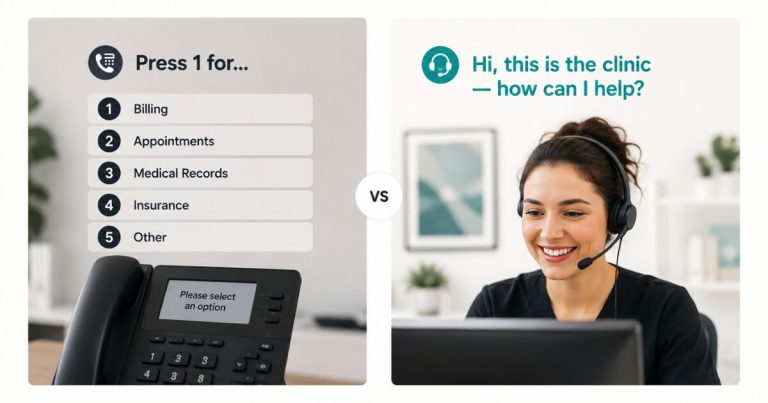
Then call your own tracking number and experience what prospective patients hear.
During this audit, we dialed the clinic’s tracking number live.
Instead of reaching a person, we landed inside a corporate phone tree.
“Welcome to… press 1… dial by name…”
The owner’s reaction was immediate.
“That’s a barrier to entry.”
For someone searching multiple IV clinics while feeling sick, another menu often becomes another reason to hang up.
The recommendation was equally direct.
Reduce the phone system to a simple new-patient versus existing-patient option.
Better yet, remove the phone tree entirely and let calls ring directly to the office.
Call tracking already captures missed calls.
Therefore, adding unnecessary friction only reduces conversions.
The content strategy also revealed another mismatch.
Approximately 40 website visitors arrived through NAD-focused blog articles.
Those pages generated zero phone calls.
By contrast, 22 ozone-therapy advertising leads produced three booked appointments.
Traffic without commercial intent is simply a vanity metric.
A longevity practice we work with experienced what true alignment looks like when inbound calls climbed past 100 per month within 4 months.
Website content, Google Business Profile optimization, and core services all reinforced the same message.
Which IV therapy leads actually convert into booked patients?
Patients with committed, chronic conditions consistently convert better than general wellness shoppers.
This clinic’s own numbers illustrated the difference.
During September, 22 ozone-therapy leads produced approximately three booked appointments.
According to the owner, the strongest-performing patients typically came from three groups:
- Autoimmune conditions
- Lyme disease
- Mold exposure
These patients usually arrive looking for a treatment plan rather than a one-time wellness visit.
Consequently, they’re far more committed to completing care.
That insight should shape your marketing.
Build condition-specific landing pages.
Write educational content around those conditions.
Create advertising campaigns that address those audiences directly.
Generic hydration messaging attracts curiosity.
Condition-focused messaging attracts commitment.
One additional advertising recommendation emerged during the discussion.
To reduce the risk of Meta or Google flagging health-related ads, remove personalized language—especially the word “you.”
Instead, write objective copy that discusses the condition rather than speaking directly to the reader.
The exact workflow from the call was simple.
Paste the script into ChatGPT and ask it to remove the word “you” while keeping the message objective.
FAQ’s About IV Therapy Clinic Google Rankings
How many calls should a Google Business Profile generate?
There’s no universal benchmark.
However, this clinic’s three to six calls per month from a profile with 96 five-star reviews indicated a relevance problem rather than a review problem.
Once your Google Business Profile, website, and primary services become properly aligned, phone calls typically increase over the following quarter—not overnight.
Are reviews enough to rank in the 3-pack?
No.
Although this clinic had 96 five-star reviews, it still lost IV therapy searches to mobile competitors.
The difference came from relevance signals.
Categories, title tags, services, and website content all emphasized regenerative medicine instead of IV therapy.
Reviews build trust.
Relevance earns rankings.
You need both.
Why does my blog traffic produce zero calls?
Because traffic only matters when it matches patient intent.
In this audit, NAD-focused blog articles generated approximately 40 visitors without producing a single phone call.
Meanwhile, ozone therapy advertising generated 22 leads and three booked appointments.
Write content around conditions that motivate patients to contact your clinic—not simply topics that attract readers.
Should my clinic use a phone tree?
Almost never.
New patients who hear “press 1” or “dial by name” frequently hang up before reaching anyone.
During this audit, the clinic owner immediately identified the phone tree as “a barrier to entry.”
Whenever possible, route new patient calls directly to a real person.
Call tracking software will still capture missed calls without adding unnecessary friction.
How do I keep IV therapy ads from getting flagged?
Use objective language instead of personalized health claims.
Removing words like “you” helps reduce personalized-health policy violations on Meta and Google.
The simplest workflow is to rewrite advertising scripts so they describe the condition objectively rather than speaking directly to the reader.
What’s the next step?
If your clinic has excellent reviews and a physical location but the phone still isn’t ringing, start with a simple audit.
Ask yourself three questions.
What does your Google Business Profile tell Google you specialize in?
Can Google actually discover your location pages?
What experience does a brand-new patient have when they call your office?
Then book a strategy call.
In 60 minutes we’ll review your Google Business Profile, inspect your title tags, evaluate your phone experience, and prioritize the changes most likely to generate more calls.
Practices that consistently align those pieces build durable organic growth engines.
One regenerative practice we work with generated $309,590 in cash-pay revenue in 10 months from SEO alone.