
What Should a Marketing Agency’s Proposal for a New Longevity Clinic Include? (A Real Proposal, Line by Line)
A physician opening a new longevity clinic asked us the question every practice owner should ask before signing with any agency: “How is this different from everybody else?” Our honest answer on that call: “It doesn’t matter how I answer that question. I’m a guy from the internet. You should be wary of anything that any guy from the internet says to you.” What protects you isn’t the pitch — it’s what’s written in the proposal. So here’s what our actual proposal and launch plan for that clinic contained, line by line, so you know what to demand from anyone you’re evaluating.
What should a marketing proposal for a new cash-pay clinic include?
One flat monthly fee.
Every deliverable listed by name.
Clear exit terms in writing before you sign.
The proposal discussed during this call included one monthly fee—$3,750 per month at the time—with a six-month commitment.
That investment covered the complete website build, SEO, one blog every week, two Google Business Profile posts each week, CRM implementation and team training, weekly 30-minute strategy calls, monthly reporting, and paid advertising management.
The clinic paid only its own advertising spend.
There were no surprise management fees.
There was also no lengthy binding contract because, as we put it during the conversation, “that contract extortion stuff is stupid.”
Regardless of what another agency charges, copy the structure.
A flat, inclusive proposal is almost always easier to manage than an à-la-carte agreement that adds another invoice every time you need support.
Likewise, a written list of deliverables is far more valuable than vague promises about being “full service.”
Why should a new longevity clinic launch with SEO instead of Google Ads?
Because most bottom-of-funnel advertising is restricted in this industry.
More importantly, paid traffic disappears the moment you stop paying for it.
Hormone replacement therapy, semaglutide, tirzepatide, stem cells, and even IV therapy frequently trigger advertising restrictions or policy reviews.
Consequently, a launch strategy built entirely around paid advertising depends on exceptions you don’t control.
Instead, this proposal focused on building owned assets first.
That included a complete website covering hormones, weight loss, gut health, peptides, memberships, and related services.
It also included a directory-style content structure.
One primary page targeted the main keyword.
Supporting city pages expanded geographic reach without creating duplicate-content issues.
Weekly blog publishing completed the content engine.
Finally, every article was written in a straightforward, factual style so Google’s AI Overviews and ChatGPT could confidently reference it.
The clinic’s personality remained on the homepage while the educational content remained highly searchable.
That’s the compounding approach.
An HRT practice built this way now generates $1.7M a year in memberships from SEO alone.
Paid advertising can always be added later.
However, SEO builds an asset your clinic owns instead of attention you continuously rent.
What happens in the first 90 days after signing with an agency?
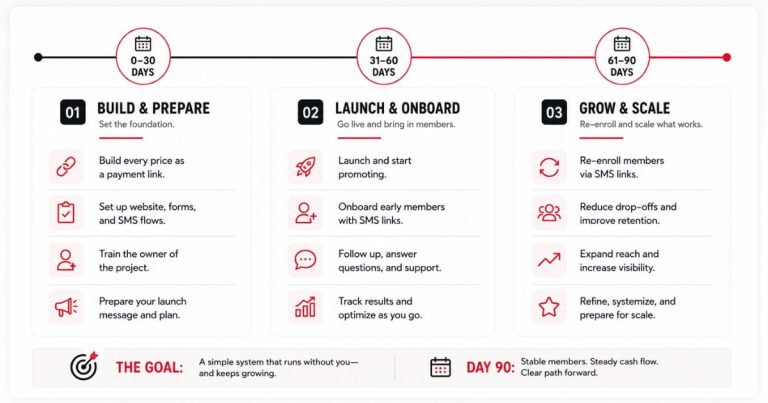
A successful launch follows a defined sequence instead of a series of disconnected tasks.
The proposal outlined the process clearly.
Signing the agreement triggered an onboarding survey.
Next came account-access handoff.
Then the onboarding call officially started the project and established billing.
After that, the website strategy session took place.
From there, the team met every week for a scheduled 30-minute strategy call.
Each agenda arrived roughly 48 hours beforehand so everyone knew what decisions would be made.
The website timeline targeted approximately 75 days from scratch.
Worst case, the project reached 90 days.
Best case, with every dependency moving quickly, it could launch in around 60 days.
Rather than waiting for one dramatic reveal, the clinic reviewed iterations throughout the build.
If an agency can’t provide this level of sequencing, they’re demonstrating a sales process instead of a launch process.
This clinic’s physical build-out still had roughly eight weeks remaining.
Therefore, the digital foundation progressed in parallel so the website could launch around opening day.
What intro offer should a new longevity clinic launch with?
Paid laboratory testing combined with a paid initial consultation.
Then apply those fees toward the patient’s first month of membership.
One example discussed during the call was a $300 laboratory package followed by a $300 consultation.
That framework had already been tested across numerous markets.
It serves three important purposes.
First, it filters for patients who are serious enough to invest.
Second, it helps offset acquisition costs.
Finally, prorating the consultation fee into the first month transforms the consultation into the beginning of a membership rather than a one-time transaction.
The same structure also scales to premium pricing.
For example, one practice could charge $599 for laboratory testing, $599 for the consultation, and $699 per month for membership.
The important point is making the financial progression feel logical for both the clinic and the patient.
The proposal also recommended structured intake assessments.
Patients completed questionnaires measuring sleep, nutrition, energy, libido, and stress during the initial consultation, again at 90 days, and again after six months.
The objective, as we explained during the call, was simple.
“I want patients to sell themselves.”
When patients can clearly see their own improvement, retention conversations become much easier.
What should the agency report to me every month?
Eight numbers.
Nothing more, and certainly nothing less.
The reporting dashboard from this proposal focused on:
- Website visits
- Website leads
- New leads
- Inbound calls
- Answer rate
- Telehealth visits
- New patient visits
- Active members
That’s the reporting stack because those numbers either generate revenue or sit one step away from it.
Notice what’s intentionally missing.
Follower counts.
Impressions.
Engagement rates.
Other vanity metrics that make reports look impressive without explaining whether the business is actually growing.
One metric deserves special attention: answer rate.
If the agency generates qualified phone calls but your team doesn’t answer them, the report should expose that immediately.
Accountability belongs on both sides of the relationship.
A longevity and functional medicine practice we work with saw website leads jump 900% and inbound calls exceed 100 per month within 4 months.
Those eight numbers made that progress obvious long before the revenue fully caught up.
What protects me if the agency relationship doesn’t work out?
Asset ownership and clear exit terms.
Both should be written into the proposal before you sign.
In this proposal, the clinic owned the website outright.
If the relationship ended, hosting continued for $100 per month.
Keeping the CRM active cost $200 per month.
As we explained during the call, “I have no reason to own or hold your website hostage.”
Compare that approach with the experience this physician previously described.
A former agency generated leads that were roughly 65% unqualified.
Even worse, those leads came from at least 13 different states despite the clinic specifically targeting Phoenix.
When the relationship ended, many of the marketing assets disappeared with it.
That’s exactly the situation you should avoid.
Whenever you’re evaluating medical practice marketing consultants, ask four straightforward questions:
- Who owns the domain?
- Who owns the website?
- Who owns the CRM account?
- Who owns the advertising accounts?
The correct answer should always be the same.
You do.
Anything else is simply a hostage clause written in friendlier language.
FAQ’s About Marketing Proposals for a New Longevity Clinic
How long should a new clinic website take to build?
In this proposal, the target timeline was approximately 75 days from scratch.
The project could stretch to around 90 days if necessary or finish in roughly 60 days when everything moved efficiently.
Throughout the process, design revisions were shared continuously instead of waiting until the end.
Ideally, the website should launch around the same time the clinic opens its doors.
Who pays for ad spend—the clinic or the agency?
The clinic pays advertising costs directly through its own advertising accounts.
Meanwhile, the agency manages those campaigns.
In this proposal, advertising management was included without an additional management fee.
Owning your own advertising accounts also protects you if the relationship ever ends.
What does the agency own versus what does the clinic own?
The agency owns the work it performs.
That includes website development, SEO, blog writing, CRM implementation, training, reporting, and strategic guidance.
The clinic owns the business itself.
That means the website, domain, advertising accounts, clinical protocols, patient follow-up process, and—in this proposal—its own organic social media efforts.
Should a new clinic keep social media in-house?
Yes, it can.
In this proposal, organic social media remained the clinic’s responsibility.
TikTok was highlighted as one of the strongest platforms for longevity and peptide content.
Meanwhile, the agency supplied strategic direction and examples of successful accounts during weekly meetings.
That approach allowed the clinic’s own voice to remain authentic while still benefiting from experienced guidance.
What does a proposal like this cost?
At the time of this proposal, the investment was $3,750 per month with a six-month commitment.
That included the website, SEO, ongoing content creation, CRM implementation, weekly strategy calls, reporting, and advertising management.
The clinic paid only its own advertising spend.
Although pricing varies by scope and market, the proposal structure matters far more than the exact monthly fee.
Look for flat pricing, clearly written deliverables, predictable timelines, and straightforward exit terms.
What’s the next step?
If you’re opening a cash-pay longevity clinic—or reviewing an agency proposal that’s full of marketing buzzwords but light on deliverables, timelines, and ownership terms—book a strategy call.
In 60 minutes we’ll map your launch sequence, build the right introductory offer, design your content engine, and identify the eight numbers your reporting should track from day one.
Most importantly, we’ll put everything in writing.
After all, you shouldn’t have to take a guy from the internet’s word for it.