
What’s the One Thing a Marketing Agency Can’t Replace? (A Client Told Us — And It Isn’t the Ads)
“On a recent consulting call, a cash-pay clinic owner we work with said something worth repeating verbatim: “Honestly, more so than you doing the ads for us — having you as a coach is so valuable to us. We were so directionless, and that’s what we missed with the other agency. We didn’t have the proper guidance. That stuff you can’t replace, I think, even with technology.” He’d had an agency before. The ads ran. The clinic still felt lost. Here’s the FAQ on why direction — not deliverables — is the thing that actually grows a practice.”
What’s the one thing a marketing agency can’t replace at your clinic?
Guidance.
A coach who knows where your practice needs to focus and holds you accountable to it.
Not the ads.
Not the website.
Not the reporting dashboard.
Deliverables are replaceable.
Hundreds of competent agencies can run Facebook campaigns or build landing pages.
Among the good ones, the differences in execution are often small.
What’s rare is someone who has grown enough practices like yours to look at your numbers, your team, and your offer and confidently say, “This is the one thing you need to fix this quarter. Ignore everything else.”
That’s exactly what the clinic owner quoted above was missing with his previous agency.
The campaigns existed.
The direction didn’t.
Why does my clinic feel directionless even though marketing is running?
Because running marketing and knowing what your business should do next are two completely different jobs.
Most agencies only handle the first.
A typical agency engagement creates activity.
Ads are running.
Social posts are scheduled.
Reports arrive every month.
However, the owner’s real questions often remain unanswered.
Should we fix the front desk before increasing ad spend?
Is pricing holding us back?
Which of the six current problems deserves attention first?
When nobody owns those answers, every month becomes reactive.
Being busy starts looking like progress.
That’s the difference between a deliverables-based relationship and working with medical practice marketing consultants who coach the business instead of simply managing marketing channels.
Here’s the simplest test.
After every meeting with your agency, do you know exactly what your clinic should improve next—and why?
If the answer is no, you probably have a vendor creating activity instead of a partner providing direction.
What does proper guidance from an agency actually look like?
A consistent meeting rhythm focused on targeted outcomes.
Not lectures.
Not reports read aloud.
When we implemented the five core functions inside our own business years ago, the transformation came through weekly internal meetings and monthly reviews.
Those meetings shifted from explaining information to assigning outcomes:
- This number
- This owner
- This improvement
- This deadline
The result was simple.
Everyone knew exactly where the business was headed.
That feeling—”we finally had direction”—is exactly what clinic owners tell us was missing before.
Inside a cash-pay practice, guidance looks like:
- A standing weekly meeting focused on the numbers
- One visible scorecard the whole team understands
- One targeted improvement at a time
- A coach who’s already solved the same problem at dozens of comparable clinics
A pain practice we guided this way added $40K+ in monthly revenue while cutting insurance dependence in half.
That wasn’t simply the result of a better advertising campaign.
It was the outcome of changing the business model itself.
No marketing deliverable creates that.
Direction does.
How do the five core functions give a cash-pay clinic direction?
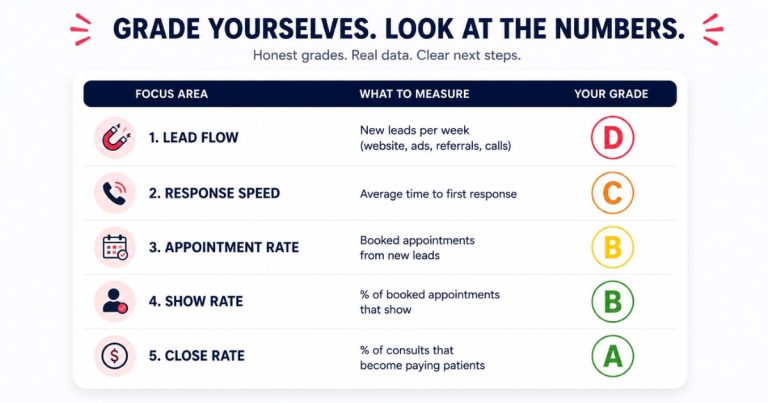
Grade your practice across each function, compare those grades with real numbers, and your next priority becomes obvious.
Every successful clinic operates around the same core functions:
- Attracting patients
- Converting patients
- Delivering care
- Retaining patients
- Managing the finances and team that support everything else
The exercise itself is remarkably simple.
Grade each function honestly.
Place the supporting numbers beside every grade.
Then look at what the data says.
As the clinic owner on the call put it:
“It’s obvious what needs to be done when you just grade yourselves and look at the numbers — all right, this is what we need to improve.”
The framework isn’t the magic.
The cadence is.
Doing the exercise once creates an interesting workshop.
Repeating it every month with a coach who challenges your assumptions creates a direction-setting system.
That’s why teams that once felt scattered often become focused within only a few weeks—even without adding a single new marketing deliverable.
Can AI or ChatGPT replace marketing guidance for my clinic?
AI can replace many production tasks.
However, it can’t replace judgment, accountability, or experience.
The owner’s own words captured it perfectly:
“That stuff you can’t replace, I think, even with technology.”
AI is genuinely valuable for drafting ads, summarizing meetings, researching ideas, and accelerating production.
In fact, we use it ourselves.
Guidance, however, is fundamentally different work.
First, it requires understanding your numbers in context.
Second, it depends on pattern recognition developed from helping dozens of comparable practices solve the same problems.
Most importantly, it requires accountability.
A 25% close rate might be acceptable for one specialty and alarming for another.
Likewise, the right strategic decision for one clinic may be completely wrong for another.
No software asks your leadership team during a weekly meeting why the conversion rate hasn’t improved.
A trusted coach does.
Ultimately, advice without accountability becomes content.
There’s already plenty of content available.
So, use AI wherever it makes production faster.
Meanwhile, hire experienced people for direction.
When you’re evaluating an agency, judge whether they’re actually selling production or guidance.
How do I know if my current agency is coaching me or just shipping deliverables?
Instead, count the business decisions—not the deliverables.
Look back over the last 90 days.
Then write down every significant business decision your agency influenced.
For example:
- A pricing change
- A hiring recommendation
- A front-desk process improvement
- A recommendation to pause advertising until another problem was fixed
However, if that list is empty while your inbox is full of reports and completed tasks, you’re purchasing production rather than coaching.
At a regenerative medicine practice we work with, the guidance itself—improving the sales process, strengthening follow-up discipline, and reviewing one consistent scorecard—is what turned marketing into $309,590 in cash-pay revenue in 10 months with a 79.4% lead-to-appointment conversion rate, without paid ads.
Of course, the leads mattered.
Ultimately, the direction made those leads valuable.
FAQ’s About What a Marketing Agency Can’t Replace
What did the clinic owner say was more valuable than the ads?
The coaching.
His exact words were:
“Honestly, more so than you doing the ads for us — having you as a coach is so valuable to us… we didn’t have the proper guidance [with the other agency]. That stuff you can’t replace, even with technology.”
What is guidance from a marketing agency, concretely?
Guidance means a recurring meeting rhythm built around:
- Weekly numbers meetings
- Monthly graded reviews
- One scorecard across the practice’s core functions
- One targeted improvement at a time
- Business decisions involving pricing, hiring, follow-up systems, and operations—not just advertising campaigns
Can AI replace a marketing agency for a medical practice?
AI can replace large portions of production.
For example, it can help create advertising copy, summarize meetings, perform research, and speed up content creation.
However, it can’t replace contextual judgment, pattern recognition developed from growing similar clinics, or the accountability that comes from a human-led weekly meeting.
Therefore, buy production wherever it’s most efficient.
Hire humans for direction.
What are the five core functions of a cash-pay practice?
The five core functions are:
- Attracting patients
- Converting patients
- Delivering care
- Retaining patients
- Managing the finances and team that support the practice
Next, grade each function every month.
Then place real numbers beside every grade.
Finally, improve the lowest-performing function first.
How quickly should guidance produce results?
In most cases, direction shows up within weeks.
Once priorities become clear, most leadership teams feel noticeably more focused.
As a result, revenue follows the operational improvements.
Process and conversion changes typically become visible over one to two quarters, compounding before additional advertising spend is ever required.
What’s the next step?
If your marketing is running but your clinic still feels directionless, the missing piece probably isn’t another deliverable.
Instead, it’s a coach who understands where practices like yours actually need to focus.
Book a strategy call.
In 60 minutes we’ll grade your practice across the core functions, review the numbers together, and identify the single most important outcome to pursue this quarter—whether or not you ever decide to run ads with us.