
What Does an Inside Sales Representative Do at a Cash-Pay Medical Practice? (The 4 R’s Job Description That Converts 79% of Leads)
Most cash-pay clinics don’t have a sales problem — they have a “nobody actually owns the leads” problem. The fix is a dedicated inside sales representative with a written 4 R’s job description: Role, Responsibilities, Requirements, Results. Below is the real one used inside a regenerative medicine practice we work with — the same practice that converts 79.4% of its leads into booked appointments — including what the role owns, why every reply must go through the CRM, how performance is judged, and what to pay.
What does an inside sales representative do at a cash-pay medical practice?
They are the frontline of new patient communication — the single person who owns every inquiry from first contact to scheduled consultation.
In the 4 R’s framework, the Role comes first because it defines the position in one sentence everyone can repeat.
At the regenerative practice this scorecard comes from, the role reads: assist new and existing patients with general information about the practice and with scheduling appointments — the frontline of new patient communication.
As the representative masters new cash-patient scheduling, the role expands into liability cases and referral-source communication.
Notice what the role is not.
It’s not a receptionist who also answers lead calls between check-ins, and it’s not a closer working a boiler-room script.
Instead, it’s a defined owner for the most expensive asset your marketing produces: inquiries.
That ensures no website lead, Facebook lead, or inbound call ever depends on whoever happened to be near the phone.
Clinics that leave lead ownership scattered leak revenue every day.
Worse, they can’t accurately measure how much because nobody is accountable for the entire pipeline.
What responsibilities should a clinic inside sales job description include?
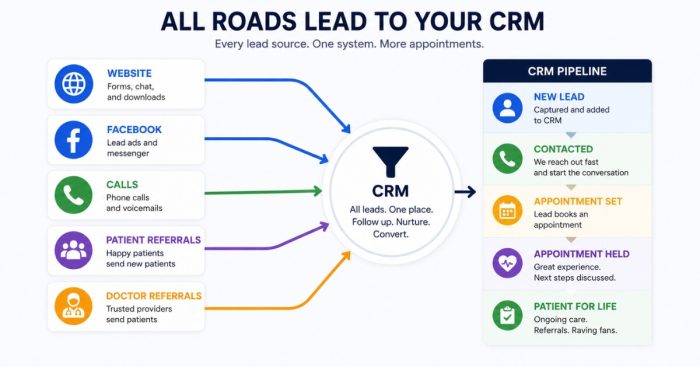
Ownership of the CRM and every lead source inside it, scheduling new patient consultations, educating leads about the clinic’s solution, and keeping referral sources informed.
The real scorecard lists these responsibilities explicitly.
The Inside Sales Representative owns the CRM — in this practice, HighLevel — which tracks and records all inbound calls, new patient inquiries, and appointment requests.
They schedule new patient consultations.
They educate new patient leads about alternatives to surgery so patients can avoid years of discomfort, serving as an advocate for drug-free, surgery-free solutions to chronic joint and spine pain.
They also keep the case-management platform current for referral-source and client updates while answering questions from referral sources and insurance companies so new referrals move efficiently.
Two details deserve special attention.
First, the education line is intentionally specialty-specific.
A representative who can genuinely explain the clinic’s alternative is doing clinical marketing, not simply answering the phone.
Write your version for your own specialty.
Second, referral-source communication belongs inside this role because referring physicians judge your practice by how responsive you are.
A delayed update to a referring physician quietly closes that referral source.
This is the operational core of patient acquisition: every source of new patients has a named owner and a documented system of record.
Why must every lead reply go through the CRM instead of personal phones or email?
Three reasons, written directly into the job requirements: quality control, coachability, and the ability to eventually build a team under this person.
The Requirements section of the scorecard is straightforward.
Reply promptly to every new patient inquiry using the CRM, and ensure every reply happens through the software.
Why is that so important?
Because conversations stored inside the CRM can be reviewed and coached.
You can’t improve conversations you can’t see.
Likewise, quality remains consistent when every interaction is visible.
Finally, the role is designed to scale.
When every conversation lives in one system, the person in this seat can eventually manage and train a team using the same recorded conversations.
The requirements also spell out pipeline hygiene after every interaction.
The representative should:
- Move the lead to the correct pipeline stage.
- Add a note documenting what should happen next.
- Create a contact record from every inbound call.
- Keep the conversations tab fully replied.
The representative handles every inquiry type, including:
- Website leads
- Facebook leads
- Inbound phone calls
- Patient referrals
- Doctor referrals
None of this is glamorous.
However, all of it is why the pipeline becomes trustworthy.
An untrustworthy pipeline is how clinics end up guessing at their own numbers.
Is an inside sales rep at a clinic supposed to “sell” patients?
No — and the scorecard says so explicitly.
The goal is not to sell or convince people. It’s to understand what’s happening with the patient and make the right recommendation.
The Results section begins with posture, not quotas.
The Inside Sales Representative is expected to be customer-service focused, creating a positive, memorable experience for every new and existing patient.
Respond quickly so people receive the information they need to make an educated decision for themselves.
Diagnose first.
Then recommend based on what the patient is struggling with and what the practice offers.
This matters commercially as much as ethically.
High-ticket regenerative and cash-pay decisions are trust decisions.
Pressure tactics create resistance precisely where you need openness.
A representative trained to ask thoughtful questions, listen carefully, and recommend appropriate solutions consistently outperforms someone trained simply to overcome objections.
Recommendation-based selling isn’t the softer option.
It’s the higher-converting one.
How do I measure an inside sales rep’s performance?
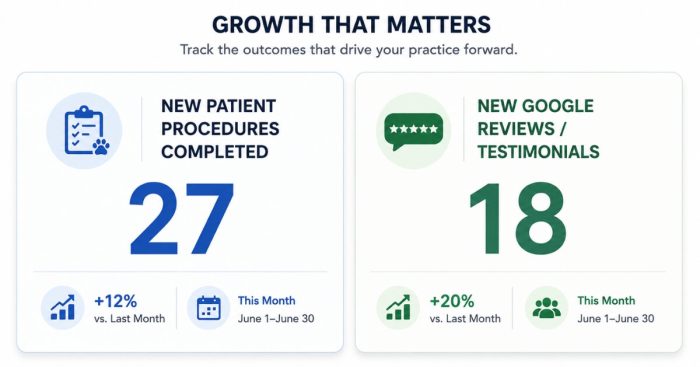
Two numbers, stated in the scorecard: volume of new patient procedures completed, and new Google reviews and patient testimonials.
Procedures completed — not calls made or talk time — ties the role directly to revenue.
It keeps the focus on quality bookings that show up and convert rather than simply filling the calendar.
New Google reviews and patient testimonials provide the counterbalance.
They make memorable patient experiences measurable and prevent the classic failure mode where a representative hits booking targets by pressuring patients who later feel burned.
A representative who books procedures and generates five-star reviews is doing the entire job.
A representative who books procedures but generates silence is borrowing against your reputation.
Review both metrics every week.
Procedures completed tell you about this month’s revenue.
Meanwhile, review velocity predicts next quarter’s performance because reviews compound into stronger local rankings and greater referral trust.
That’s the same flywheel that powers effective stem cell clinic marketing, where skeptical, high-ticket patients read everything before they ever make a call.
How much should I pay an inside sales representative at a cash-pay clinic?
$65,000 to $85,000 base plus commission — benchmarked against comparable medical case manager and inside sales roles on the open market.
That’s the range in the actual scorecard, cross-checked against live Indeed listings for medical case manager and inside sales roles when it was written.
Many owners hesitate to pay a coordinator more than $65,000.
Instead of reacting to the salary, run the math.
At a regenerative practice where a single case can generate a five-figure procedure, the difference between a representative converting 30% of inquiries and one converting more than 70% is worth many times the salary difference every month.
The commission structure matters too.
Tie compensation to completed procedures rather than booked appointments so the incentive matches the metric that actually produces revenue.
Underpaying this position is the expensive decision.
The cheaper hire is more likely to churn, mishandle hundreds of patient conversations before anyone notices, and suppress the conversion rate on every marketing dollar you spend.
The right hire often becomes the highest-return employee in the building outside of your providers.
FAQ’s About the Inside Sales Role at a Cash-Pay Clinic
What is the 4 R’s framework for clinic job descriptions?
The 4 R’s stand for Role, Responsibilities, Requirements, and Results.
Together they define the position, outline exactly what it owns, establish the non-negotiable operating rules, and identify the metrics used to evaluate performance.
Written this way, a new hire knows exactly what success looks like before their first day.
What KPIs should a clinic inside sales rep be judged on?
Two primary KPIs:
- Volume of new patient procedures completed
- New Google reviews and patient testimonials generated
The first ties the role directly to revenue.
The second protects the patient experience while strengthening local search visibility and long-term trust.
What’s the difference between an inside sales rep and a front desk receptionist?
A receptionist serves patients who are already in the building or already on the schedule.
An inside sales representative owns everyone who isn’t yet.
That includes every website lead, Facebook lead, inbound phone call, and referral inside the CRM from first inquiry through scheduled consultation.
Combining these roles usually means the leads lose every time the front desk gets busy.
How much does a clinic inside sales representative cost?
Market rate is approximately $65,000 to $85,000 in base salary plus commission, which aligns with comparable medical case manager positions.
Whenever possible, tie commission to completed procedures rather than booked appointments so incentives stay aligned with revenue instead of calendar volume.
What’s the next step?
If your leads are currently owned by “whoever answers the phone,” book a strategy call.
In 60 minutes we’ll map the inside sales role for your specialty, build the 4 R’s scorecard, design the CRM pipeline it runs on, and outline the compensation plan.
We’ll also show you what your conversion rate should look like once the role is properly filled.