
How Do I Know My Clinic’s SEO and Blog Strategy Is Starting to Work? (The Early Signals That Turn Into Long-Term Results)
On a recent performance call, before we shared the numbers, we asked the owner what he’d noticed. “We’re starting to get an increase in general — we’ve booked eight new patients so far.” Then we showed him the actual data: 10 website leads in November, 47 in December, one month after his blog strategy launched. That’s what an early growth signal looks like — and if you know how to read it, it tells you exactly what’s coming next. Here’s the FAQ on spotting the signals and turning them into long-term results.
What early signals show my clinic’s marketing is starting to work?
Website leads trending up month over month — before revenue moves, before rankings look impressive, and usually before the owner “feels” busier.
Marketing results arrive in a fixed order: visibility first, then traffic, then leads, then booked patients, and finally revenue.
Owners who only watch the last number conclude nothing is happening during precisely the months when everything is happening.
The clinic in this story is a perfect example.
A month into a blog strategy, the owner’s impression was modest: “We’re starting to get an increase in general — we’ve booked eight new patients so far.”
However, the leading indicator told the real story.
Website leads had jumped from 10 to 47 in a single month, a 370% increase.
Revenue follows a number like that. It simply follows it by a quarter.
The discipline is to define your leading indicators in advance.
Track website leads, organic inquiries, and booked consults from the website, then judge the strategy using those metrics during the ramp.
If the leading numbers move, hold course.
The lagging ones are already in the mail.
How fast can a blog and SEO strategy produce leads for a medical practice?
Faster than the “SEO takes a year” cliché suggests.
This clinic went from 10 website leads to 47 in one month, with eight new patients booked, roughly a month after the strategy launched.
The standard advice that SEO takes six to twelve months is true for competitive head terms.
Ranking a homepage for “med spa near me” is slow.
However, a blog strategy built around the specific questions patients actually type can produce movement much sooner.
Question-focused content often ranks quickly in the long tail, where competition is lower and search intent is stronger.
Each post becomes a new door into your website.
As you publish consistently, those doors multiply every week.
We’ve watched this pattern repeat across specialties.
Another regenerative practice generated 66,200 organic clicks and an average search position of 4 within 10 weeks of launch.
A longevity clinic we work with increased website leads by 900% and added 100+ inbound calls a month within just 4 months using the same fundamental approach: consistent, intent-matched content paired with a website built to convert visitors.
The early months look like a few extra leads.
The compounding months look like a different business.
What is the “rising tide” effect in clinic SEO?
Every useful post you publish raises Google’s trust in your entire domain — and as the water rises, so do all the boats.
The owner in this story described it perfectly during the call: when you make a genuine contribution to what Google can show searchers, Google helps you rank better for other things.
Search engines evaluate domains, not just individual pages.
A clinic website that consistently publishes substantive answers to real patient questions builds topical authority.
That authority lifts every page on the domain — your TRT service page, your weight-loss landing page, and your location pages — even though none of them changed.
The blog posts are the tide.
The service pages are the boats.
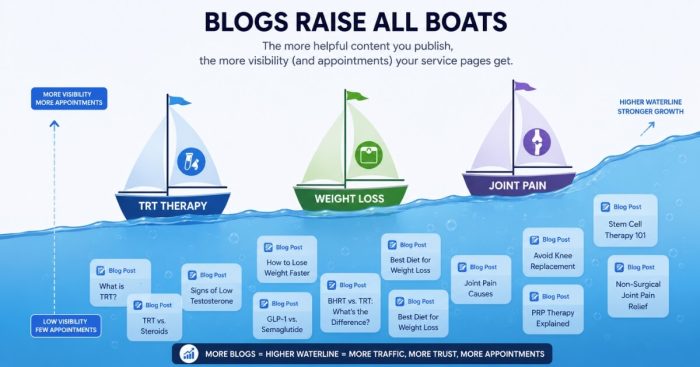
This is why content strategies compound while ad campaigns simply repeat.
Nobody gets there in a month.
However, everybody who gets there passed through a month that looked like 10 leads becoming 47.
Which numbers should I watch each month while my SEO strategy ramps?
Four: website leads, booked patients from organic, ranking breadth, and lead-to-patient conversion rate.
Website leads are the headline metric.
Count every form submission, phone call, and chat that originated from the website, then compare month over month rather than day to day.
Booked patients from organic prove the leads are real people with real intent.
Ranking breadth — how many different search queries your website appears for — measures the rising tide directly.
It should expand every month that a new post goes live.
Lead-to-patient conversion tells you whether your team is keeping up with the new volume, which brings up the number most owners miss in the excitement.
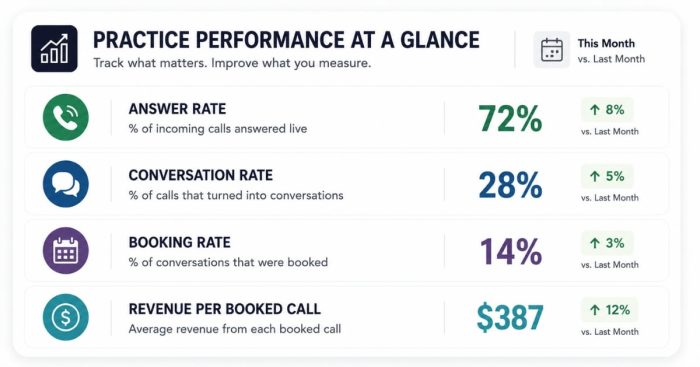
Notice what happened in this clinic’s numbers: 47 leads, 8 booked patients.
That’s the strategy working and a conversion opportunity sitting in plain sight.
When lead volume quadruples, the front desk’s habits — response speed, follow-up cadence, and phone skills — suddenly matter four times as much.
Rising lead volume with flat conversion isn’t a content problem. Instead, it’s the signal to fix the patient acquisition machinery behind the website before you scale traffic further.
What should I do when the early signals appear — scale up, wait, or change something?
Hold the content cadence, fix the conversion bottleneck the new volume just exposed, and resist the urge to redirect budget toward something flashier.
The moment early signals appear is often the moment owners accidentally sabotage the strategy.
Some declare victory and stop publishing. As a result, the tide stops rising just as compounding is about to take over.
Others become impatient with the modest absolute numbers and shift budget into paid ads, starving the channel that was quietly building a durable asset.
The right move is less exciting but far more effective.
Keep the publishing cadence that produced the signal.
Then tighten your follow-up process so more of the new leads become patients.
Finally, give the compounding effect a full two to three quarters to do what it does.
Here’s a practical rule of thumb from the clinics we’ve scaled: when website leads triple, treat it as a conversion audit trigger, not a celebration.
Review how quickly new leads receive a call, what the booking path looks like, and whether your tracking attributes patients to their true source.
Those are the unglamorous parts of medical practice marketing that determine how much of the rising tide your clinic actually keeps.
FAQ’s About Early SEO and Blog Strategy Signals for Clinics
How long does it take for a blog strategy to generate leads for a clinic?
Long-tail, question-focused content can begin generating leads within the first one to two months.
One clinic went from 10 website leads to 47 in a single month after launching its blog strategy.
Competitive head terms take longer. However, the compounding effect builds over two to three quarters.
What’s the first metric that improves when clinic SEO starts working?
Website leads — including form submissions, phone calls, and chats originating from the website — trending up month over month.
This metric moves before revenue, before impressive rankings, and usually before the owner subjectively feels busier.
What is the rising-tide effect in SEO?
Google evaluates entire domains, so every substantive post that answers real patient questions increases your site’s topical authority.
As a result, rankings improve across other pages, including service pages and location pages that never changed.
As the water rises, so do all the boats.
My leads went up but bookings didn’t — is the SEO strategy failing?
No.
The strategy is working, and it has simply exposed a conversion bottleneck.
When lead volume multiplies, front-desk response speed and follow-up cadence become proportionally more important.
Audit how quickly new leads are contacted before changing anything about the content.
What’s the next step?
If you’ve started publishing content and you’re not sure whether the early numbers justify the patience — or you haven’t started because “SEO takes too long” — book a strategy call.
In 60 minutes we’ll look at your current website leads, show you what the ramp looked like at clinics that went from 10 leads a month to a compounding organic engine, and map the publishing-plus-conversion plan for your specialty.