
What Should I Do the First Month My Clinic’s Membership Count Drops? (Two Fixes — One Tech, One Uncomfortable)
“It’s the first time we’ve had a decrease in membership rather than an increase every month. We need to solve it.” That’s how a clinic owner opened a recent consulting call with us — and it’s one of the healthiest sentences a cash-pay owner can say, because the first monthly decline is a signal, not a crisis. The answer we gave was two solutions, applied together: one is a tech fix, and the other one is going to be uncomfortable. Here’s the full FAQ.
Why did my clinic’s membership count drop after months of growth?
Because, for the first time, the members you lost outnumbered the members you added. In a weight-loss or wellness membership, that almost always means patients stopped feeling progress.
Membership count is simple arithmetic: adds minus cancels. When a clinic grows every month and then dips, owners instinctively blame the adds side — leads, ads, or the front desk.
However, in most cases, the adds were fine while the cancels quietly crept up.
Patients cancel a recurring membership for one dominant reason: they no longer feel the program is doing something for them. Either they hit their goal and see no reason to stay, or they stalled and see no reason to stay.
Both exits come from the same root. Nobody at the clinic was watching their progress closely enough to intervene.
That’s why the fix isn’t “more marketing.” Instead, you need visibility into every member’s progress, plus a designed path for the members who succeed.
Those are the two solutions, and you should do them both.
What’s the tech fix — and what two questions should my refill forms ask?
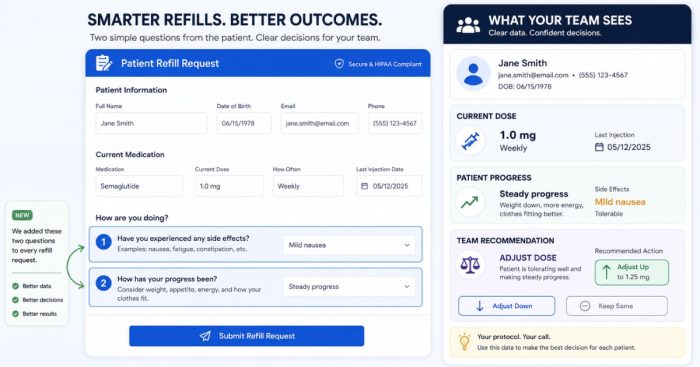
Add two questions to every refill or check-in form:
- “How many pounds have you lost in the last 30 days?”
- “How many more pounds do you want to lose?”
We rolled this exact change out at a weight-loss medspa whose membership growth had flattened.
Before the change, a refill request was just a transaction. The patient asked, the team fulfilled, and nobody looked at the trajectory.
After the change, every refill became a monitoring event.
By looking at one form, the team can now see what dose the patient is taking, how much they lost in the last 30 days, and whether the dose needs to increase or decrease.
For example, a patient who lost nothing in 30 days gets a dose review and a provider touchpoint before frustration turns into a cancellation.
Meanwhile, a patient who is six pounds from goal gets flagged for the maintenance conversation before they cancel on their own terms.
The beauty of this fix is that it costs nothing and deploys in an afternoon inside whatever forms tool your CRM already has.
It converts data you were never collecting into retention interventions your team can actually run.
The same medspa client grew to $6.7M in annual revenue on the back of systems exactly like this one — unglamorous, form-level fixes that keep the machine measurable.
What’s the “uncomfortable” fix that stops membership decline?
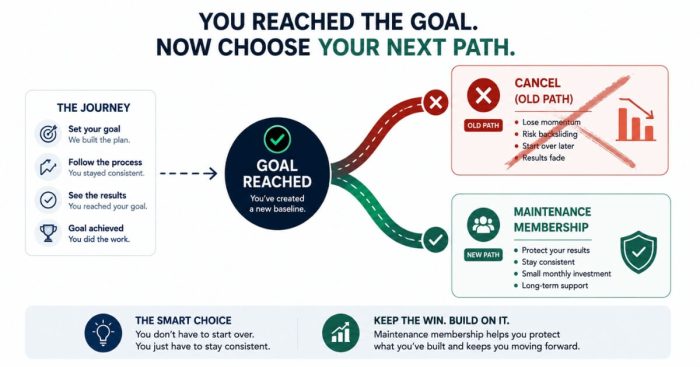
Build a maintenance program — and pre-sell every patient, from day one, on the expectation that they will eventually get off the medication and into it.
This is the fix most owners resist because it feels like planning for revenue loss.
However, it’s the opposite.
The clinic in this story has a maintenance program for members who achieve their weight-loss goal. Instead of the membership ending at goal weight, it transitions into a lower-intensity, lower-cost program the patient expected from the day they enrolled.
The patient was pre-sold with the expectation of getting off the product. Therefore, graduation doesn’t mean goodbye. It means moving to the next phase.
Why is that uncomfortable?
Because it forces an honest standard onto your clinical experience: if we weren’t getting patients to feel good enough that they wanted to stay connected to the clinic, we didn’t do our job.
A maintenance program only works if the patient’s experience made the clinic feel worth keeping.
Owners who dodge the down-sell are usually dodging that mirror.
By contrast, the owners who build it discover the math is decisively in their favor. A maintenance member at a reduced monthly rate, staying for another year and referring friends, is worth far more than a canceled member who “finished.”
Should I really pre-sell patients on eventually getting OFF the medication?
Yes — because it’s clinically honest, it removes the cancellation cliff, and it makes the down-sell feel like a promotion instead of a pitch.
GLP-1 and weight-loss patients all privately ask the same question: “Am I going to be on this forever?”
A clinic that dodges the question creates quiet anxiety and an eventual abrupt exit.
By contrast, a clinic that answers it on the enrollment call — “our goal is to get you to your target, then transition you off the medication into maintenance, where we protect the result” — has just done three things.
It differentiated itself from every script mill.
It set an expectation that makes the month-of-goal conversation natural instead of salesy.
Finally, it reframed the membership from “a drug subscription” into “a supervised journey with phases,” which is what a medical practice actually sells.
This is the same principle that makes membership models work in every cash-pay vertical.
an HRT clinic we work with holds 250 active members at $1,000 a month because the membership is structured as an ongoing relationship with defined phases, not an open-ended bill the patient tolerates until they don’t.
How do I know if the decline is a churn problem or a lead problem?
Split your monthly number into adds and cancels, then compare each against your trailing three-month average. Five minutes in your CRM answers it.
If adds held steady and cancels rose, you have a retention problem. Deploy the two fixes above before touching your ad budget.
If adds fell and cancels held steady, look upstream at lead flow and front-desk conversion.
If both moved the wrong way at once, fix retention first anyway. Pouring new members into a leaking program is the most expensive way to hide a problem.
In addition, rising churn eventually poisons the referral and review engine that feeds your GLP-1 & weight loss clinic marketing results.
The deeper discipline is watching the leading indicators so the drop never surprises you again:
- Pounds lost per member per month (from your new refill forms)
- Members within 10 pounds of goal (your maintenance pipeline)
- Refill requests that arrive late
All three deteriorate 60 to 90 days before the membership count does.
As a result, a clinic that reviews them weekly effectively sees churn coming a quarter early. That’s the difference between managing a trend and reacting to a scare.
FAQ’s About Fixing a Clinic Membership Drop
What should a weight-loss clinic do first when memberships decline?
Add progress questions to every refill form — “How many pounds have you lost in the last 30 days?” and “How many more do you want to lose?” — so the team can see each member’s dose and trajectory and intervene before frustration becomes a cancellation. It’s free and deploys in an afternoon.
What is a maintenance program at a cash-pay clinic?
A lower-intensity, lower-cost membership phase that patients transition into after achieving their goal instead of canceling.
Patients are pre-sold on it from enrollment. The clinic’s stated goal is to get them off the medication and into maintenance, which protects both the patient’s result and the clinic’s recurring revenue.
Why do patients cancel weight-loss memberships?
Two dominant reasons explain most cancellations.
First, they hit their goal and see no reason to stay.
Second, they stall and see no reason to stay.
Both trace back to the same root: no one at the clinic was tracking their progress closely enough to intervene, adjust the dose, or offer the next phase at the right moment.
How can I predict membership churn before it shows up in my numbers?
Watch these three leading indicators every week:
- Average pounds lost per member per month
- The count of members within 10 pounds of goal
- Late refill requests
All three typically deteriorate 60–90 days before the membership count drops.
What’s the next step?
If your membership number just dipped for the first time — or it’s still growing but you have no maintenance program waiting for the members who succeed — book a strategy call.
In 60 minutes we’ll look at your adds-versus-cancels math, set up the refill-form questions for your exact program, and map the maintenance offer your patients should be pre-sold on from day one.