
How to Build a Joint-Pain Google Ads Campaign for a Regenerative Medicine Clinic (Keywords, Offer, Budget — and the Urgency Fix)
This is the actual joint-pain Google Ads campaign we built for a regenerative medicine clinic, explained piece by piece: how the ad groups are structured, which keywords launch first and why, the ad angles that fit a non-surgical clinic, the offer, and the budget math. Plus the uncomfortable second half most agencies skip — what to do when the leads arrive on schedule and then won’t answer the phone.
How should a regenerative clinic structure a joint-pain Google Ads campaign?
Use two types of ad groups:
- Treatment-specific groups
- Condition-specific groups
Then weight the bids based on search intent.
The treatment-specific ad groups include:
- PRP
- Stem cell
- Shockwave
- Prolozone
- Peptides
- Surgery alternatives
Each ad group contains a cluster of closely related keywords with its own advertisements.
The treatment-specific groups capture people searching for solutions by name, including:
- PRP therapy
- Peptides for joints
- Prolozone
- Stem cell treatment
- Shockwave therapy
- Regenerative medicine treatment
The highest-intent cluster is surgery alternatives.
Those keywords include:
- Avoid knee replacement
- Avoid joint surgery
- Alternative to hip surgery
Meanwhile, the condition-specific groups capture symptom searches such as:
- Hip pain
- Shoulder pain
- Knee pain
- Arthritis
- Osteoarthritis
The structure matters because search intent varies widely between these terms.
Therefore, the campaign should pay accordingly.
For example, you should be willing to spend more per click for “avoid knee replacement” than for a broad “knee pain” search.
One patient is actively trying to avoid surgery now.
The other may only be looking for information.
This is the same bottom-of-funnel-first logic behind our regenerative medicine marketing strategy.
Own the ready-to-buy searches before paying to educate browsers.
Which keywords should I launch first — treatments or conditions?
Launch the treatment-specific keywords first.
Start with:
- PRP
- Shockwave
- Prolozone
- Stem cell
- Peptides
- Surgery alternatives
Hold the knee, hip, shoulder, arthritis, and osteoarthritis groups until later.
When we launched this campaign, we intentionally kept the condition-specific groups turned off.
Someone searching for “shoulder pain” could be looking for:
- A massage
- A chiropractor
- A diagnosis
- General information
By contrast, someone searching for “PRP therapy” or “alternative to knee surgery” is much closer to buying.
Those are the clicks most likely to become booked consultations while the campaign is still learning.
The launch budget was $50 per day.
Over the first 21 days, the expectation was that the campaign would gather enough data to optimize.
That meant:
- A few ad-level conversions
- A few booked consultations
- Enough search-term data to guide the next decisions
The correct mindset starts with patient lifetime value.
Once the campaign reaches roughly $1,000 in spend, the test may feel uncomfortable.
Then remember that one regenerative medicine patient is typically worth $5,000–$7,000 to the clinic.
That changes how you interpret the risk.
A pain practice we work with turned that patient math into $2,095,039 of added revenue in 10 months.
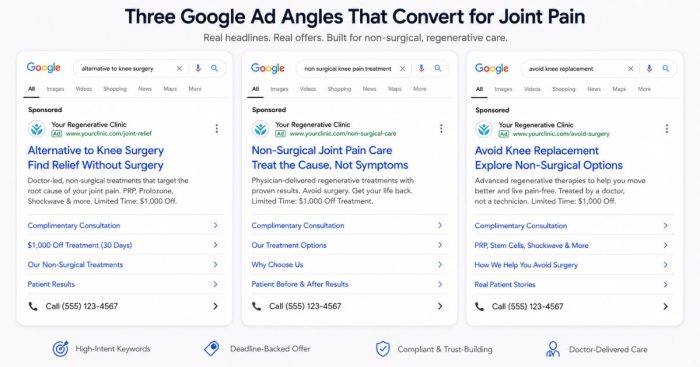
What ad angles work for non-surgical joint pain?
Position the clinic against the alternatives patients already distrust.
Examples include:
- “Cancel your joint surgery today.”
- “Stop getting cortisone shots.”
- “Treated by a doctor, not a technician.”
The strongest regenerative advertisements don’t lead with a treatment modality.
Instead, they offer an escape from a path the patient already fears.
Strong angles include:
- Alternative to knee surgery
- Non-surgical joint-pain care
- Joint surgery versus our approach
Many patients have already been told surgery is their next step.
The advertisement simply names the alternative.
Secondary angles can reinforce credibility, including:
- Top-rated non-surgical joint-pain specialists
- Physician-delivered care
- A complete treatment menu
That treatment menu may include:
- PRP
- Prolozone
- Shockwave
- Peptides
- Regenerative cell therapy
One compliance rule applies to every regenerative campaign.
Never imply FDA approval where it doesn’t exist.
Not every regenerative treatment is FDA approved.
Therefore, the landing page should contain a clear disclaimer, while the headlines should avoid approval claims entirely.
That approach does not reduce conversions.
However, it does protect the practice.
Both advertising platforms and regulators review these pages.
This is a standard safeguard in pain management marketing, where the audience is older, in pain, and understandably skeptical.
What offer should a joint-pain campaign run?
Use a complimentary first consultation paired with a dollar-value incentive and a deadline.
For this clinic, the offer was:
- A complimentary consultation
- $1,000 off treatment
- The offer had to be claimed within 30 days
The complimentary consultation removes the first barrier.
Patients risk nothing to find out whether they’re candidates.
The $1,000 discount solves a different problem.
It creates urgency.
Joint pain often lacks natural urgency.
A patient may have lived with a bad knee for several years.
As a result, waiting one more month feels easy.
Without a reason to act now, interested leads can delay indefinitely.
That’s why the expiration matters more than the discount itself.
The message becomes:
“Claim your $1,000 off — complimentary consult within 30 days.”
That turns a vague future decision into a decision for this month.
The offer should also appear beyond the landing page.
Front-desk voicemails and texts should lead with it.
For example:
“We’d love to get you in for a limited-time offer — $1,000 off and a complimentary consultation.”
That’s much stronger than:
“We’re returning your inquiry.”
A financial incentive with a clear end date is one of the most reliable urgency tools a clinic controls.
Why are good ad leads not answering the phone — and how do I fix it?
Because nothing in the follow-up gives them a reason to answer now.
Fix three things:
- Rewrite the first automated text.
- Lead with the deadline-backed offer.
- Continue calling because the leads are real.
Here is what happened with this campaign.
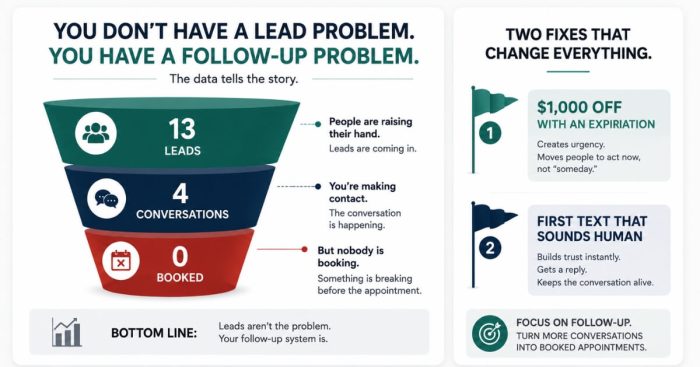
During the first two weeks, the clinic generated:
- 13 leads
- 0 booked consultations
The coordinator was following up correctly.
She:
- Called within minutes
- Reached one lead within four minutes
- Left voicemails
- Sent texts immediately afterward
She reached four of the 13 leads.
Normally, the clinic would expect to reach at least half.
However, the leads themselves were legitimate.
We could verify:
- The exact keywords that generated them
- Local area codes
- Genuine treatment interest
- A verified caller ID that wasn’t appearing as spam
These were also Google leads.
They actively searched for a solution.
They weren’t Meta users interrupted while scrolling.
Therefore, the problem wasn’t lead quality.
It wasn’t effort either.
The missing ingredient was urgency.
The patient submitted the form and mentally categorized the problem as:
“Whenever.”
The first fix was rewriting the automated opening text.
The existing message sounded:
- Bland
- Automated
- Robotic
Only two of eight leads replied to it.
The new version needed to sound as if a real person had written it.
It also needed to lead with the deadline-backed offer.
The second fix was using assets the clinic already had.
When a prospect asked about outcomes, the team should immediately send the before-and-after link.
Timing also mattered.
Most leads arrived:
- Shortly after closing
- During weekends
That creates a strong case for automated follow-up that responds immediately when a team member cannot.
Clinics that combine fast, human follow-up with real urgency consistently book the patients other practices lose.
That’s the difference between merely buying ads and operating a patient acquisition system.
Should I launch a new campaign or scale the one that’s working?
Do more of what works first.
Then improve it.
Only after that should you add something new.
When we finished building this joint-pain campaign, we asked one important question:
“Why are we launching a different campaign when we already have one that’s working?”
This follows the Hormozi sequence:
- Do more.
- Do it better.
- Add new things.
The clinic already had a body-contouring campaign that was converting well.
Therefore, the default move was to continue feeding that campaign.
Specifically, it was a liposuction campaign at the same practice that produced leads at $88.54 and booked consultations at $447.
However, there was a strategic reason to launch the joint-pain campaign.
The existing body-contouring campaign was seasonal and heading into its summer slowdown.
Joint pain is not seasonal in the same way.
That made the new campaign a deliberate expansion rather than a distraction.
A strategic reason is valid.
Boredom is not.
Before launching anything new, ask whether the additional budget would produce more value inside a campaign that’s already converting.
That discipline may feel repetitive.
However, it is also how a regenerative practice we work with generated $309,590 in cash-pay revenue in 10 months without paid ads at all, by relentlessly compounding one working channel.
FAQ’s About Joint-Pain Google Ads for Regenerative Clinics
What budget do I need to test a joint-pain campaign?
Start with approximately $50 per day for 21 days.
That equals roughly $1,000 in total spend.
This amount gives the campaign enough time to:
- Gather initial conversion data
- Identify useful search terms
- Produce early consultation bookings
- Begin optimizing
Judge the test against patient lifetime value.
One regenerative patient worth $5,000–$7,000 can pay for several unsuccessful tests.
Are Google leads better than Facebook leads for regenerative medicine?
Generally, yes.
Google leads actively searched for a solution.
You can also see the exact keyword they used.
By contrast, Meta leads are usually interrupted while scrolling.
As a result, they often show:
- Lower answer rates
- Lower booking rates
- Lower show rates
That doesn’t mean Meta cannot work.
It simply means Google traffic usually starts with stronger intent.
Can my ads say regenerative treatments are FDA approved?
No.
Only make that claim when the specific treatment is actually FDA approved.
Keep approval language out of the headlines.
Also, include a clear disclaimer on the landing page.
You can still use strong credibility angles, such as:
“Treated by a doctor, not a technician.”
That message builds confidence without creating unnecessary compliance risk.
How fast should we call a new joint-pain lead?
Immediately.
Call within minutes, not hours.
Then:
- Leave a voicemail.
- Send a text immediately afterward.
- Continue following up.
However, speed alone isn’t enough.
The voicemail and text should clearly mention the deadline-backed offer.
Otherwise, fast follow-up simply means the lead ignores you sooner.
What should the first automated text to a new lead say?
Write something a real person would plausibly send.
Include:
- The lead’s name
- Who you are
- The limited-time offer
- One simple question
Avoid messages that sound automated or overly polished.
This clinic saw only two of eight leads respond before the message was rewritten.
The first text should feel human, useful, and easy to answer.
What’s the next step?
If your regenerative clinic is generating legitimate leads that won’t answer the phone—or you’re preparing to launch joint-pain ads without the right keyword structure, deadline-backed offer, and follow-up process—book a strategy call.
In 60 minutes, we’ll:
- Map your campaign structure.
- Set the test budget against your actual patient lifetime value.
- Review your offer and deadline.
- Rewrite the first-touch messages that determine whether leads become consultations.