
How Does a Local Wellness Clinic Win GLP-1 and TRT Patients With Local SEO? (Citations, Neighborhood Pages, and Pricing the Offer)
An IV therapy clinic we work with watched its Google Business Profile calls drop from six a month to three — while its brand-new website was already producing weight-loss and peptide leads it didn’t expect. The diagnosis and the fix came out of one strategy call: citation problems were suffocating the map rankings, neighborhood pages would extend its reach, and the new GLP-1 and TRT inquiries needed properly priced offers waiting for them. Here’s the whole playbook.
Why did my clinic’s Google Business Profile calls drop?
Almost always: citation problems — inconsistent name, address, and phone data scattered across the directories Google checks.
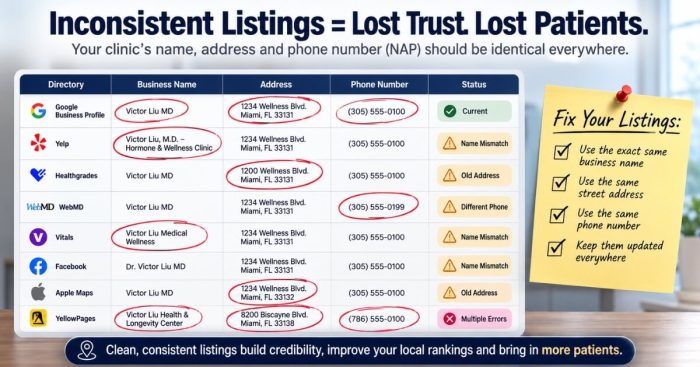
This clinic’s audit found textbook damage.
An old mailing address from a previous location popping up all over the place.
Different phone numbers from the past couple of years.
Two different business names in circulation — the brand with “Denver” appended, and the brand without.
And four listings on a single directory that somebody else had claimed, all different, all wrong, requiring a formal dispute just to get access.
Google cross-references every mention of your business across the web, and every mismatch erodes its confidence in who you are and where you are.
The result is exactly what this clinic saw: a profile sitting just under the cusp of the map pack, with calls sliding from six a month to three.
Nothing about the clinic got worse — its data hygiene simply lost to competitors with cleaner citations.
How do I fix my clinic’s local citations?
Audit every directory, dispute wrongly claimed listings, and standardize one exact name, address, and phone everywhere.
The work is unglamorous and effective.
First, inventory every citation — the majors plus the long tail of local directories — and record every variant of your name, address, and phone number you find.
Second, claim or dispute what you don’t control; where someone else has claimed your listings, file the disputes and follow them through.
Third, correct everything to a single canonical NAP:
- One business name
- No city suffixes unless that’s your legal brand
- The current address
- The current tracking-safe number
Expect the process to take weeks, not hours — disputes are slow, and Google recrawls on its own schedule.
But this is foundational patient acquisition infrastructure: every dollar you spend on ads and content works harder when the map listing underneath it is trusted.
Do neighborhood and city pages actually help a local clinic rank?
Yes — for the suburbs patients will actually drive from.
Build a page template once, then publish a page for each nearby city and neighborhood.
The key discipline is honest geography.
When we read a statewide city list to this clinic’s owner, most of it failed the driving-distance test:
- Colorado Springs
- Aurora
- Fort Collins
- Greeley
- Loveland
All too far.
What survived was the true service area:
- Lakewood
- Thornton
- Arvada
- Westminster
Those are the pages worth building, because they match searches real prospective patients make — “IV therapy Arvada,” “TRT clinic Westminster” — and Google rewards location pages that correspond to genuine service areas rather than SEO wishcasting.
Each page follows the same template:
- The service
- The location
- Directions and service notes specific to that area
- The booking path
Combined with citation cleanup, this is what moves a profile that’s “just under the cusp” into the map pack.
That kind of local visibility isn’t limited to major metros. One regenerative practice reached an average search position of 4 in a small North Dakota market.
And the payoff compounds — an HRT clinic we rebuilt this way grew organic traffic from 80 to 1,000+ visitors a month, which now drives $1.7M a year in membership revenue from SEO alone.
How should a wellness clinic price a GLP-1 weight-loss offer?
À la carte monthly memberships, priced by dose — tirzepatide typically runs $400–500 a month, entry pricing around $325, scaling roughly $50 per 2.5mg as the dose increases.
When this clinic’s new website produced a tirzepatide lead out of nowhere, the owner’s honest reaction was “I’m not sure what to do with this.”
The structure we gave him: run a discovery call, free or paid, to learn the patient’s goals.
You can’t quote precisely without knowing the dose, and most patients start at 2.5mg.
Then deliver through a dropship pharmacy, the easiest, most hands-free fulfillment model — medication ships directly to the patient, and your clinic manages the protocol.
For pure weight-loss injections, most operators keep it simple:
- Monthly membership pricing
- Labs optional
- Strong margins at the $400–500 price point
Some clinics require labs and use them as a future upsell.
Weight loss works à la carte in a way hormones don’t, because the patient’s goal is finite.
The deeper program design — what happens at goal weight, cross-sells, retention — is its own discipline inside GLP-1 & weight loss clinic marketing, but the entry offer is this simple.
How should I price TRT — volume model or concierge model?
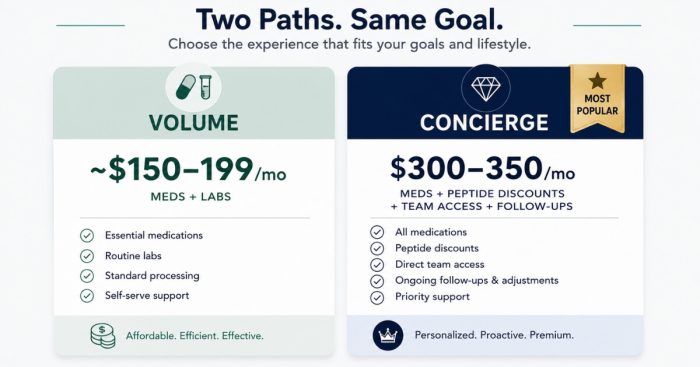
Pick a lane: volume at $150–200/month for men who want their meds and to be left alone, or concierge at $300–350/month with real included value.
Don’t price concierge without building the value.
The honest market context: men can get TRT for under $200 a month in most places, and plenty of clinics run a good business there — around $225 for the initial visit with blood work, then roughly $150 a month including labs every three months.
There’s nothing wrong with the volume lane; a lot of guys just want their stuff.
If you want the higher-paying clientele — the concierge, biohacker-longevity experience — you have to earn the $300–350 price with included value:
- Discounted peptides
- Direct access to the team
- Follow-up consultations built in
A clean way to get there: launch meds-only at $175–225 a month, build a base of 20–30 members, then raise the price as you add the value layer.
Either way, run the standard TRT lab cadence:
- Initial
- 30 days
- 90 days
- 6 months
- One year
Dose adjustments live in those first two follow-ups.
Add-ons create margin too: mobile phlebotomy for roughly a $75 upcharge sells well to busy professionals, and one clever clinic we saw lists mobile prices as the default with a 20% discount for coming in.
Positioning, pricing, and the patient math are the core of men’s hormone clinic marketing — the lane you pick determines everything downstream.
What stops new GLP-1 and TRT leads from becoming patients?
Three killers:
- No deposits
- No pipeline stages
- Replies that pitch before they connect
Deposits first.
This clinic’s own data: without deposits, bookings don’t show.
A national comparison from our network is starker — an AI voice agent booked 26 appointments for one practice, and two showed up, because the AI couldn’t take deposits.
Meanwhile, the clinic’s paid consults — deposit-backed — ran four booked, three showed.
When one lead refused a deposit citing scam fears, the correct answer was exactly what the owner said:
- Point to the reviews
- Hold the policy
- “We’re here if you change your mind.”
Pipeline stages second.
If every lead sits stacked in “prospects,” you can’t see whether the constraint is:
- Lead volume
- Contact rate
- Booking rate
- Show rate
- Close rate
Move every lead through:
- Called
- Talking
- Booked
- Showed
- Bought
Then the bottleneck identifies itself.
Replies third.
When a lead writes in with a complicated situation, don’t go straight to the pitch.
Open with empathy, ask how long they’ve dealt with the issue, and start a dialogue — the pitch lands later and better.
Fast responses win, but fast and human wins bigger.
Do these three while the SEO compounds, and the growth math works the way it did for a wellness practice whose website leads grew 900% with 100+ new inbound calls a month inside four months.
FAQ’s About Local SEO for GLP-1 and TRT Patients
What is a citation problem in local SEO?
Any inconsistency in your clinic’s name, address, or phone number across online directories — old addresses, multiple phone numbers, name variants, or listings claimed by someone else.
Google reads the mismatches as uncertainty and quietly suppresses your map ranking.
How many neighborhood pages should a clinic build?
One per city or neighborhood patients will realistically drive from — typically 4–8 pages for a metro clinic.
Build from a single template and be honest about your service area; pages for cities an hour away don’t rank and don’t convert.
What should a clinic charge for tirzepatide?
Market entry pricing starts around $325 a month, with $400–500 the normal range, scaling roughly $50 per 2.5mg dose increase.
Quote after a discovery call — you can’t price accurately without knowing the starting dose and the patient’s goals.
Is $150-a-month TRT sustainable?
Yes, as a volume play — roughly $225 for the initial with blood work, then about $150 a month with labs quarterly.
It just can’t pretend to be concierge.
If you want $300–350 a month, include real value:
- Peptide discounts
- Team access
- Built-in follow-ups
Should I require deposits for consultations?
Yes.
Deposit-backed bookings show up; free bookings evaporate — one practice saw 2 of 26 AI-booked, deposit-free appointments attend.
If a lead refuses a deposit, point to your reviews, hold the policy, and leave the door open.
What’s the next step?
If your Google Business Profile calls are sliding, your citations are a mess from old addresses and phone numbers, or new GLP-1 and TRT leads are arriving before your offers are ready — book a strategy call.
In 60 minutes we’ll:
- Audit your local presence
- Map the neighborhood pages worth building
- Structure the weight-loss and hormone offers those searches should land on