
Should a Cash-Pay Clinic Collect the Full New-Patient Fee Up Front? (The $899 Prepay Strategy, Word-for-Word)
When we told a functional medicine clinic’s team they’d be collecting the full $899 new-patient fee before the first visit — not a deposit, all of it — the office manager’s first question was the one every owner asks: “Do you think people will actually do that?” They do. You just ask. This article is the working playbook from that clinic: why prepay works, the exact close line, the pushback rebuttals, and what happened to bookings when the price went up $100 at the same time.
Should my cash-pay clinic collect the new-patient consult fee up front?
Yes.
Collect the full fee when the appointment is booked.
Established cash-pay clinics routinely collect between $600 and $900 before the patient’s first visit.
This isn’t an experiment.
It’s a common structure throughout cash-pay medicine.
For example:
- One clinic in our network collects $600 up front.
- An HRT practice we’ve worked with for years collects $900 up front on new patients — the same practice that grew from $1M to $4M a year.
The patient was going to spend the money either way.
Collecting payment at the time of booking simply moves the sales cycle forward.
The key idea is this:
Prepayment isn’t just about receiving money sooner.
It’s about creating commitment.
A patient who has already paid is far more likely to:
- Show up
- Complete laboratory testing
- Arrive at the consultation ready to become a patient rather than continue shopping
Collecting payment early also allows the clinic to begin work immediately.
Laboratory testing can be ordered right away.
Instead of waiting, progress begins immediately.
How do I ask for $899 up front without scaring patients away?
Frame the payment as the beginning of care.
Not as the purchase of an appointment.
Use this exact closing question:
“Would you like me to go ahead and order your labs and schedule your initial consultation?”
That’s the working close.
Avoid phrases like:
“Would you like to reserve your spot in our personal health restore program?”
That language sounds overly sales-oriented.
Patients notice.
The stronger approach is concrete and clinical.
Talk about actions the clinic will immediately take on the patient’s behalf, including:
- Ordering laboratory testing
- Ordering functional medicine testing
- Scheduling the physician consultation
The prepaid fee also needs to include visible value.
In this clinic’s offer, the $899 covers:
- A comprehensive laboratory panel
- A functional saliva test
- A live blood analysis
- A full 60-minute physician consultation
Testing kits are mailed immediately.
Patients don’t spend weeks waiting to begin.
When the clinic increased the first-visit fee from $799 to $899, those diagnostics became part of the package.
The price increased by $100.
The perceived value increased by much more.
What do I say when a patient pushes back on paying everything up front?
Use this response:
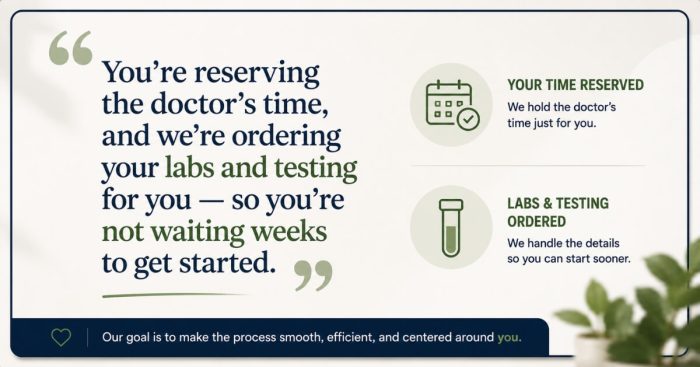
“You’re reserving the doctor’s time, and we’re ordering your labs and testing for you — so you’re not waiting weeks to get started.”
That’s the rebuttal.
It works because it’s true.
The fee isn’t simply reserving a place on the calendar.
It immediately pays for real work, including:
- The physician’s reserved time
- Laboratory requisitions
- Testing kits shipped directly to the patient’s home
When delivered naturally, the conversation shifts.
Instead of asking:
“Why do you need my money now?”
the patient begins seeing everything that starts happening the moment they commit.
Two additional points help the front desk deliver this confidently.
First, this structure is normal.
Cash-pay clinics commonly collect between $600 and $900 before the initial appointment.
Second, commitment also protects the patient’s outcome.
Patients who prepay are more likely to:
- Complete testing
- Attend appointments
- Achieve better results
Ultimately, confidence is the real script.
A team member who genuinely believes the process is fair communicates that confidence naturally.
Should new patients run their labs through insurance instead?
No.
The clinic uses one simple response:
“It’s not that we don’t want to work with insurance; we’ve just found it usually ends up more expensive than letting us order the labs for you.”
Patients often assume insurance automatically saves money.
However, this clinic repeatedly found the opposite.
Patients who ordered laboratory work through their insurance sometimes received unexpected bills worth several thousand dollars.
Meanwhile, the same laboratory panel ordered directly through the clinic cost approximately $300 and was already included in the consultation fee.
One example from the original discussion involved a patient whose insurance quoted $3,500 for laboratory testing the clinic had already covered.
The script remains honest and low-pressure:
“By all means, if you’d like to try your insurance, feel free — but patients have ended up with surprise bills of a few thousand dollars, where it’s $300 for labs through us, included in your visit.”
There’s no argument.
There’s no lecture about insurance.
Just the numbers.
Patients usually reach the conclusion themselves.
Operationally, this also creates a cleaner process for the clinic.
You’re no longer navigating insurance approvals in the middle of your patient acquisition pipeline.
How does collecting up front shorten the sales cycle into programs?
The old process looked like this:
- Consultation
- Labs
- Second consultation
- Program presentation
The new process is much shorter.
Patients pay when they book.
Their laboratory testing is completed before the first appointment.
Then the physician presents the program during the very first consultation—with results already available.
That’s the real advantage.
When patients arrive for their 60-minute consultation, the diagnostic information already exists.
The conversation is built around their results rather than postponed until a second visit.
The physician also introduces pricing before the front desk discusses numbers.
For example:
“We have programs varying between $350 and $1,600 a month depending on how much support you want or need.”
Because pricing has already been introduced, it doesn’t feel unexpected later in the conversation.
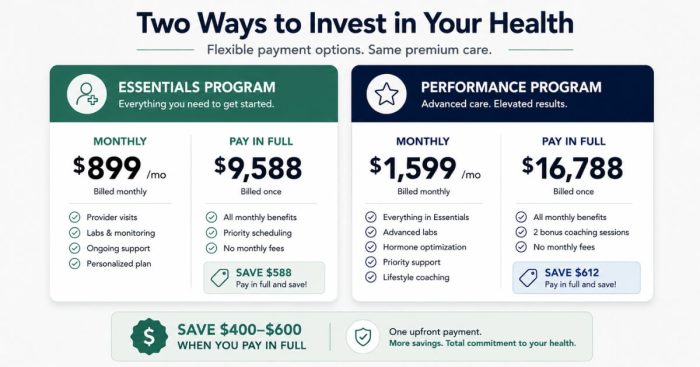
The clinic presents two six-month programs:
- $899 per month
- $1,599 per month
The higher-priced option serves two purposes.
It exists for patients who genuinely want the most comprehensive level of support.
It also positions the core program as the sensible choice.
Each program is offered with two payment options:
- Monthly payments
- Pay in full
Patients who pay in full save approximately $400–600.
Third-party financing also makes full payment more accessible.
With 0% financing for 12–15 months (for qualified applicants), the clinic receives the full payment immediately while the financing company manages the patient’s monthly payments.
This is the offer structure we build through functional medicine & longevity clinic marketing:
- Anchored pricing tiers
- Clearly named inclusions
- Simple payment pathways
What keeps prepaid program patients from cancelling halfway through?
Include the treatments patients actually want.
Communicate proactively.
Always keep a down-sell option available.
The biggest complaint under the clinic’s previous $799-per-month program sounded like this:
“I’m already paying $800 a month, and you’re asking me to pay for all this other stuff she recommends.”
The solution was straightforward.
The clinic included hormones and peptides directly inside the new programs.
These were the same treatments patients had previously been purchasing separately.
The programs also added member discounts, including:
- 10% off supplements
- 10% off testing
- 10% off treatments
For example, a $5,000 exosome treatment saves a member $500.
For engaged patients, those discounts can nearly offset the cost of membership.
Retention also becomes proactive.
Instead of waiting for patients to reach out, the clinic schedules communication at:
- Two weeks
- Four weeks
- Six weeks
- Eight weeks
- Twelve weeks
Proactive communication consistently outperforms reactive communication.
Patients appreciate accountability.
Even with strong programs, some monthly patients eventually realize they don’t need the highest level of support.
Rather than losing them completely, the clinic offers a maintenance option.
The maintenance tier ranges from $349–549 per month and includes:
- Hormones
- Peptides
- Ongoing access to the care team
Patients continue receiving the services they value most while remaining active within the practice.
The results reflected the new structure.
Monthly bookings increased from:
- 9 new patients in August
- 17 in September
- 25 in October
This growth occurred even after the upfront consultation fee increased.
FAQ’s About Collecting the New-Patient Fee Up Front
How much do cash-pay clinics typically collect before the first visit?
Established cash-pay clinics commonly collect between $600 and $900 before the initial appointment.
One clinic we work with collects $600.
Another collects $900.
The amount itself matters less than the structure.
Collect the full fee at booking.
Then order laboratory testing immediately.
Do patients really pay $899 before meeting the doctor?
Yes.
You simply ask.
The clinic featured in this article increased its first-visit fee from $799 to $899 while moving payment collection to the time of booking.
During the same three-month period, monthly new-patient bookings increased from 9 to 25.
What should the prepaid fee include?
The value should be obvious.
This clinic includes:
- A comprehensive laboratory panel
- A functional saliva test
- A live blood analysis
- A 60-minute physician consultation
Testing kits are mailed immediately so care begins the day payment is received.
Should I offer financing on programs?
Yes.
Use a third-party medical financing provider with 0% promotional terms for 12–15 months for qualified applicants.
The clinic receives payment in full immediately.
The patient pays through the financing company.
Offering a $400–600 savings for paying in full also encourages that option.
Should I call it a membership or a program?
Call it a program.
A membership sounds like paying for access.
A program sounds like a personalized clinical recommendation with:
- A beginning
- A structured plan
- A defined outcome
The mechanics are identical.
The positioning is much stronger.
What’s the next step?
If your current sales process still follows the sequence of consultation, labs, second consultation, and then the program presentation—or your front desk collects deposits instead of full commitment—book a strategy call.
In 60 minutes, we’ll:
- Restructure your new-patient offer.
- Clarify exactly what’s included.
- Determine what should be collected up front.
- Give your team the exact closing and rebuttal scripts they need to present the process confidently.