
The 4 Business Laws Every Cash-Pay Clinic Owner Learns the Hard Way (Bought & Learned Lessons)
Some lessons in a cash-pay practice are learned. The expensive ones are bought — paid for in burned-out staff, quit-too-early campaigns, and toxic hires kept six months too long. This article is the bought-and-learned list: four old business laws — Averages, Sowing & Reaping, Association, and Reciprocity — and exactly how each one shows up in a clinic that’s trying to grow.
What is the Law of Averages in a cash-pay clinic — and why does it prevent team burnout?
If you do something often enough, a ratio will appear.
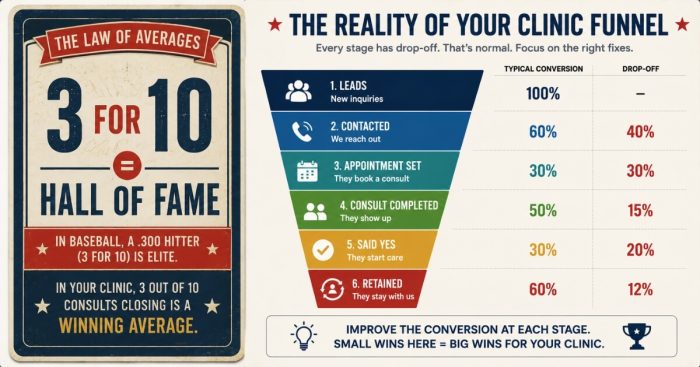
A clinic team that closes 3 out of 10 patients on programs and treatment is doing very well.
Baseball illustrates the idea perfectly.
In Major League Baseball, the ratio is called a batting average.
A hitter who strikes out 7 out of 10 times can still end up in the Hall of Fame.
Business follows very similar math.
If your patient coordinator closes 3 out of 10 consultations on a high-ticket program, you don’t have a sales problem.
Instead, you have a Hall-of-Fame closer.
The most important part of this law isn’t the math.
It’s morale.
When no one explains the expected ratios, team members quietly assume that every lead should:
- Answer the phone
- Book an appointment
- Show up
- Pay for treatment
Reality doesn’t work that way.
When only 3 out of 10 move forward, the team begins believing they’re failing.
That’s how burnout starts.
Instead, manage expectations at every stage.
Track and communicate:
- Answer rate
- Booking rate
- Show rate
- Close rate
Then the same numbers that once discouraged your team become evidence they’re performing exactly as expected.
A regenerative practice we work with converted 79.4% of its leads into booked appointments — and that ratio is tracked, published to the team, and celebrated.
That’s precisely why the number stays high.
What is the Law of Sowing & Reaping for a medical practice?
Plant good seed in good soil.
Water it.
Give it sunlight.
Eventually, it grows.
However, many of the variables remain outside your control.
You still have to keep planting.
Sometimes the seed isn’t great.
Other times, the soil isn’t.
Some years don’t bring enough rain.
Other seasons don’t bring enough sunlight.
Marketing behaves the same way.
A campaign can be built well and still encounter:
- A slow market
- A seasonal downturn
- An algorithm update
- External factors you didn’t create and can’t control
The lesson isn’t to control the weather.
The lesson is to keep planting the best seed possible.
Clinic owners usually struggle with this law when they launch one campaign, experience a difficult quarter, and conclude that:
- Advertising doesn’t work.
- SEO doesn’t work.
- Content marketing doesn’t work.
- Their market is simply different.
Successful owners take a different approach.
They continue planting every season.
Some harvests are smaller than others.
Over time, however, the combined results continue to grow.
That’s the patience behind every durable medical practice marketing system we build.
Keep planting.
Measure honestly.
Don’t panic during cloudy seasons.
What is the Law of Association & Influence — and how does it explain staff turnover at clinics?
You become the average of the five people you spend the most time with.
The same principle applies to your team.
We’ve worked with physicians who consistently carried negative, problem-focused attitudes.
After meeting their teams, the pattern became obvious.
The staff often:
- Had poor attitudes
- Weren’t excited to come to work
- Showed inconsistent attendance
- Experienced constant turnover
That’s rarely just a hiring issue.
It’s usually the Law of Association flowing downhill from leadership.
The law works in two directions.
First, it applies to you.
Become the leader who is continually improving.
Teams are inspired when they watch the owner grow.
The opposite rarely produces the same effect.
Second, it applies to everyone around you.
One toxic employee influences every person nearby.
If you truly have a toxic team member, the real cost isn’t one position.
It’s the attitude of everyone sitting beside them.
Remove that influence as quickly as possible.
Every month you wait changes the average your strongest employees become.
What is the Law of Reciprocity — and how does a cash-pay clinic use it to get patients?
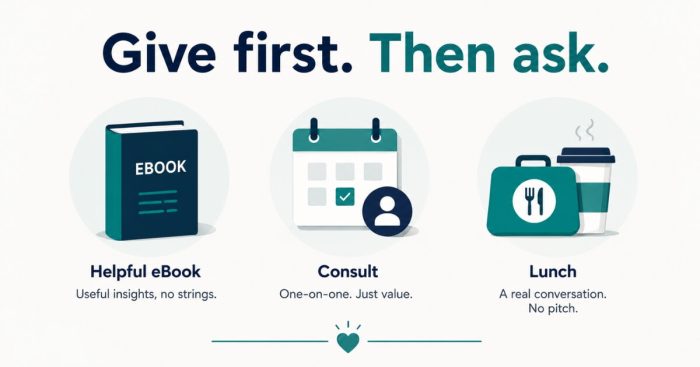
Give first.
Then it becomes much more likely you’ll receive.
Inside a clinic, that means delivering genuine value before making any request.
The original lesson shares three practical examples.
First, provide a free educational ebook.
It teaches patients something valuable before they’ve spent a dollar.
Second, offer a free consultation.
It’s a simple gesture that shows patients you value their time.
Third, buy lunch for your team.
Doing so strengthens relationships and often inspires people to give more effort without being asked.
Giving first also builds authority at scale.
Patients respond to value with trust.
Then they respond to trust with bookings.
The original lesson also states the principle directly.
Giving away your knowledge at a low cost—hoping clinics succeed and later hire you—is itself an example of the Law of Reciprocity in action.
How do I actually apply these four laws in my clinic this month?
Publish your ratios.
Keep planting.
Audit your influences.
Choose one thing to give away.
Each law becomes practical when you turn it into a monthly habit.
Law of Averages
Write down your actual numbers this month.
Track your:
- Answer rate
- Booking rate
- Show rate
- Close rate
Then share those numbers with your team.
When everyone understands the expected ratios, closing 3 out of 10 no longer feels like failure.
It feels like success.
Law of Sowing & Reaping
Think about the marketing channel you abandoned too early.
Now commit to two more planting seasons before deciding whether it truly works.
Consistency often wins where impatience fails.
Law of Association & Influence
Identify the strongest negative influence inside your clinic.
If it’s a team member, begin the exit process.
If it’s you, begin the personal work.
Either way, don’t ignore it.
Law of Reciprocity
Choose one give-first asset and launch it before the end of the month.
For example:
- A free educational ebook
- A free consultation
- A monthly team lunch
None of these actions require new software.
None require additional staff.
They simply require the owner to believe that timeless business principles still apply to modern clinics.
The practices that continue compounding year after year are the ones that act like they do.
FAQ’s About the 4 Business Laws for Clinic Owners
What’s a good close rate for high-ticket cash-pay programs?
Closing around 3 out of 10 consultations on a treatment plan or high-ticket program is considered very strong.
According to the Law of Averages, that’s Hall-of-Fame performance.
If your close rate consistently exceeds that level, consider increasing prices or generating more consultation volume.
If it’s significantly lower, evaluate lead quality and your consultation process before assuming the closer is the problem.
How do I keep my front desk motivated when most leads don’t answer the phone?
Tell them the expected ratios before they start.
Burnout usually comes from unrealistic expectations—not from the work itself.
When your team understands how many calls typically lead to one booked appointment, unanswered calls become part of the process instead of evidence they’re failing.
What should I do about one negative team member?
Move quickly.
A single negative employee influences everyone around them.
According to the Law of Association, even your strongest team members gradually become an average that includes that person’s attitude.
Coach honestly.
Give them an opportunity to improve.
If nothing changes, exit them promptly.
What should my clinic give away first?
Begin with something educational.
A free ebook or guide that answers your patients’ most common questions is an excellent starting point.
Then pair it with a free or low-barrier consultation.
Both provide meaningful value before asking the patient to make a commitment.
That’s what activates reciprocity.
Do these laws replace marketing?
No.
They create the conditions that allow marketing to succeed.
Advertising and SEO fill your funnel.
These four laws determine whether your team converts those opportunities, survives slow seasons, and builds the kind of culture patients notice.
What’s the next step?
If your team is burning out because they expect impossible ratios—or you’ve spent years starting and stopping marketing channels without seeing long-term growth—book a strategy call.
In 60 minutes, we’ll:
- Review your actual funnel metrics.
- Set realistic performance ratios for your team.
- Identify the give-first asset most likely to fill your calendar first.