
Do Blog Posts Actually Matter for a Cash-Pay Clinic’s SEO? (What We Found When a Client Clicked His Own Blog)
On a weekly strategy call with a cash-pay longevity clinic in one of the most competitive markets in the country, the owner’s teammate texted him mid-meeting: “Every time you click a blog post, it leads to an article about the New World Order.” The finished articles existed—they’d just never made it from the development site to the live one, so the blog was serving placeholder junk under a real staff byline. Here’s why that mattered enough to fix within the hour, what blogs actually do for a clinic’s rankings, and the 10-minute audit every practice owner should run this week.
Do blog posts actually matter for a cash-pay clinic’s SEO?
Yes.
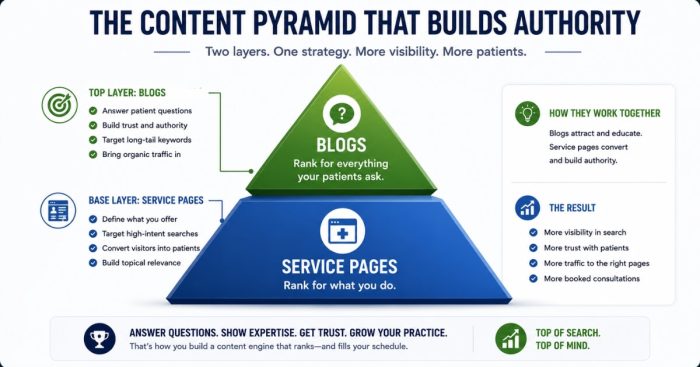
Once your service pages exist, blogs become the majority of your SEO strategy moving forward.
Service pages do the first job.
They tell Google what you do and where you do it.
Because of that, a clinic can begin ranking using service pages alone.
That’s exactly what happened with the clinic in this story.
It was already “doing pretty well for not really putting too much focus on it other than putting the pages up.”
However, service pages only cover the limited number of searches that mention your services directly.
Blog posts cover everything else your patients actually search for, including:
- Symptoms
- Comparisons
- Costs
- “Is this right for me?” questions
That was why the assessment during the strategy call was so direct.
The majority of the SEO strategy moving forward would be blogs.
Ironically, the clinic’s blog was completely wrong at that moment.
Service pages put you on the map.
Blogs help you take territory.
That’s especially true in highly competitive markets.
The scale of that visibility can build quickly with consistent publishing. One regenerative practice generated 5.14 million search impressions in the first 10 weeks of a publishing program.
This layered approach is the foundation of medical practice marketing that compounds instead of plateauing.
What did the owner find when he clicked his own blog?
He found published placeholder content.
The live blog contained filler articles with no connection to the clinic, all published under a real staff byline.
The real articles had already been written.
They were sitting in a folder waiting to go live.
However, while the website was still under development, placeholder blog posts had been published instead.
The finished articles never made it to the live website.
As a result, every blog URL served dummy content to both patients and Google.
Fortunately, the fix took less than an hour.
The problem was simply that nobody had clicked the live posts.
That moment highlighted two important lessons.
First, filler content isn’t harmless.
Instead, it actively signals to Google that your website contains low-quality content while your competitors publish real answers.
Second, this type of problem is almost invisible from inside the business.
The homepage looked polished.
The service pages were ranking.
The clinic had even celebrated its first online booking.
Only clicking the actual blog posts exposed the issue.
How often should I audit my own clinic’s website?
Once a month.
Spend about 10 minutes.
Click your blog posts.
Complete a test booking.
Then send your web team a Loom video if something is broken.
The audit that would have caught this issue months earlier is surprisingly simple.
Open your website exactly as a patient would.
Then:
- Click three blog posts.
- Read the live content.
- Complete your booking process from beginning to end.
The clinic in this story celebrated its first completed online booking because it confirmed that someone could successfully move through the entire process.
If you discover anything broken, don’t send screenshots and long email explanations.
Instead, record a Loom video.
As one comment during the call put it:
“If you send me a Loom of what you’re talking about, it is so much easier.”
That approach allows fixes to happen within hours instead of after multiple email threads.
The entire audit takes about 10 minutes each month.
The alternative is hearing about problems from a patient.
Or worse, never discovering them at all while wondering why your SEO isn’t producing results.
My clinic ranks fine—why am I still not winning my market?
Because in a competitive market, ranking “fine” is only the starting point.
The clinic that answers the most patient questions wins over time.
When the owner in this story expressed concern about Google rankings, the diagnosis wasn’t technical.
The response was simple:
“Google’s good. You’re just in the most competitive city in the world.”
His goal was ambitious.
He wanted to become the number one clinic in every town and village within a 10-mile radius over the next 12 months.
Service pages alone won’t accomplish that.
Instead, success comes from publishing real, relevant, crawlable answers every week until your clinic owns the question space surrounding your services.
The compounding effect is real.
However, it only happens when the content is real.
None of that growth happens with a blog full of placeholder content.
Should I start a newsletter instead of a blog?
Not yet.
Wait until your email list is large enough to influence revenue.
With around 500 subscribers, a newsletter “won’t make a massive difference right now.”
That was the honest advice this clinic owner received after suggesting a hyper-local newsletter.
The idea itself wasn’t wrong.
Local authority content has real value.
However, the economics of the channel matter.
A newsletter can only reach the people already on your list.
By comparison, a blog post is:
- Public
- Permanent
- Compounding
It can be discovered by every potential patient in your market who searches that question today, next month, or next year.
The sequence that produces the greatest leverage is straightforward.
First:
- Publish blog content.
- Build organic traffic.
- Grow your email list.
Then, once your audience is large enough, add a newsletter.
Starting with the newsletter while your list is still small means doing the lower-leverage work first.
Who should write my clinic’s blog—and how do I hold them accountable?
Whoever creates the content, the owner should verify it.
Make sure the content is:
- Real
- Relevant to your services
- Actually published on the live website
In this case, an agency wrote the articles.
The writing wasn’t the problem.
The publishing process was.
If you outsource your content, your accountability process should remain simple and consistent.
Click the live posts.
Then verify:
- The article contains real content—not placeholder filler.
- The topic is relevant to the patients you actually serve.
- The byline presents the content professionally.
- The article is live on the production website—not stuck on the staging site.
Publishing placeholder content or unfinished articles damages trust with the exact patients who cared enough to click.
Likewise, expect your agency to respond appropriately when problems are found.
The response shouldn’t be defensive.
Instead, it should sound like:
“I’ll get it fixed within an hour.”
Results like that don’t happen because of one breakthrough tactic.
They’re the result of hundreds of small quality checks exactly like this one.
FAQ’s About Blogging for a Cash-Pay Medical Practice
Do blogs really help a medical practice rank on Google?
Yes.
Service pages tell Google what you do and can help your clinic rank on their own.
However, they only target searches that mention your services directly.
Blog posts answer everything else patients search for, including:
- Symptoms
- Costs
- Comparisons
- “Is this right for me?” questions
Once your service pages are in place, blogs become the largest part of your SEO strategy, especially in competitive markets.
How often should a cash-pay clinic publish blog posts?
Consistency beats intensity.
A steady weekly or biweekly publishing schedule performs better than publishing ten articles at once and then disappearing.
Each blog post becomes:
- A public asset
- A permanent asset
- A compounding asset
Every article can attract local patients searching for that question month after month.
How do I know if my clinic’s blog is actually working?
Check it every month.
First, confirm the basics.
Verify that:
- The live content is real—not placeholder text.
- Every post is relevant to your services.
- Your booking flow works from beginning to end.
Then monitor long-term trends such as:
- Organic traffic
- Organic bookings
One clinic we work with increased organic traffic from 80 monthly visitors to more than 1,000.
That growth now supports $1.7 million in annual membership revenue.
Should my clinic write a newsletter or a blog first?
Start with the blog.
A newsletter can only reach your existing subscribers.
With around 500 email addresses, it won’t make a significant impact.
A blog, however, grows through search.
It attracts new visitors.
It also builds the audience your future newsletter will rely on.
Add the newsletter after the blog has created enough momentum.
My agency writes our blog—what should I check?
Click the live posts every month.
Confirm that:
- The content is real.
- The articles are relevant.
- Placeholder text isn’t still live.
- The bylines are presented professionally.
- The posts actually made it from the staging site to the live website.
If something is broken, send your team a Loom recording.
Issues like these are usually fixed much faster with a screen recording than with a long email.
What’s the next step?
Go click your blog.
Right now.
Do it before the next patient does.
If you discover placeholder content, broken articles, or a booking process that stops halfway through, you’re not dealing with an SEO problem.
You’re dealing with a publishing problem.
And it’s costing you the exact patients who research before they buy.
If you’d like another set of eyes on your website, book a strategy call.
In 60 minutes, we’ll audit your site the same way we audit our clients’:
- Service pages
- Blog content
- Booking flow
Then we’ll map the content strategy that helps your clinic take territory in your market instead of simply holding a place on the map.