
What Questions Should a Medical Practice Marketing Consultant Ask You on a Strategy Call? (Our Exact Discovery Script)
Most practice owners judge a consultant by the pitch. That’s backwards — the pitch is the part they rehearsed. Judge them by the questions they ask you. Below is the actual discovery script we use on strategy calls with cash-pay practice owners, published in full: the agenda, the goal questions, the vertical-specific questions that separate experts from generalists, and what honest program pricing looks like. Use it to evaluate anyone you ever get on the phone with — including us.
What should actually happen on a strategy call with a medical practice marketing consultant?
A diagnosis.
Not a pitch.
Instead, the agenda should be stated clearly within the first minute.
Here’s the structure we use on our own strategy calls:
- About 10 minutes discussing what prompted the call, where your business is today, and where you’d like it to be one year from now.
- About 10 minutes providing recommendations and assigning practical homework.
- The final 10 minutes belong entirely to you, where you can ask anything about your business, our recommendations, or any other topic.
If it’s appropriate, we schedule a follow-up call about a week later to review implementation.
Meanwhile, if you’re a complete self-starter, we simply point you toward the right resources and send you on your way.
Notice what’s missing.
There’s no contract presented within the first five minutes.
Likewise, there’s no “this offer expires today.”
A consultant who begins with an agenda like this is showing that the purpose of the meeting is to provide direction for your business.
By comparison, a consultant who opens with a slide deck about themselves is showing that the purpose of the meeting is filling their own pipeline.
What discovery questions should a consultant ask about my practice and goals?
They should ask questions about your destination, your history, and the people involved.
Without those three areas, recommendations are simply guesses.
For example, our core discovery questions include:
- What is your overall goal for your practice?
- Do you have an annual profit goal?
- Do you eventually want to sell the business?
- Do you want to open another location?
- Have you worked with agencies or marketers before?
- Has anything worked particularly well?
- Why do you believe bringing marketing and sales in-house—or keeping them outsourced—is the better fit?
- Who else will be involved in implementing operational changes?
Every question has a purpose.
For instance, profit and exit questions reveal whether you need:
- A lead-generation solution
- A business-structure solution
Those are very different engagements.
Similarly, questions about previous agencies uncover what’s already been tried and why it failed.
However, the implementation question is the one most consultants never ask.
It’s also one of the strongest predictors of success.
Otherwise, recommendations handed to an owner with no implementation support usually end up sitting in a drawer.
If a consultant skips these questions before offering recommendations, they aren’t diagnosing.
Instead, they’re distributing.
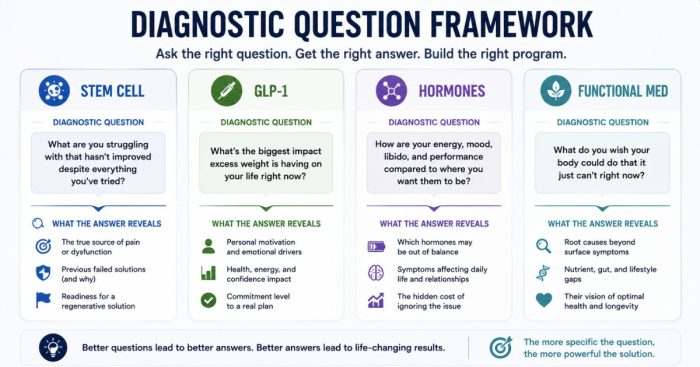
What vertical-specific questions separate a real expert from a generalist?
Experts ask technical questions about your specialty.
Generalists can’t fake those conversations.
Accordingly, our discovery process changes depending on the type of clinic.
For stem cell and regenerative medicine practices, we ask:
“Have you changed your injection or treatment protocols in the last two years? Many practices are doing IV treatments instead of joint injections.”
For weight-loss clinics, we ask:
“After your patients complete their GLP-1 injections, do you get them on any other type of membership?”
For hormone clinics, we ask:
“How long do your hormone patients stay with you on average before they switch their prescription to a cheaper provider?”
These questions don’t focus on advertising.
Instead, they focus on:
- Retention
- Clinical protocols
- Downstream revenue
The GLP-1 question reveals whether you have a real business or simply a prescription funnel.
Meanwhile, the hormone question uncovers patient churn.
That’s one of the biggest threats to membership practices.
In fact, it’s also the challenge behind the hormone clinic we helped grow from $1M a year to $4M a year and 250 active members at $1,000 a month.
Retention—not lead flow—created that compounding growth.
Likewise, the regenerative medicine question immediately reveals whether a clinic is keeping pace clinically.
It’s the same specialty where we helped Dr. Joy Kong become the #1 stem cell expert on YouTube, hire 4 more doctors, and scale herself out of the day-to-day.
If someone can’t ask at least one technical question about your specialty, they may still be able to sell advertising.
However, they can’t sell judgment.
What red flags should I watch for on a consultant’s discovery call?
There are five major red flags:
- Pitching before diagnosing
- Ignoring your team
- Skipping homework
- Dodging technical questions
- Creating same-day pressure
Pitching before diagnosing is the biggest warning sign.
If recommendations come before questions, you’re listening to a script written for everyone.
That means it was written for no one.
Ignoring your team is another problem.
After all, the consultant won’t be answering your phones or implementing your systems.
If they never ask who will carry out the recommendations, they’re selling a plan with no hands attached.
Skipping homework is another clue.
A genuine consultant should always be able to provide something valuable you can implement before paying them.
As a result, they demonstrate direction before asking for trust.
Likewise, dodging specialty-specific questions exposes a generalist.
Finally, beware of urgency tactics such as:
“The price goes up Friday.”
A practice that’s been operating for eight years can survive another week before making an important decision.
Ultimately, you don’t need expertise to recognize these red flags.
You simply need to stop judging the confidence of the presenter and start evaluating the structure of the conversation.
How should a consultant’s programs be structured — and what does honest pricing look like?
Programs should be tiered based on how much work the consultant performs versus your internal team.
They should also have a clearly defined end-state.
Above all, pricing should be presented honestly.
Without games.
Here’s how our own programs are structured.
Essentials — $500 per month
Designed for owners who primarily want the tools, funnels, and email systems.
Practice Mastery — $2,500 per month
Includes everything in Essentials, plus:
- Weekly accountability
- Monthly accountability
- Ongoing implementation support
Market Dominance — $7,000 per month
Or a smaller monthly retainer combined with revenue sharing.
In this program, we handle virtually everything related to:
- Patient acquisition
- Patient retention
We only structure this engagement when it’s a genuine win-win.
Otherwise, we recommend Practice Mastery alongside specific à la carte services.
However, the most important detail isn’t the monthly price.
It’s the structure.
Our programs are designed as six-month engagements.
As a result, the goal is graduation.
That means becoming less dependent on us and more dependent on the systems we’ve helped build inside your business.
That’s the opposite of the traditional agency model.
By contrast, many agencies benefit when clients stay dependent forever.
Whenever you’re evaluating a consultant, ask one question:
“What does it look like when I need you less?”
If they don’t have an answer, you’ve learned what the retainer is really designed to accomplish.

What do consultants who’ve done this for years consistently see in practice owners?
After more than eight years of strategy calls, the same themes appear again and again.
Because of that experience, hearing these ideas during a consultation is usually a sign you’re speaking with someone who has real experience.
Some of the most common observations include:
- Doctors should not be public servants. Undercharging doesn’t make you noble—it makes your practice fragile.
- Focus on your patients, not your competitors.
- Become an educated and sophisticated practice owner. Owners who understand the business side stop being sold to and start choosing the right partners.
- How you do anything is how you do everything.
- Invest heavily in yourself so you genuinely believe it’s the right thing for your patients to invest in themselves, too.
- Be willing to change your thinking. The practice that got you here was built with the thinking that got you here.
A consultant who speaks this way is usually describing patterns they’ve observed across hundreds of owner conversations.
By comparison, a consultant who only discusses cost per lead and creative testing is describing a marketing dashboard.
Both perspectives have value.
However, only one belongs in a long-term medical practice marketing partnership.
FAQ’s About Strategy Calls With a Medical Practice Marketing Consultant
Is a free strategy call just a disguised sales pitch?
It shouldn’t be.
Instead, the structure of the call usually tells you within the first two minutes.
A legitimate strategy call:
- States the agenda immediately.
- Spends the first part learning about your business and goals.
- Provides recommendations and homework you can execute without becoming a client.
- Leaves time for your questions.
If the meeting begins with the consultant’s story and ends with a contract, it was simply a sales pitch presented differently.
How should I prepare for a strategy call with a marketing consultant?
Know your numbers.
Also, know your destination.
Bring information such as:
- Your annual profit goal
- Average patient retention
- Where new patients currently come from
- Whether your long-term goal is to sell the practice or open another location
The stronger your answers, the more specific the guidance becomes.
You’ll also recognize much faster when a consultant never asks for any of that information.
What’s a good sign the consultant actually knows my specialty?
They ask a technical question that a generalist wouldn’t know to ask.
For example:
- Hormone clinic: How long do patients stay before switching to a lower-cost provider?
- Weight-loss clinic: What membership do patients transition to after completing GLP-1 therapy?
- Regenerative medicine: Have your treatment protocols changed during the last two years?
Questions like these explore retention and the economics of your specialty.
As a result, they focus on parts of your business that a logo-and-ads vendor rarely considers.
What homework should I expect after a discovery call?
Expect something specific, practical, and free to implement before paying anything.
Examples include:
- Improving your offer
- Building a follow-up sequence
- Tracking a new performance metric
Homework demonstrates that the consultant believes providing direction creates trust.
Otherwise, when there’s no homework, the value often begins only after the invoice.
What commitment length is reasonable for a consulting program?
Six months is a practical working window.
It’s long enough to implement meaningful improvements and measure results.
At the same time, it’s short enough to maintain accountability.
The more important question isn’t the length.
Instead, it’s whether the program is designed for graduation.
The goal should always be leaving you less dependent on the consultant and more dependent on the systems built inside your business.
Otherwise, open-ended retainers with no defined end-state often keep practices renting the same solution indefinitely.
What’s the next step?
You now have the discovery script.
If you’d like to experience the other side of that conversation, book a strategy call.
We’ll ask you these exact questions.
We’ll provide direction and practical homework for your practice whether or not we ever work together.
Meanwhile, if you’re a complete self-starter, we’ll point you toward helpful resources and send you on your way.
That’s the model.
Ultimately, you leave with a plan either way.