
Should Your Cash-Pay Clinic Add Peptide Therapy? (Why a $4M Hormone Clinic Owner Says Peptides Are the Next Level of Longevity)
Ask the owners of the fastest-growing cash-pay clinics what comes after the GLP-1 boom and you keep hearing the same word: peptides. One of them — a hormone clinic owner whose practice grew from $1M to $4M a year — put it plainly: “I think they’re the next level of longevity.” Here’s the FAQ on whether your clinic should add a peptide program, and how to do it without turning yourself into a commodity.
Are peptides actually the future of longevity medicine, or just another fad?
The operators with the strongest track records are treating peptides as the next durable wave in cash-pay medicine.
They’re not treating them as another fad.
We recently asked the owner of a hormone practice we’ve worked with for years whether he believed this niche would become as popular as it is today.
His answer was simple.
“Yeah. You always thought it would.”
Then he expanded on that thought:
“More people are taking advantage of peptides and what they can do. And I don’t think peptides are going anywhere anytime soon. I think they’re the next level of longevity. And I think there’s going to be a lot of really cool stuff that’s coming out. That’s where it’s all headed.”
That opinion matters because of who it’s coming from.
This is the same operator behind the hormone clinic we helped grow from $1M a year to $4M a year in 4 years, with 250 active members paying $1,000 a month.
He invested in hormone optimization before the market became crowded.
He built a membership model around it.
Then he rode that wave to substantial growth.
When someone with that track record says peptides are where longevity medicine is headed, it’s worth paying attention.
That becomes even more relevant as new research continues to emerge and patient awareness keeps growing.
Why should my clinic pay attention to the peptide wave now instead of waiting for it to mature?
Because cash-pay medicine rewards clinics that move early.
It punishes those that arrive after the wave has already peaked.
Hormones five years ago followed this pattern.
GLP-1 therapies did the same thing a few years later.
Both markets experienced:
- Strong patient demand
- Limited competition
- Lower advertising costs
- Easier differentiation
Eventually, both became crowded.
Telehealth providers entered the market.
Pricing became compressed.
Standing out became more expensive.
GLP-1 therapies also created another advantage.
They trained a massive number of patients to comfortably pay cash for pharmacological support related to metabolism, weight management, and healthy aging.
Peptides build directly on that awareness.
Waiting for the category to mature means entering when the easiest demand has already disappeared.
Clinics that build a credible peptide program today—with established protocols, compliant sourcing, and a strong patient education system—have an opportunity to own their local market before competitors even create a webpage about peptides.
That’s how clinics stay ahead.
They position themselves for where patient demand is going.
Not where it’s already been.
Building that positioning early is exactly what peptide therapy clinic marketing is for.
How do I know if my clinic is ready to add a peptide program?
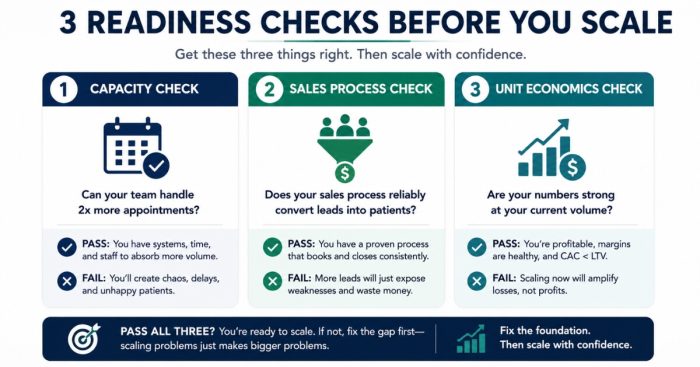
Run three readiness checks.
They are:
- Clinical protocols
- An existing patient base
- Follow-up capacity
First, evaluate your clinical protocols.
Your medical director should feel genuinely comfortable with every compound you’ll offer.
Your sourcing should come from reputable, compliant pharmacies.
A peptide program built on weak sourcing creates risk instead of growth.
Second, look at your current patient base.
Peptides work best as an extension of existing relationships.
Ideal launch audiences include:
- Hormone therapy members
- Functional medicine patients
- Weight-loss patients completing GLP-1 programs
If you already have an active patient list, you already have an audience that costs nothing to reach.
Third, evaluate your follow-up capacity.
Patients considering peptide therapy ask many questions before making a decision.
If your team already struggles to respond to inquiries or nurture leads, adding another service line simply increases the number of missed opportunities.
Fix the follow-up system first.
Then launch the new program.
If you pass all three readiness checks, you’re ready.
If you fail one, you’ve identified exactly what needs to be improved first.
Should peptides be a one-off service or part of a membership program?
They should be part of a membership program.
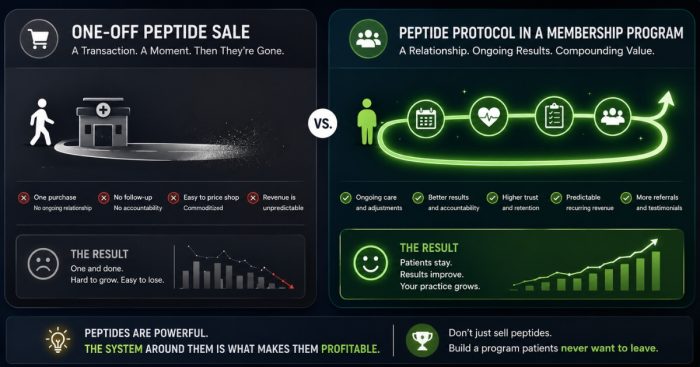
Selling peptides as a one-off product is one of the fastest ways to become a commodity.
Once patients start comparing your price per vial with telehealth providers, you’ve already lost the pricing battle.
Someone will always sell the molecule for less.
What discount providers can’t easily replicate is a physician-led program.
That includes:
- Baseline laboratory testing
- Individualized protocols
- Scheduled follow-up visits
- Ongoing adjustments based on patient progress
That’s what patients are actually willing to pay premium prices for.
It’s also what keeps them engaged long term.
The recurring model consistently outperforms the transactional one.
The hormone clinic mentioned earlier demonstrates that clearly.
It operates with 250 active members paying $1,000 each month.
That creates a recurring revenue engine that compounds every month, including $1.7 million per year in membership revenue attributable to SEO alone.
Peptides fit naturally into that same framework.
They can become:
- A protocol inside a broader longevity or performance membership
- An add-on tier for existing members
Structure the offer so patients buy an outcome and an ongoing relationship.
Not simply a vial.
How do I market a peptide program without compliance problems?
Market the program and the outcome.
Never market the molecule.
Never make disease claims.
Advertising platforms aggressively flag ads that focus on specific molecule names.
Unapproved disease-treatment claims can also place your advertising account—and potentially more—at risk.
Clinics that successfully market peptide programs lead with the patient’s goals instead.
Those goals include:
- Recovery
- Energy
- Performance
- Healthy aging
They also rely on education-first content to do the heavy lifting.
That content includes:
- Explainer videos
- FAQ pages
- Long-form articles
The goal is to answer the exact questions patients are already searching for on Google and ChatGPT.
The individualized clinical conversation belongs inside the consultation.
Marketing’s job is simply to earn that consultation.
This education-first strategy is the same foundation behind functional medicine & longevity clinic marketing.
High-consideration patients spend significant time researching before they book.
The clinic that answers their questions most effectively usually wins the appointment.
What happens if I ignore the peptide and longevity wave?
You probably won’t lose overnight.
Instead, you’ll lose gradually.
Patients looking for broader longevity care will slowly move to competitors offering a more complete solution.
Every cash-pay specialty is moving toward longevity.
Hormone clinics are adding metabolic programs.
Weight-loss clinics are adding hormone optimization.
Functional medicine practices are combining everything into concierge memberships.
The patient of 2026 increasingly wants one clinic that manages their overall healthspan.
They aren’t looking for a single prescription anymore.
A clinic that remains focused on only one service keeps patients only until someone nearby offers something more comprehensive.
Moving early creates real advantages.
That growth came from positioning around the broader longevity journey rather than promoting one individual treatment.
The demand already exists.
The only question is which clinic in your market captures it.
FAQ’s About Adding Peptide Therapy to a Cash-Pay Clinic
Are peptides going away once the hype dies down?
The operators investing their own money don’t believe so.
A hormone clinic owner who grew his practice from $1 million to $4 million annually told us:
“I don’t think peptides are going anywhere anytime soon. I think they’re the next level of longevity.”
As additional studies are published and more patients experience positive outcomes, awareness continues to grow.
It’s the same pattern hormone therapy and GLP-1 programs previously followed.
Do I need to be a hormone or longevity clinic to add peptide therapy?
No.
However, having adjacent services makes the launch easier.
Peptides cross-sell naturally to patients already participating in:
- Hormone therapy
- Functional medicine
- Weight-loss programs
Those patients already trust your clinical recommendations.
A clinic without an existing patient base can still launch a peptide program.
It simply has to acquire every patient through paid marketing instead of activating an audience it already owns.
How should I price peptide therapy?
Price the program.
Not the product.
If patients compare your per-vial pricing with telehealth providers, you’ll lose that comparison.
Instead, bundle peptides into a physician-led protocol that includes:
- Laboratory testing
- Individualized dosing
- Scheduled follow-up visits
- Ongoing clinical oversight
Whether it’s structured as a membership or a program fee, the patient should be purchasing an outcome—not a commodity.
Can I run Facebook or Google ads for a peptide program?
Yes—but carefully.
Ads focused on molecule names or disease-treatment claims are frequently flagged.
They can even place your advertising account at risk.
Instead, lead with patient goals such as:
- Recovery
- Energy
- Healthy aging
Direct traffic to education-focused landing pages.
Then let the consultation handle the individualized clinical discussion.
Organic educational content—including SEO articles, FAQ pages, and video—remains the most durable channel for generating peptide demand.
What’s the first step to launching a peptide program?
Start with your existing patients.
Not cold traffic.
First, finalize your clinical protocols and sourcing.
Then announce the new program to:
- Your active patient list
- Existing members
Cross-selling to patients who already trust your clinic validates the offer and generates revenue before you spend money acquiring new patients.
What’s the next step?
If you run a cash-pay clinic and you’re deciding whether peptides, longevity programming, or a membership model belong in your 2026 roadmap, book a strategy call.
In 60 minutes, we’ll map:
- Where patient demand in your market is heading
- Which program structure best fits your patient base
- What you should build first so you catch the wave instead of chasing it