
What Does “Working On Your Business” Actually Mean for a Cash-Pay Clinic Owner? (And Why If You’re Not Growing, You’re Dying)
One of the owners behind a hormone clinic we’ve worked with for years said it better than any business book: “You got to work in your business. You got to do the day-to-day. And then you got to work on your business. And sometimes people don’t have the capacity, don’t want to do that. It’s a lot of freaking work.” Every clinic owner has heard the on-vs-in cliché. Almost nobody can say what “on” actually means on a Tuesday afternoon. Here’s the practical version — and why the owners who skip it watch their practices quietly shrink.
What’s the difference between working in and working on a cash-pay medical practice?
Working in the business is everything with a today deadline.
That includes:
- Seeing patients
- Answering staff questions
- Handling refill requests
- Managing the schedule
Working on the business is everything that changes what next year looks like.
That includes:
- Building systems
- Reviewing numbers
- Hiring
- Improving offers
- Developing marketing strategy
The distinction isn’t about importance.
The day-to-day work produces today’s revenue.
The distinction is about what each hour buys.
An hour spent in the business produces one hour of output, once.
An hour spent on the business — writing the phone script, defining a role, or fixing the follow-up sequence — produces output every week afterward without you.
Clinics plateau when 100% of the owner’s hours produce only single-use output.
As the owner quoted above admitted, the reason usually isn’t ignorance.
It’s capacity.
Working on the business is real work.
However, it’s invisible this week.
Nothing about it feels urgent while a patient is standing at the front desk.
Why do most clinic owners never get around to working on the business?
Because the day-to-day always feels urgent.
The building work never does.
And honestly, it’s a lot of freaking work.
There’s no shortage of good intentions.
Every owner plans to:
- Document processes “next month”
- Build the dashboard “after the busy season”
- Write the job description “when things calm down”
Things never calm down.
A clinic where the owner does everything naturally creates an endless stream of work for the owner.
It’s a self-sealing loop.
There’s no time to build systems because there are no systems.
The owners who escape that cycle don’t magically find spare time.
They deliberately take it.
Time spent working on the business gets scheduled exactly like a patient appointment.
It’s a recurring, non-negotiable block protected by the front desk the same way a consultation would be.
If it isn’t on the calendar, it’s only a wish.
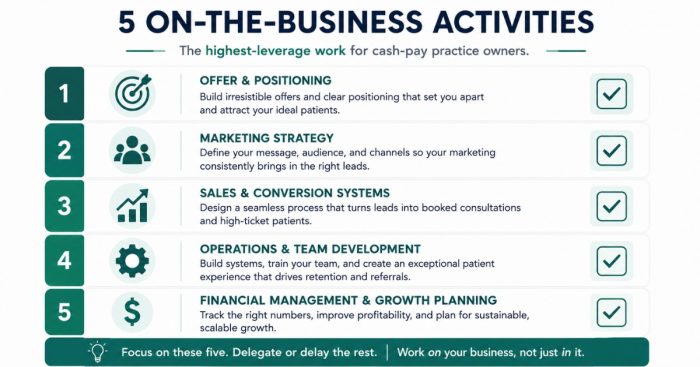
What does working on the business actually look like, week to week?
Five activities.
If your on-the-business time isn’t going toward one of these, it’s probably disguised busywork.
- Review the numbers every week. Look at leads, bookings, shows, new patients, and revenue. Thirty minutes at the same time every week.
- Document one recurring process. Write down the phone-answer script, consult follow-up, or no-show protocol. One documented process every week compounds quickly.
- Hire and define roles. Write job descriptions, interview candidates, and define what success looks like for every position.
- Make offer and pricing decisions. Decide what you sell, what it costs, and what the next step is for existing patients.
- Review marketing strategy. Don’t spend this time posting on Instagram. Instead, decide where next quarter’s patients will come from and evaluate whether your medical practice marketing is actually producing tracked, attributable patients.
Notice what’s missing from the list.
Answering staff questions isn’t on it.
Fixing the printer isn’t on it.
Personally chasing a lead isn’t on it.
Those tasks are necessary.
However, they’re still in-the-business work wearing an on-the-business costume whenever the owner is the one doing them.
Is “if you’re not growing, you’re dying” actually true for a medical practice?
Yes.
A clinic that holds flat revenue is losing ground everywhere costs continue to rise.
The same owner who described the day-to-day grind also shared the principle that shaped his decisions:
If you’re not growing, you’re dying.
Staying flat isn’t neutral.
Staff costs increase every year.
Rent increases.
Advertising costs increase.
Patients naturally leave even the best practices.
They move.
They age out.
Life changes.
A clinic that builds no new growth systems doesn’t stay the same size.
Instead, it slowly shrinks while the owner continues working just as hard.
Growth isn’t simply a personality trait for ambitious owners.
It’s the maintenance cost of standing still.
The owner we quoted wondered whether loving growth was “a me problem.”
It isn’t.
It’s part of the job description.
How do I free up capacity to work on my clinic instead of just in it?
Delegate the day-to-day deliberately.
Do it one documented process at a time.
Capacity is created.
It is never found.
The sequence that works is simple:
- Document the task.
- Assign it to a specific owner.
- Review the numbers every week so quality doesn’t drift.
Front-desk call handling, lead follow-up, scheduling, and routine patient communication can all leave the owner’s plate once they’re documented and assigned.
This is exactly what we watched happen at Eternity Health Partners.
The growth didn’t happen despite the owners stepping back from the daily grind.
It happened because stepping back created the time needed to build the systems.
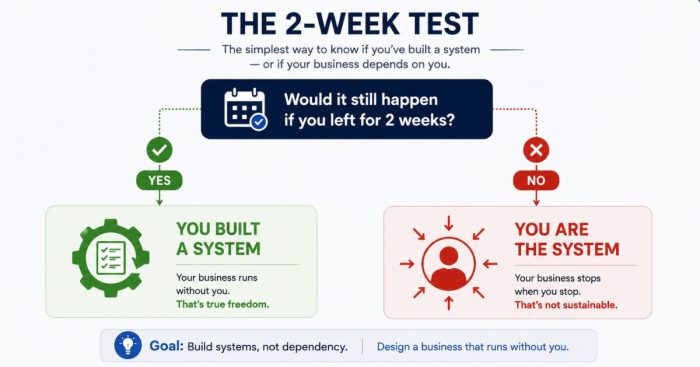
The test is simple.
Ask yourself:
Would this still happen if I took two weeks off?
If the answer is yes, you’ve built a system.
If the answer is no, you are the system.
Every week you remain the system is another week nobody is building the clinic.
When should a clinic owner bring in outside help for the on-the-business work?
Bring in outside help when the same growth problem has survived three of your own attempts to fix it.
You should also consider outside help when you already know what needs to be built, but the day-to-day never gives you the time to build it.
Some owners have the capacity and the desire to do the building work themselves.
They simply need the right playbook.
Others recognize that between patient care and family responsibilities, the on-the-business work will always lose the battle for time.
Both situations are workable.
Pretending otherwise is not.
If you’re in the second group, the leverage move is bringing in medical practice marketing consultants who build the machinery with your team instead of handing you another to-do list.
That’s the difference between buying advice and buying installed systems.
FAQ’s About Working On Your Business as a Clinic Owner
Can I keep seeing patients full-time and still work on my business?
Yes.
However, it won’t happen by accident.
Protect a recurring weekly block and treat it exactly like a booked patient appointment.
Use that time for:
- Numbers review
- Process documentation
- Hiring work
Owners who wait for free time never find it.
A clinic without systems continuously creates more day-to-day work for its owner.
What should a clinic owner delegate first?
Start with the recurring, documentable day-to-day work.
That includes:
- Phone handling
- Scheduling
- Lead follow-up
- Routine patient communication
Document each task.
Assign it to a specific owner.
Then review the related numbers every week so quality doesn’t drift while the work leaves your plate.
What if my clinic can’t afford to hire yet?
Begin with documentation instead of headcount.
Writing down your five most common recurring processes costs nothing.
At the same time, it immediately makes your existing team more capable of handling them.
The hours you reclaim become the time you can invest in building the business.
That work ultimately creates the capacity to afford the next hire.
Is growth really necessary if I just want a stable practice?
Yes.
Standing still is really slow shrinkage.
Staff costs rise.
Rent rises.
Advertising costs rise.
Patients naturally churn every year.
Even a practice that wants to stay the same size needs new-patient acquisition and retention systems simply to maintain its current level.
That’s why “if you’re not growing, you’re dying” applies even to owners who aren’t trying to build an empire.
How do I know if I’m working on or in the business right now?
Use the two-week test.
Ask yourself:
Would this task still happen if I disappeared for two weeks?
If the answer is yes, you’ve built a system and can step away from it.
If the answer is no, then you are the system.
Turning that task into something documented and delegated is the next piece of on-the-business work.
What’s the next step?
If you’ve read this far and recognized yourself as the owner who knows exactly what needs to be built but hasn’t had a free hour in years to build it, that’s not a character flaw.
It’s the predictable result of a practice designed around your own hands.
The solution isn’t heroic effort.
It’s a sequence:
- Review the numbers
- Document the processes
- Delegate the work
- Build growth systems that operate without you
Book a free strategy call.
We’ll help you identify which piece of the on-the-business work will move your clinic first.
We’ll also show you the order in which the owners who grew their practice 4× built those systems.