
Should a Cash-Pay Medical Practice Discount Its Services in Ads? (When to Cut the Price and When to Reposition the Offer)
Every cash-pay practice owner hits this wall: the ad account needs an offer, but you didn’t build a premium clinic to slap “$500 OFF” on a billboard. Here’s the uncomfortable truth from running ad campaigns across aesthetics, hormones, functional medicine, regenerative, and weight-loss clinics — the answer is not “never discount.” It’s a decision rule. If the service is commoditized, you discount (or compete on value and still discount). If you refuse to discount, you have exactly one alternative: reposition the offer so it can’t be price-shopped. This FAQ walks through the rule and the exact offer amounts that are working.
Should my cash-pay medical practice discount its services in ads?
If the service you’re advertising is commoditized, meaning a patient can get the same thing somewhere else at a comparable price, then yes.
Lead with a dollars-off offer.
Alternatively, compete on value and still include a dollars-off incentive.
If you’re unwilling to discount, don’t run the ad as-is.
Instead, reposition the service into something that can’t be directly compared.
That’s the entire decision rule.
However, most clinics skip it.
Some discount everything.
As a result, they train their market to wait for promotions.
Others refuse to discount anything.
Consequently, they pay for ads that lose every comparison against a competitor with a lower-priced offer.
The highest-performing option in our campaigns is the hybrid approach.
Build obvious value into the offer through a better program, a stronger name, or bundled deliverables.
Then add a dollar amount off on top.
Value plus a discount beats either one alone.
The discount earns the click.
Meanwhile, the added value wins the comparison.
The offer is the highest-leverage variable in your medical practice marketing.
The same ad budget, targeting, and creative can produce dramatically more patients when paired with a stronger offer.
Why shouldn’t I run ads for low-ticket treatments at my clinic?
As a general rule, don’t run ads for low-ticket treatments or procedures.
The economics make profitability very difficult.
The only exception is a clinic with an exceptionally efficient sales process that consistently moves low-ticket patients into higher-ticket programs.
Consider the numbers.
A “$25 off any IV treatment” offer must cover:
- Ad spend
- Front-desk labor
- Chair time
- Product cost
All of that comes from a ticket worth less than $200.
Even a strong cost per lead often leaves little or no profit.
Spine and chiropractic campaigns illustrate this problem well.
Making chiropractic advertising profitable is extremely difficult.
Free decompression treatments, free adjustments, and free sports massages have all worked as front-end offers.
However, they only succeeded when the clinic had a disciplined ascension path behind them.
Without that path, you’re buying $40 patients with $80 clicks.
For nearly every cash-pay clinic, there’s a better approach.
Advertise the higher-ticket services.
Then let low-ticket treatments function as retention tools and add-on services instead of primary advertising offers.
How do I know if my service is commoditized — and what do I do about it?
Use a simple test.
If another clinic in your market offers the same service at a comparable price inside a comparable program, then it’s commoditized.
A commoditized service needs a dollars-off offer to win the click.
Think about someone shopping for a non-surgical facelift.
They’re probably comparing three browser tabs.
The tab offering “$250 off” usually gets the first click.
This happens constantly in aesthetics.
Offers like “$150 off PRP micro-needling” and “$250 off Non-Surgical Facelift” consistently perform well.
In fact, almost any dollar amount off a non-surgical facelift has generated strong results in our campaigns.
The exact number matters less than simply having a number.
After all, the patient’s alternative is often a competitor with no offer at all.
What you shouldn’t do is advertise a commoditized service without any offer.
Then hope your brand alone carries the campaign.
Brand helps you close the sale.
However, it rarely earns the first click when another clinic is leading with a meaningful discount.
How do I discount without cheapening my premium positioning?
Attach the discount to a repositioned, named offer.
That could be a program, a quiz-qualified consultation, or a membership.
In other words, avoid hanging a sale sign directly on the procedure.
That’s how you preserve premium positioning while still giving people a reason to click.
Three repositioning strategies consistently work.
1. The consultation front-end
A Free Skin Consultation or Free Menopause Consultation positions the clinic around expertise instead of price.
As a result, it feels more premium than a discount.
The trade-off is a longer sales process.
A $99 ED Consultation achieves the same effect for men’s health while filtering out people who only want something free.
2. The quiz front-end
A Low Testosterone Quiz, Women’s Hormone Quiz, Chronic Fatigue Quiz, Lyme Disease Quiz, or Thyroid Function Quiz naturally leads into a free consultation or free testing.
The quiz performs the qualification.
Therefore, the free consultation attracts symptom-driven patients instead of bargain hunters.
3. The membership credit
For functional medicine and concierge practices, one of the strongest offers we’ve used is a concierge membership with $500 off the first year.
Lead volume is typically lower.
However, lead quality increases dramatically because the offer filters for patients ready to commit to long-term care.
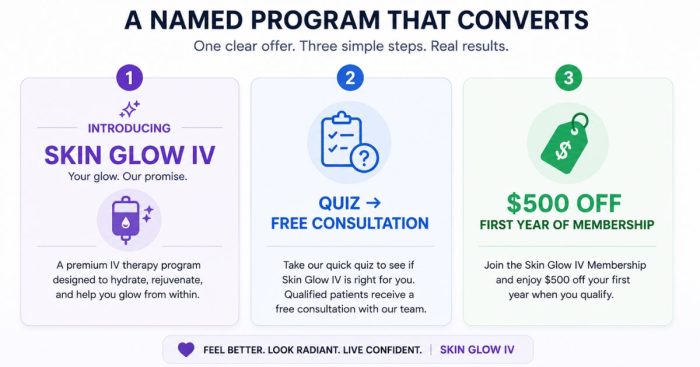
Finally, give the offer a name.
A strong program name often converts better than a generic service description.
For example, a free SKIN GLOW IV added to treatment outperforms “free IV with treatment,” even though the drip is identical.
The name increases the perceived value.
What discount amounts are actually working in cash-pay medical ads right now?
The ranges that consistently work are:
- $500–$1,000 off for high-ticket treatments
- $150–$500 off for mid-ticket treatments
- Free consultations or free testing when positioning matters more than speed
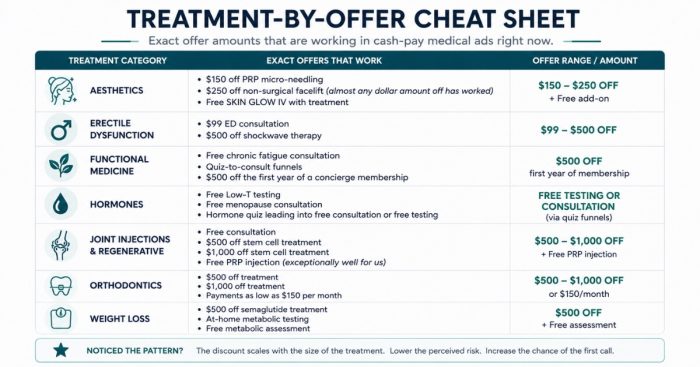
Here’s the treatment-by-treatment breakdown from our campaigns.
- Aesthetics: $150 off PRP micro-needling; $250 off non-surgical facelift (although almost any dollar amount off has worked); free SKIN GLOW IV with treatment.
- Erectile dysfunction: $99 ED consultation; $500 off shockwave therapy.
- Functional medicine: Free chronic fatigue consultation; quiz-to-consult funnels; $500 off the first year of a concierge membership.
- Hormones: Free Low-T testing; free menopause consultation; hormone quiz leading into free consultation or free testing.
- Joint injections and regenerative: Free consultation; $500 off stem cell treatment; $1,000 off stem cell treatment; and a free PRP injection. That last offer has performed exceptionally well for us, and very few competitors have copied it.
- Orthodontics: $500 or $1,000 off treatment; payments as low as $150 per month.
- Weight loss: $500 off semaglutide treatment; at-home metabolic testing; free metabolic assessment.
Notice the pattern.
The discount scales with the size of the treatment.
For example, $500 off a multi-thousand-dollar stem cell procedure doesn’t cheapen the service.
Instead, it lowers the perceived risk of making the first call.
That’s the same offer strategy behind a pain and regenerative medicine practice we helped add $2,095,039 in revenue in just 10 months.
High-ticket treatments, lower front-end barriers, and a strong sales process work together.
Is it really the price — or the presentation of the price?
It’s the presentation.
After building offer sets across every one of these treatment categories, the conclusion is straightforward.
The deciding factor isn’t the price itself.
Instead, it’s how the price is presented.
Orthodontics demonstrates this perfectly.
A “$5,000 treatment” and “payments as low as $150 per month” represent the same economics.
However, one gets ignored while the other books consultations.
The same principle applies elsewhere.
“$500 off your first year” performs better than “10% off.”
A free SKIN GLOW IV feels more valuable than a generic “free add-on.”
Likewise, a free PRP injection creates more interest than another “free consultation” offer in a crowded news feed.
Before concluding your market won’t pay your prices, change how you present them.
Anchor the offer to the full treatment value.
Break the investment into monthly payments.
Attach the price to a named program.
Or convert the savings into a first-year membership credit.
Then place that offer inside a patient acquisition system that follows up quickly enough to convert the clicks.
Even the strongest offer fails when nobody works the leads.
FAQ’s About Discount Offers in Cash-Pay Medical Ads
Do dollar-off offers attract low-quality patients to a cash-pay clinic?
Not when the discount applies to a high-ticket service.
Someone responding to $500 off a stem cell treatment is still preparing to invest thousands of dollars.
The discount simply lowers the risk of taking the first step.
Low-quality leads usually come from discounting low-ticket services because the discount becomes the entire purchase.
Should I use a free consultation or a dollar-off discount in my ads?
Use a free consultation, or even a paid consultation like $99, when positioning matters and you’re comfortable with a longer sales process.
Use dollars off when the service is commoditized and speed is more important.
In many cases, the strongest offer combines both value and a dollar-off incentive.
How big should the discount be on a high-ticket treatment?
Discounts between $500 and $1,000 consistently perform well for treatments that cost several thousand dollars.
Examples include stem cell therapy, shockwave therapy, and orthodontics.
Meanwhile, discounts between $150 and $250 fit mid-ticket aesthetic services such as PRP micro-needling and non-surgical facelifts.
Always scale the discount to the size of the treatment.
That way, it feels meaningful without looking desperate.
Can a free-treatment offer like a free PRP injection actually be profitable?
Yes.
A free PRP injection has been one of the strongest-performing joint injection offers we’ve used.
It succeeds because it introduces patients to a multi-thousand-dollar regenerative treatment plan.
The free treatment demonstrates value.
Then the treatment plan generates the revenue.
However, this only works when a genuine ascension path exists.
What if I don’t want to discount my services at all?
Then reposition them.
That’s the rule.
Wrap the service inside a named program, a quiz-qualified consultation, or a membership that includes a first-year credit.
Doing so gives patients something unique that competitors can’t directly compare.
What doesn’t work is advertising a commoditized service at full price with no offer.
What’s the next step?
If your ads simply say “contact us for pricing,” or if you’re discounting everything and attracting patients who only buy the discount, book a strategy call.
In 60 minutes, we’ll map your treatment menu against the commoditized-versus-premium decision rule.
Then we’ll identify the two offers worth funding with ad spend and recommend the exact dollar amounts and naming conventions to test first.
We’ve used these same offer structures to help a wellness medspa add $6,708,600 in revenue and 3,727 new patients in a single year.
The winning offers weren’t necessarily cheaper than the competition.
They were simply presented better.