
The Welcome Video Script That Onboards New Patients at a Cash-Pay Clinic (Steal This 7-Beat Template)
The moment a new patient pays, a timer starts. The next 48 hours determine whether they arrive committed, half-in, or not at all. This is the exact welcome video script we use at Real ADvice to onboard every new client—seven beats, under two minutes, recorded once—adapted line by line for a cash-pay medical practice welcoming new patients and members.
Why should a cash-pay clinic send a welcome video to every new patient?
Because the highest-risk window in the patient relationship is the gap between payment and the first visit.
A welcome video fills that gap in two minutes, automatically, forever.
A new patient who just paid for a program, membership, or consultation feels excited.
At the same time, they’re often slightly nervous.
If the next thing they receive is only a confirmation email, buyer’s remorse gets the floor.
Instead, imagine the next thing they see is the provider saying:
“Congratulations. Here’s exactly what happens next.”
Immediately, three things change.
The purchase feels validated.
The next steps feel manageable.
The clinic also feels human before the patient ever walks through the door.
There’s another reason to use a welcome video.
Volume.
A founder can personally call every new patient when the clinic welcomes 10 people each month.
Nobody can personally welcome that many patients.
A recorded welcome video allows the personal touch to survive at scale.
You film it once.
Then you deliver it thousands of times.
It works the same way on your busiest day as it does on your slowest.
That’s why it becomes the bridge between patient acquisition and retention.
The ad and the phone script convinced the patient to pay.
The welcome video helps them arrive committed.
What should a new patient welcome video actually say?
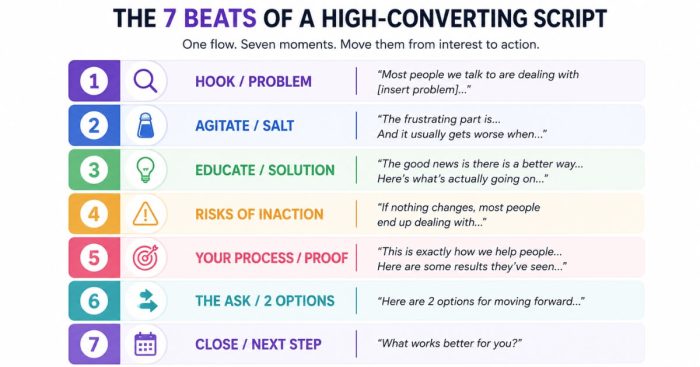
Use these seven beats, in this order:
- Congratulate the decision.
- Thank them for their trust.
- Preview the three next steps.
- Point to the intake form.
- Encourage early completion.
- Remove the fear of getting stuck.
- End with a rally cry.
Here’s the template, adapted almost word for word from the script we use ourselves.
1. Congratulate the decision
Say:
“Congratulations on taking the next step toward [what they actually bought—more energy, weight loss, or getting their health back].”
Don’t say, “Thanks for your order.”
They made a decision.
Honor it.
2. Thank them for their trust
Say:
“Thank you so much for trusting us with your health. I sincerely look forward to seeing your transformation.”
Health is personal.
So is trust.
Say the word.
3. Preview the three steps
Tell them:
“You’ll receive an email shortly from me with three steps.”
Then name all three.
Keep it to three.
Not seven.
4. Point to the intake form
Say:
“Also, on this page—below or next to this video—you’ll find your intake form whenever you’re ready to begin.”
5. Encourage early completion
Explain the benefit:
“Completing the form before your first appointment will dramatically increase the speed at which we can deliver value to you.”
Notice the incentive.
You’re promising faster results, not demanding compliance.
6. Remove the fear of getting stuck
Say:
“If you get stuck, feel free to skip that step. We’ll help you personally at your first appointment.”
That single sentence rescues the patients who would otherwise abandon the form halfway through.
7. End with a rally cry
Finish with:
“Feel free to reach out if you have any questions. Let’s get to work. I’ll see you at your first appointment.”
What three next steps should the welcome video preview?
Focus on the three actions that stand between paying and receiving care.
For most cash-pay clinics, those are:
- Book the first appointment.
- Complete the intake form.
- Know what to expect during the visit.
This structure comes directly from the source script.
There, the email previews three steps:
- schedule your onboarding call
- share access
- identify your ideal outcome
Translate that framework into your patient journey.
Keep the number at three.
1. Schedule
If the first appointment or labs aren’t booked yet, make this the first step.
An unscheduled patient is often a refund waiting to happen.
2. Paperwork
Provide one link for the intake form, consent forms, and health history.
Keep everything together.
3. Preparation
Explain what to expect.
Cover fasting before labs, what to bring, how long the visit will take, and how to contact the team.
Why only three steps?
Because three fits in a patient’s head.
A seven-item onboarding checklist feels like homework.
By contrast, schedule, forms, and what to expect gets completed.
Everything else can happen during the first appointment or later in the onboarding sequence.
How do I get new patients to complete intake forms before their first visit?
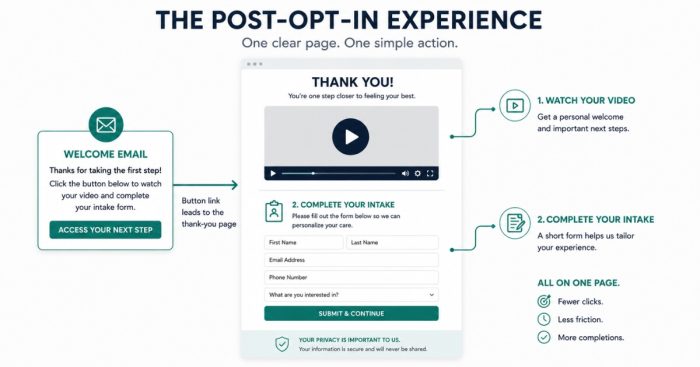
Place the intake form directly below the welcome video.
Then sell speed instead of demanding compliance.
Finally, give patients explicit permission to skip any confusing questions.
The script does all three in about 15 seconds.
First, the form lives on the same page as the video.
Patients don’t have to search through email attachments.
Second, the reason to complete it early is framed as the patient’s benefit, not the clinic’s.
Tell them:
“Completing the form before your first appointment will dramatically increase the speed at which we can deliver value to you.”
Notice the difference.
The incentive is faster results, not obedience.
Third, release the pressure.
Tell patients:
“If you get stuck, skip it. We’ll help you personally at your first appointment.”
That one sentence often determines whether the form gets completed or abandoned.
The moment many patients hit a question they can’t answer, they either need permission to move forward or they close the browser.
This matters more than most owners realize.
A completed pre-visit intake becomes the “before photo” for the entire patient journey.
It’s the baseline for the 90-day check-in.
It also allows the first consultation to focus on the treatment plan instead of paperwork.
In addition, it becomes the first documented data point in the patient’s journey.
Clinics that treat intake as front-desk administration usually end up with 40-question forms nobody finishes.
Clinics that treat it as the first act of care often receive completed forms the very same day.
How polished does the welcome video need to be — and who should record it?
One take, phone camera, under two minutes, and the face should be the provider or founder — not a stock spokesperson.
The script is seven beats; read naturally, it runs 60 to 90 seconds. That’s the target.
Patients aren’t grading production value.
Instead, they’re checking whether the person they just gave money to feels present and competent.
A slightly imperfect one-take video from the actual provider outperforms a polished agency-produced piece with a stranger in it.
The entire point of the video is simple:
“A human here knows you exist.”
Practical rules:
- Natural light.
- Clinic in the background.
- Provider looking directly into the lens.
- No script visible on camera. (Bullet points taped beside the lens are perfectly fine.)
Record three takes.
Pick one.
Ship it.
You can always record a better version next quarter.
However, you can’t recover the hundred patients who onboarded with silence while waiting for the videographer.
This same bias toward shipping separates clinics with working medical practice marketing from clinics with a folder full of unfinished brand assets.
Where should the welcome video live so every new patient actually sees it?
Put it in two places:
- the thank-you page patients see immediately after paying or booking
- the first email in the automated welcome sequence
Both locations should be automated.
The thank-you page is valuable because attention is highest immediately after a purchase.
Place the video there.
Then position the intake form directly below or beside it, exactly as the script recommends.
The welcome email serves as a backup.
It reaches patients who paid over the phone or closed the thank-you page before watching.
Send it within minutes.
Include the same video along with the three next steps in writing.
Both placements should live inside the same CRM automation that powers the rest of your onboarding journey.
That way, the video never depends on someone remembering to send it.
That’s precisely why the system works.
Onboarding that depends on memory becomes inconsistent during busy weeks.
Onboarding that’s automated gives patient number three and patient number three thousand the exact same experience.
FAQ’s About New Patient Welcome Videos
How long should a new patient welcome video be?
Keep it between 60 and 90 seconds.
Two minutes should be the absolute maximum.
The video has one job:
Congratulate the patient, preview the three next steps, and point them to the intake form.
Anything longer competes with the form you’re asking them to complete.
Who should appear in the welcome video?
The provider or founder.
Patients trusted that person when they decided to pay.
A stock spokesperson or a text-only animation removes the entire point of the video, which is proving that a real person at the clinic knows the patient exists.
Where should the welcome video be placed?
Place it on the post-purchase thank-you page with the intake form directly below it.
Also include it in the first email of the automated welcome sequence.
Set up both locations once.
Then let the CRM trigger them automatically so every new patient receives the video within minutes of paying.
What if patients still don’t complete the intake form after watching?
Follow the script’s pressure valve.
Give patients explicit permission to skip confusing questions:
“If you get stuck, skip it—we’ll help you personally at your first appointment.”
Then send one automated reminder that sells speed to results instead of compliance.
Partial forms are acceptable.
Abandoned patient relationships are not.
Does the welcome video need professional production?
No.
One take on a phone with natural light and the clinic in the background usually performs better than a delayed, professionally produced video.
The value comes from presence, not polish.
Ship the imperfect version today.
Improve it next quarter if you want.
What’s the next step?
If new patients pay and then hear nothing until an appointment reminder, your onboarding process is leaking commitment that you already paid to create.
Book a strategy call.
In 60 minutes we’ll map your post-purchase journey, adapt this seven-beat welcome video script to your specialty, and show you exactly where the video, intake forms, and automation fit into your existing CRM.