
The Front Desk Script That Sells a $900 Paid Consultation at a Cash-Pay Hormone Clinic (Word for Word)
Most front desks answer the phone like a help desk: answer questions, quote prices, hang up, and hope. Clinics that convert first-time callers into paying patients run the call like a sale—because it is one. Below is the actual new-lead front desk script from a cash-pay hormone clinic that sells $550 in labs plus a $350 initial consultation on the first call. Your team can use these exact lines.
Should my front desk try to sell a paid consultation on the first phone call?
Yes.
The first call is the sale.
If the caller hangs up without a scheduled, paid next step, you don’t have a lead.
You have a person who once called.
Clinics that offer free consultations train callers that the clinic’s time is worth nothing.
Then they wonder why no-show rates are brutal and consult rooms fill with tire-kickers.
On the other hand, clinics that charge—but let an untrained front desk “just answer questions”—lose the caller as soon as the price comes up.
A price without a problem attached is always too expensive.
The script below solves both problems.
By the time the price comes up, the caller has already explained, in their own words, why they need the problem solved.
As a result, the $900 first step feels like the obvious next move instead of a fee.
This is the unglamorous half of patient acquisition.
It’s not about getting more leads.
It’s about having a front desk that converts the callers you already have.
What is the call structure that sells a paid consultation?
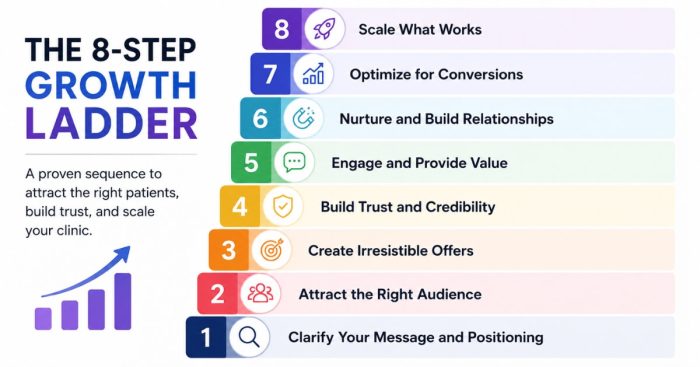
There are eight moves, in order:
- Identify the problem.
- Salt the cut.
- Offer the solution.
- Explain just a little.
- Take away risk.
- Add a penalty for waiting.
- Ask for the business.
- Present two options and let the caller choose.
That’s the entire mental outline the front desk carries into every new-lead call.
Notice what’s missing.
There’s no feature dump.
There’s no service menu.
There’s no reciting every program the clinic offers.
Instead, the caller does most of the talking during the first half of the conversation.
Meanwhile, the front desk earns the right to present the price by listening first.
Two of the steps do most of the heavy lifting.
First, “salt the cut” means getting the caller to explain why the problem actually hurts.
The goal isn’t to make them uncomfortable.
Instead, it’s to let them say, “I’ve tried everything for two years and nothing worked.”
Once they say that out loud, they no longer need convincing that doing nothing is the expensive option.
Second, “explain just a little” is a warning, not a suggestion.
The front desk explains enough to build confidence.
Then they move directly to scheduling.
Callers don’t buy from the team member who explains the most.
Instead, they buy from the one who makes the next step feel easy.
How does the front desk get a stranger to open up about their problem?
Start with one trust question and one fork:
“How did you hear about us? Were you referred by a friend or did you look us up online?”
The answer tells the front desk exactly which question to ask next.
If it’s a referral:
“What’s going on that your friend referred you to us?”
If they found you online:
“So tell me, what’s going on that has you looking for naturopathic doctors online?”
Then comes the single most important instruction in the entire script:
LISTEN.
Don’t interrupt with solutions.
Don’t start pitching the membership.
Instead, let the caller explain the problem.
They’re giving your front desk the exact words that will close the sale ten minutes later.
Those words include the symptoms, the frustrations, and the life they want back.
A front desk that listens carefully can later say, “Solving that is exactly what we do,” and mean it specifically instead of generically.
What does “salt the cut” mean on a new patient call—and what questions do it?
It means helping the caller explain what they’ve already tried and why it hasn’t worked.
Do that by asking three questions, gently and in order:
- “What are you doing right now to try and solve this problem?”
- “What have you tried in the past?”
- “Has there been anything that has given you any relief? Anything that’s worked?”
Every answer raises the stakes.
For example, a caller who lists two failed diets, a drawer full of supplements, and a doctor who “just said my labs were normal” is building the case for a real workup.
You’re not building it for them.
If the conversation needs more urgency, the script goes one layer deeper with a why-now question.
For weight loss specifically, ask:
“Is there anything going on in your life right now that has you wanting to lose this weight now?”
It might be a wedding, a reunion, holiday parties, a summer trip, or a medical scare.
A deadline the caller names is worth more than ten discounts you could offer.
Only then does the script move into what it calls the quick blast:
“Well, I’m glad you found us—because solving [their problem] is exactly what we do. In fact, we’ve been serving Santa Barbara for over a decade, and we specialize in exactly that.”
The problem is named.
The authority is established.
Each happens in a single sentence.
How should the front desk present the price of a paid consultation?
Present it plainly.
Attach it to a clear next step.
Then immediately follow it with a two-option choice instead of a yes-or-no question.
Start by asking permission:
“Do you want me to explain what it looks like to become a patient here?”
Almost nobody says no.
Then explain the next step with the prices attached.
State it like logistics rather than a sales pitch:
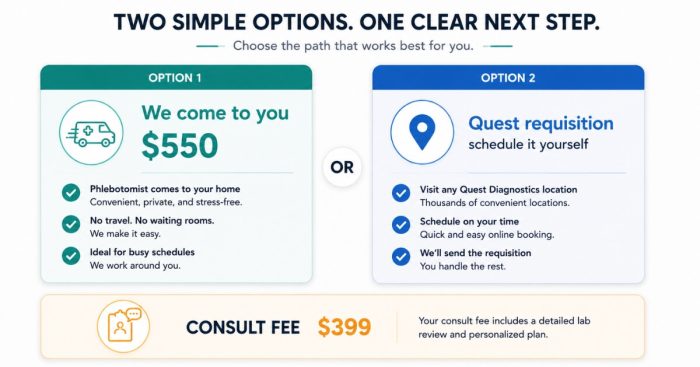
“To get started, we’ll do labs and an initial consultation to review your lab work with you. The labs are $550 and the initial consultation is $350. After the consultation, if it’s appropriate for you to move forward with hormone treatment, we’ll map out your plan.”
Next, remove the risk and close in the same breath:
“We can send a mobile phlebotomist to your home before your consultation to complete the labs—no waiting in line or difficult scheduling—for the $550, or we can send you a lab requisition to Quest. Do you want me to schedule the phlebotomist to come to your home, or should I send you the requisition to schedule on your own?”
Notice what happened.
The caller was never asked, “Do you want to book?”
Instead, they were asked which of two ways they wanted to book.
The script follows one simple rule:
Show only two options.
Two options create a choice.
Five options create homework.
The moment the caller chooses one, the front desk simply says:
“Okay, great. I can get that scheduled for you. I just need to collect a little basic information to move forward.”
Then collect the information.
That’s the close.
The same framework also works for weight-loss and women’s health callers.
Only the details of the first step change.
What should the front desk say when a caller asks about insurance?
Use one rehearsed line and deliver it with confidence:
“It’s not that we don’t want to work with insurance—it’s that insurance doesn’t work with us.”
This reframes cash-pay from a barrier into a positioning statement.
It also avoids arguing about deductibles or coverage.
Immediately afterward, soften the landing by explaining what the clinic does accept:
“We do accept HSAs and FSAs, and we offer financing.”
Insurance objections on these calls usually aren’t about money.
Instead, they’re about permission.
The caller wants reassurance that paying cash for healthcare is normal.
They also want to know that other patients do it successfully.
Finally, they want practical payment tools, such as HSAs, FSAs, and financing, that make the decision easier.
This script isn’t theoretical.
It’s the actual new-lead front desk script from Eternity Health Partners, an HRT clinic that grew from $1M a year to $4M a year and fields 60 new-patient inbound calls a month.
Every one of those calls is answered by a front desk following this framework instead of improvising.
The ceiling for a trained phone team is also remarkably high.
For example, Orthobiologics Associates converts 79.4% of leads into booked appointments using the same discipline:
- a structured script
- a clear next step with a price
- a two-option close
FAQ’s About Front Desk Paid Consultation Scripts
Why charge for the initial consultation instead of offering it free?
Because a paid first step filters for callers who are serious.
It also establishes the value of the provider’s time before the patient ever walks through the door.
A caller who pays $350 for a consultation usually arrives, completes their labs beforehand, and listens to the treatment plan differently than someone attending a free sales presentation.
What if the caller says the paid consultation is too expensive?
Go back to the problem, not the price.
Price objections usually mean the front desk skipped the salt-the-cut questions.
The caller hasn’t fully explained what the problem is costing them yet.
Restate their own words.
Then present the available affordability tools, including HSAs, FSAs, and financing.
How many options should the front desk present at the close?
Two.
The script’s rule is to show only two options.
For example, offer a mobile phlebotomist visit at home or a lab requisition to Quest.
Two options turn a yes-or-no decision into a choice between two paths.
By contrast, five options create homework instead of action.
Does this script work for weight-loss and women’s health calls too?
Yes.
The eight-step framework stays exactly the same.
Only the clinical details change.
Weight-loss calls, for example, add a why-now question:
“Is there anything going on in your life right now that has you wanting to lose this weight now?”
Named deadlines, such as weddings and reunions, convert better than generic motivation.
What does “take away risk” actually look like on a booking call?
It means making the next step feel effortless and low risk.
Examples include:
- sending a mobile phlebotomist to the caller’s home instead of requiring a lab visit
- clearly explaining that the consultation is designed to review lab work and determine whether treatment is appropriate
- offering HSA, FSA, and financing options
Risk removal comes from logistics, not discounts.
What’s the next step?
If your front desk answers questions and quotes prices instead of following a script that sells the first paid step, you’re paying for leads that your own phone line is losing.
Book a strategy call.
In 60 minutes, we’ll listen to how your calls are handled today, adapt this eight-step script to your specialty and pricing, and show you what a trained patient coordinator can do to your booking rate within 30 days.