
How Do I Build Ads and Offers for High-Ticket Treatments at My Cash-Pay Clinic? (The Full Playbook, From Offer to Audience to Ad)
Before you build a single ad, you need to answer a harder question: what are the ads selling? Clinics that win with paid traffic almost always advertise expensive programs. These include neuropathy programs, knee-pain programs, hormone and thyroid programs, and memberships. The math behind high-ticket advertising forgives what low-ticket math punishes. This is the playbook we use with clients, from offer economics to lead magnets to the exact audience sizes and ad structure.
Why are high-ticket treatments the best thing to advertise?
Because when your program sells for $5,000–$10,000, you can spend $1,000—or even $2,000 while you’re starting out—to acquire that patient and still stay profitable.
It gets even better from there.
Your second patient from the same campaign usually costs less than the first.
Likewise, the third patient usually costs less than the second because the campaign keeps optimizing.
Now compare that with the low-ticket version of the same math.
Suppose you’re selling a $300–$500 treatment—or worse, a $99 consultation.
Your cost per lead is $20.
As a result, you have to convert almost every lead just to break even.
Then add the cost of paying a salesperson or front desk team member to work those leads, and the margin disappears entirely.
As our training doc puts it, it becomes stressful and not that fun.
If you don’t have a high-ticket program yet, build one before you run ads.
Building the program now beats losing money on low-ticket ads.
Good candidates include a neuropathy program, a knee-pain program, a functional medicine program, a thyroid program, or a hormone program.
Whenever possible, structure it as a membership.
Recurring models create wonderful cash flow.
They’re also how an orthopedic surgeon we ran Facebook ads for added $2 million in revenue from a single channel: a high-ticket offer, patient math that works, and a campaign that compounds.
Should the ad sell the treatment — or something free first?
Something free first.
For high-ticket offers, the highest-quality leads come from giving educational value before asking for the consultation.
This is the law of reciprocity applied to patient acquisition.
Give value for free before asking someone to do something for you.
Instead of “book a consultation,” make the call to action “download the guide” or “take the quiz.”
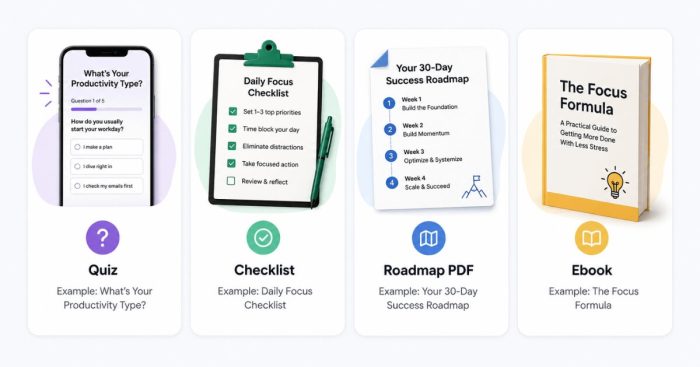
Lead magnets that work, straight from our playbook, include:
- a low-hormone checklist
- a low-T quiz for men
- a menopause quiz or checklist for women
- a scoring rubric
- an ebook
- a roadmap PDF that visually shows what treating their condition looks like
The quizzes are also easy to build.
They’re basically the questions you’d ask during an initial consultation, formatted as a self-assessment.
Two things happen when you lead with value.
First, the lead qualifies themselves.
Someone who completes a menopause quiz is telling you exactly why they’ll book.
Second, you build expert status before the first appointment.
By the time the patient arrives, they’re almost starstruck when they meet the doctor.
They’ve read your guide.
They’ve taken your quiz.
They’ve watched your video.
As a result, they arrive pre-sold.
That’s the engine behind quiz-funnel campaigns in men’s hormone and TRT clinic marketing, where the quiz routinely out-converts the “free consult” ad by a wide margin.
How should I price my high-ticket program against competitors?
Ignore them.
Compete on value, not price.
Matching the clinic down the street is a race to the bottom.
It doesn’t matter that the clinic down the street charges $3,000 or $5,000 for their knee injections.
Instead, ask a different question:
“How much value can I package?”
The model to copy comes from an unlikely place—a dentist.
Their membership costs $350 a year.
It includes two cleanings, an annual exam, an X-ray, and 10% off all treatments.
Instead of pricing against other dentists, they asked what the patient was already going to buy from them—and elsewhere—and then packaged it together into one annual membership.
Next, they stack the experience.
They offer sunglasses for the chair light.
They hand out chapstick during the visit.
Those are small touches, but people remember how you make them feel.
That’s the whole philosophy.
Focus on your patients, not your competition.
A program that bundles what patients actually need, delivered with an experience they talk about, can charge more than the market rate and still feel like the obvious choice.
Value stacking also makes the ad’s offer feel like a no-brainer before price ever enters the conversation.
How do I test my offer before spending money on ads?
Email it to your existing patient list first.
If people who already trust you won’t take the offer, cold traffic definitely won’t.
This is the cheapest ad test in existence.
Take your planned headline, your ad copy, and your offer.
Then send them as an email to past patients.
If it books appointments, you’ve validated the offer and the message with zero ad spend—and made money doing it.
If it falls flat with an audience that already knows and likes you, there’s no way it survives contact with strangers scrolling Facebook.
Instead, fix the offer, not the targeting.
Even so, owners consistently skip this step because it feels too simple.
However, it’s the difference between spending your first $2,000 of ad budget learning your offer is weak and learning that for free from a list you already own.
How do I build the Facebook audience for a local clinic?
Build a radius around the clinic, target 150,000–225,000 people, use simple demographic filters by treatment, and avoid anything more advanced until you have thousands of patients.
That audience size comes from experience.
It’s big enough to spend profitably, yet small enough to stay local and relevant.
Keep your targeting simple.
Start with a radius around the clinic.
Then filter by the obvious demographics for the treatment.
An ED treatment runs to men only.
An aesthetics treatment runs to women.
Osteoarthritis targets people aged 50+.
Athletes and sports-injury offers target people aged 25–50.
Start with age and gender.
Then adjust the radius if needed.
Skip interest stacking, detailed behaviors, and every other rabbit hole until you’ve accumulated roughly 2,000–3,000 customers.
At that point, upload your customer list as a lookalike audience.
Then let Facebook find more people like the ones who already bought.
Before that threshold, extra complexity simply fragments your data and slows down learning.
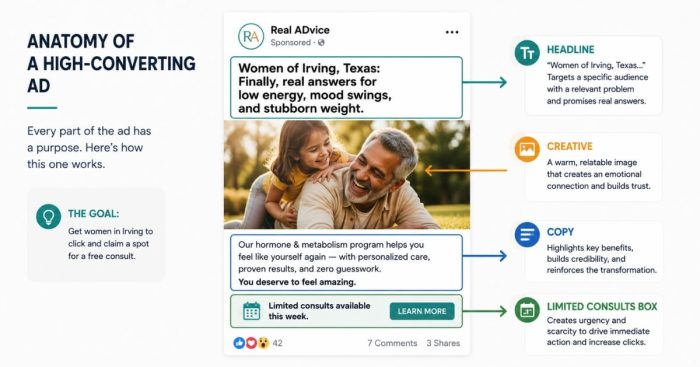
What makes the actual ad convert — headline, creative, and copy?
Three components each have one job.
The headline gets attention.
The creative shows the outcome.
The copy makes the reader say, “This is for me.”
Start with the psychology.
People move toward pleasure or away from pain.
As a result, every ad either inspires hope (our favorite) or names the pain and offers the way out.
For creative, static images that depict the outcome work reliably.
A weight-loss ad shows smiling, fit women walking.
A knee-pain ad shows someone playing the sport they miss.
An osteoarthritis ad goes even deeper.
It might show a smiling elderly man playing with his grandchild or a golfer back on the course.
Pain-side creative also works.
Examples include an inflamed knee or feet on fire.
Once you have them, a real patient video testimonial becomes the single best creative for cold traffic because people relate to the story.
The headline should call out exactly who you’re helping.
Examples include:
- “Residents of Exeter, New Hampshire—”
- “Women of Irving, Texas—”
- “Moms of Atlanta—”
The copy should name what they’re struggling with, make them feel understood, and then offer the free next step, such as the quiz or guide.
The headline box at the bottom should carry the urgency.
For example:
- “Limited consults available”
- “Click the link to apply”
Finally, keep tracking simple.
Use native Facebook lead forms before moving to landing pages.
Facebook already tracks those forms.
Automation can also deliver the lead magnet the moment someone opts in.
This whole stack—offer, magnet, audience, and creative—is the paid-ads half of a complete medical practice marketing system.
FAQ’s About High-Ticket Ads and Offers for Cash-Pay Clinics
What counts as “high ticket” for a cash-pay clinic ad campaign?
Programs in the $3,000–$10,000+ range.
Examples include neuropathy, knee-pain, functional medicine, thyroid, hormone programs, and memberships with strong annual value.
At those prices, you can pay $1,000–$2,000 to acquire a patient and still stay profitable while the campaign optimizes.
Why shouldn’t I just advertise a $99 consultation?
Because the math collapses.
With a $20 cost per lead and $99 of revenue, you must convert nearly every lead just to break even.
That’s before paying the person who works the leads.
Low-ticket ads make sense only as an entry point into a high-ticket program, never as the destination.
What’s the best lead magnet for a hormone or weight-loss campaign?
A self-assessment quiz or checklist.
Examples include a low-T quiz for men or a menopause checklist for women.
Build it from the questions you’d ask during an initial consultation.
It gives value, qualifies the lead, and positions your provider as the expert before the first visit.
How big should my Facebook audience be for a local clinic?
Target 150,000–225,000 people.
Build the audience as a radius around your clinic.
Then apply simple age and gender filters that match the treatment.
Save lookalike audiences until you can upload a list of 2,000–3,000 existing customers.
Should I send ad clicks to a landing page or use Facebook lead forms?
Use lead forms until your funnel is more advanced.
They’re pre-built, tracked natively, allow qualifying questions, and pair with automation that instantly delivers your lead magnet.
Landing pages earn their complexity later.
What’s the next step?
If you’re about to run ads for a low-ticket offer—or you have a high-ticket service but no program, no lead magnet, and no tested offer—build first and spend second.
The sequence above is the difference between ads that compound and ads that quietly eat $2,000 a month.
Book a free strategy call.
In 60 minutes, we’ll look at your services, pick the high-ticket program worth building ads around, and map the offer, lead magnet, and audience for your market.