
How Long Should I Give Paid Ads to Work at My Cash-Pay Clinic? (Why Patience and Strategy Beat Overpromising)
One of our clients — a cash-pay clinic owner running an HRT campaign with us — put it this way: “I’ve appreciated you being able to very cleanly do these paid ads without overpromising, and being okay with them kind of puttering along as we figure them out… you’re more patient than a lot of the previous people we worked with.” That patience isn’t a personality trait. It’s the strategy. Here’s the FAQ on how long paid ads actually take, what should happen while they’re “puttering,” and how to tell patience from excuses.
How long should I give paid ads to work at my cash-pay clinic?
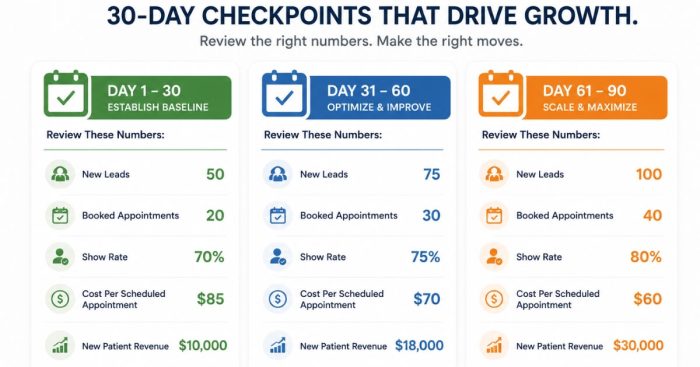
90 days of structured testing before you judge the channel — but with visible progress checkpoints every 30 days.
Anyone who promises profitable ads in week two is either lucky or lying, and you shouldn’t build a practice on either.
The first month of a cash-pay campaign is a paid research project: you’re buying data about which hooks, offers, and audiences your market responds to.
Month two is optimization — killing losers, feeding winners.
Month three is when cost per booked consult should be trending toward your target.
The clinics that get burned are almost never the ones whose ads started slow; they’re the ones who quit at day 25, switched agencies, and restarted the same 90-day clock with someone new — three times in a row.
That said, “give it 90 days” is not “hear nothing for 90 days.”
You should see the testing work happening: new creatives shipping, clear reporting on what was killed and why, and cost per lead moving in the right direction.
Patience with a process is smart.
Patience with silence is expensive.
Why do HRT and hormone campaigns take longer to dial in than other ads?
Because hormone care is a high-consideration, compliance-constrained purchase — the patient takes longer to decide, and the platforms restrict how directly you can talk to them.
An HRT membership is a monthly commitment to a medical relationship, often $150–$300 a month for years.
Nobody impulse-buys that off one ad.
The funnel that works is usually education-first: a quiz, a symptom checklist, or a short video that lets the prospect self-identify before they ever see a booking page.
Meanwhile Meta and Google restrict personalized-health language, so creative testing has to find angles that convert without tripping ad review.
That’s a narrower creative space, and narrower spaces take more iterations to find the winners — this is the core of effective men’s hormone and TRT clinic marketing.
The payoff for the patience is that hormone patients are among the highest-lifetime-value patients in cash-pay medicine.
A campaign that “putters” for two months and then reliably produces $200/month members for years is worth ten campaigns that spike cheap leads who never convert.
What should actually be happening while my ads are “puttering along”?
Three things, each with a number you can ask for at the 30-day mark.
Creative testing with a scoreboard. At least 3–5 distinct angles (pain-led, curiosity-led, offer-led) should have been tested, and your agency should tell you which won, which died, and what’s being tested next.
Ask: “Which hook is winning and by how much?”
Cost per lead trending down. Early leads are expensive — that’s normal. What matters is direction.
Ask: “What was CPL in week one versus this week?”
The funnel behind the ad getting fixed. Leads that don’t answer, booking flows that confuse, follow-up that doesn’t happen — ad performance is often funnel performance in disguise.
This is why the client above named CRM management as one of the two most helpful things we do alongside the ads themselves.
Ask: “What’s our lead-to-consult rate, and what changed in the funnel this month?”
If your agency can answer all three crisply, the campaign is working even if the revenue hasn’t arrived yet.
If they can’t, “be patient” is a stall, not a strategy.
How do I tell the difference between a patient agency and an overpromising one?
Listen to what they say before you sign — the overpromise always happens in the sales conversation, not the campaign.
An overpromising agency quotes results (“30 new patients in your first month, guaranteed”) before they’ve seen your market, your offer, or your close rate.
A strategic one scopes the test: what will be tested, what the checkpoints are, and what the decision looks like at each one.
Our client compared it directly to past vendors: previous agencies had promised fast and delivered churn; what he valued was clean execution “without overpromising” and high-level strategic conversations about the campaign — the kind where you talk through the HRT offer and funnel, not just the ad budget.
There’s a simple structural reason the honest answer wins: paid ads amplify a clinic’s whole system.
When the system is right, the results are extraordinary — a medspa we ran multi-channel paid campaigns for added $6,708,600 in revenue and 3,727 new patients in a single year.
But that result came from offers, funnels, and follow-up built deliberately — not from a magic first month.
Any agency selling the result without the build is selling you the ending of someone else’s movie.
When should I actually pull the plug on a paid ad campaign?
When the numbers say the funnel is fine but the economics still don’t work — not when you’re bored or nervous.
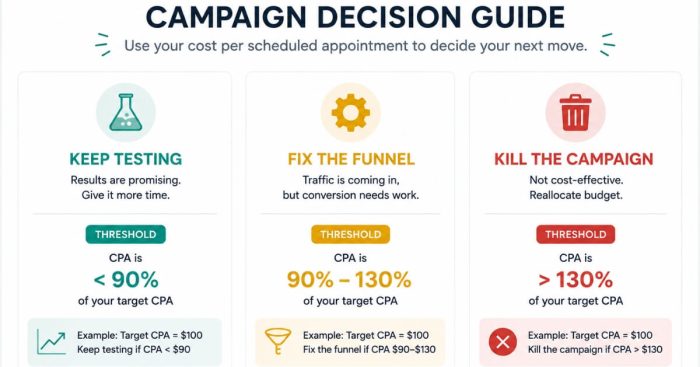
Three-gate decision at day 90: first, is cost per booked consult at or trending toward a number where your average patient value makes the math work? (For most cash-pay clinics, a patient worth $3,000+ supports a cost per booked consult of $150–$300.)
Second, is the lead-to-consult conversion above roughly 20–30%? If it’s not, the problem is usually follow-up or offer, not the ads — killing the campaign fixes nothing.
Third, have at least 3–5 creative angles been properly tested? If not, you haven’t finished the experiment you paid for.
Kill it only if the answer pattern is: funnel converting fine, creatives fully tested, economics still upside down.
That combination means the channel or offer genuinely doesn’t fit — and that’s a strategic finding worth the test budget.
We’ve seen the opposite outcome too: done right, a single channel can carry a practice, like the orthopedic surgeon whose Facebook ads added $2 million in revenue.
The difference between those two endings is almost never patience alone — it’s patience plus a medical practice marketing system that converts what the ads produce.
FAQ’s About Paid Ads Patience and Strategy for Cash-Pay Clinics
How long before paid ads become profitable for a medical practice?
Plan on 90 days of structured testing: month one buys data, month two optimizes, month three should show cost per booked consult trending toward target.
Some campaigns hit sooner, but building your expectations around a lucky week two sets you up to quit good campaigns early.
What’s a normal cost per lead for a cash-pay clinic’s ads?
It varies widely by vertical and market, which is exactly why the trend matters more than the number: early CPL is always inflated, and a healthy testing phase shows it falling week over week.
Judge campaigns on cost per booked consult against your average patient value, not on raw lead cost.
Is it a red flag if my agency asks for 90 days?
No — it’s usually a green flag, if it comes with 30-day checkpoints, visible creative testing, and falling costs.
The red flag is a guaranteed-results pitch before they’ve seen your offer and close rate, or a “be patient” answer with no data behind it.
Why are my ads generating leads but no patients?
Because ads and funnel are different systems.
If lead-to-consult conversion is under 20%, the leak is usually speed-to-lead, follow-up cadence, or a confusing booking flow — fix the CRM side before blaming the campaign.
Should my agency handle my CRM as well as my ads?
Ideally the same team owns both, or coordinates tightly.
Ad optimization depends on knowing which leads became consults and patients — data that lives in the CRM.
Agencies that refuse to look past the lead handoff can’t actually optimize for revenue.
What’s the next step?
If you’re three weeks into a campaign and wondering whether to panic, or you’ve been burned by an agency that promised week-one miracles — the fix is the same: a testing plan with real checkpoints and a funnel that converts what the ads produce.
Book a free strategy call.
In 60 minutes we’ll look at your offer, your market, and your numbers, and tell you honestly whether paid ads are your next move — and what the first 90 days should look like if they are.
No overpromising.
That’s the point.