
What Should My Clinic Do When Leads Start Coming In Faster Than Expected? (The Playbook for a Sudden Lead Surge)
A clinic owner we work with said it out loud on a call: “You’re getting some leads for weight loss and peptides and stuff… I’m not sure fully what to do with this right now, but I’m just going to roll with it.” His new website had started producing before his team had a plan for the volume. It’s a good problem — and it’s still a problem, because unworked leads go cold in hours, not weeks. Here’s the FAQ on what to do when demand shows up before you’re ready.
Why are leads suddenly coming in faster than expected from my clinic’s website?
Because a properly built website plus real search demand compounds faster than most owners are told to expect — especially in weight loss and peptides.
Most clinic owners have been burned by “SEO takes a year” talk. So, when a rebuilt site starts producing in the first weeks, they’re caught flat-footed.
However, high-intent cash-pay searches for weight loss programs, peptide therapy, and hormone care are happening every day in your city. People search Google, and they ask ChatGPT.
When your site answers those questions clearly and makes booking obvious, the leads that were always out there start landing in your inbox.
The owner above didn’t run a single new ad. His words to us: “It’s impressive how the website’s starting to produce already.”
We’ve seen the same pattern at scale.
The surge isn’t luck. It’s pent-up demand meeting a site that finally converts it.
What are the first 3 moves when a wave of new leads hits my clinic?
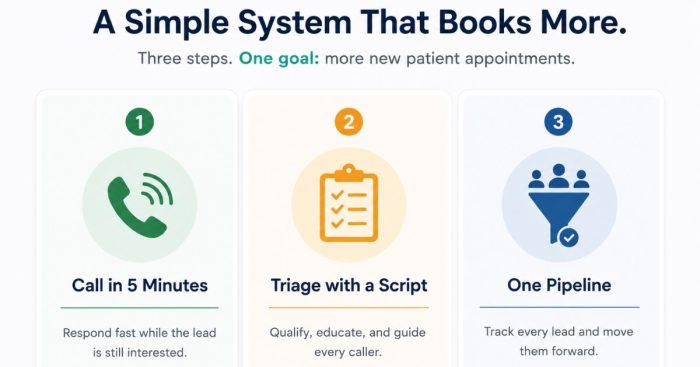
Three moves, in this order — and all three can be live within a week.
Set a 5-minute response window.
A web lead’s odds of answering collapse within the first hour.
Whoever owns lead response should call within five minutes during business hours.
After hours, send an automated text immediately:
“Hi, this is [Name] from [Clinic]. Got your request — what’s the best time tomorrow for a quick call?”
Triage with a script, not a vibe.
Your front desk needs exact words for the new lead types.
For a weight-loss inquiry, ask:
“So I can point you to the right program — are you looking to lose 15 pounds or more, and have you tried a medical program before?”
Those two questions route the lead to the right consult instead of a generic callback.
Put every lead in one pipeline.
Website forms, phone calls, and Instagram DMs should all land in one CRM pipeline with stages your team can see.
If leads are still being forwarded around by email, you’ll lose track of a third of them by Friday.
How do I avoid wasting weight-loss and peptide leads I didn’t plan for?
Treat them as time-sensitive, high-LTV inquiries — because that’s what they are.
A weight-loss lead is usually someone who finally decided, this week, to do something about it.
A peptide lead has typically been researching for weeks and is comparing two or three providers.
Both go cold fast. Both are also worth far more than their first transaction.
A GLP-1 patient who hits goal weight can move into maintenance, hormone optimization, or longevity programs. Likewise, a peptide patient is a natural recurring-program member.
That’s why building a predictable patient acquisition system around these verticals pays for itself so quickly.
Each recovered lead isn’t one visit. It’s often a multi-year patient relationship.
Practically, that means don’t quote a full price list by text.
Instead, book the consult:
“The doctor covers exactly that in a 15-minute consult — I have Tuesday at 2 or Wednesday at 10, which works?”
Then place every non-responder into an 8-touch follow-up sequence instead of giving up after one call.
If peptides are becoming a real service line for you, our guide to peptide therapy clinic marketing covers how to position and price it compliantly.
Should I slow down my marketing until my team catches up?
No. Fix throughput, don’t throttle demand — pausing momentum is the most expensive way to buy breathing room.
When a site or campaign starts compounding, turning it off doesn’t pause your position. It surrenders it.
Google and the LLMs that now answer patient questions reward pages that keep earning engagement. Rankings you abandon get reoccupied.
The right response to “we can’t handle all these leads” is almost never less marketing.
Instead, build a tighter system. Block more consult slots on the calendar. Move simple visits to telehealth. Give the front desk the triage script.
If the calendar truly fills, raise prices or start a waitlist with a deposit.
Every one of those options makes you money. Pausing makes you none.
The owner who told us, “I’m just going to roll with it,” had the right instinct — roll with it.
However, rolling with it needs structure within the first 30 days. Otherwise, the team burns out and the leads leak.
How do I turn an early lead surge into durable growth?
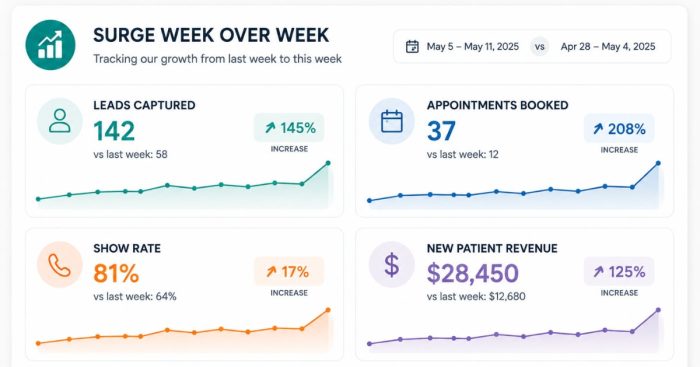
Track four conversion numbers weekly, and staff to the bottleneck they reveal.
The four are:
- Contact rate (what percentage of leads you actually reach)
- Booking rate (reached → consult booked)
- Show rate (booked → showed)
- Close rate (showed → paid patient)
A surge exposes your weakest link within two weeks.
If contact rate is low, it’s a speed-to-lead problem.
If booking rate is low, it’s a script problem.
If show rate is low, it’s a reminder or deposit problem.
If close rate is low, it’s a consult structure problem.
This is the difference between clinics that convert a surge into a new revenue plateau and clinics that look back on it as “that busy month.”
An orthobiologics practice we work with converts 79.4% of leads into booked appointments and generated $309,590 in cash-pay revenue in 10 months without paid ads. That’s not because their leads are better. It’s because every stage of the funnel has an owner and a number.
FAQ’s About Handling a Sudden Lead Surge at Your Clinic
How fast should my clinic respond to a new website lead?
Within 5 minutes during business hours, and with an instant automated text after hours.
Contact rates fall off a cliff after the first hour. A lead who filled out your form is often filling out a competitor’s form ten minutes later.
What should my front desk say to a new weight-loss lead?
Ask two triage questions, then close for the booking.
“So I can point you to the right program — are you looking to lose 15 pounds or more, and have you tried a medical program before?”
Then follow with:
“The doctor covers exactly that in a 15-minute consult — I have Tuesday at 2 or Wednesday at 10, which works?”
Never quote the full program price by text.
Should I pause my ads or SEO if my clinic can’t handle the lead volume?
No.
Add consult capacity, tighten triage, use telehealth for simple visits, or introduce a deposit-backed waitlist instead.
Pausing surrenders rankings and momentum that took months to build. Restarting costs more than staffing up would have.
How many times should we follow up with a lead who doesn’t answer?
At least 8 touches across phone, text, and email over two to three weeks.
Most clinics quit after one or two attempts. That’s why “dead” lead lists are usually full of bookable patients.
Why did my new website start generating leads so quickly?
Because demand for cash-pay services like weight loss, peptides, and hormone care already existed in your market.
Your old site simply wasn’t converting it.
A site with clear service pages, visible pricing context, and an obvious booking path captures demand that was previously bouncing.
What’s the next step?
If your leads are starting to come in faster than expected — or you want them to — the window to build the system is now, while the momentum is working for you.
Unworked leads don’t wait, and neither do competitors.
Book a free strategy call. In 60 minutes we’ll map your lead flow, find where the surge would leak, and give you the response windows, scripts, and pipeline structure to convert it.
If it’s a fit, we’ll build it with your team.