
How Much Revenue Is Your Front Desk Losing on Post-It Notes?
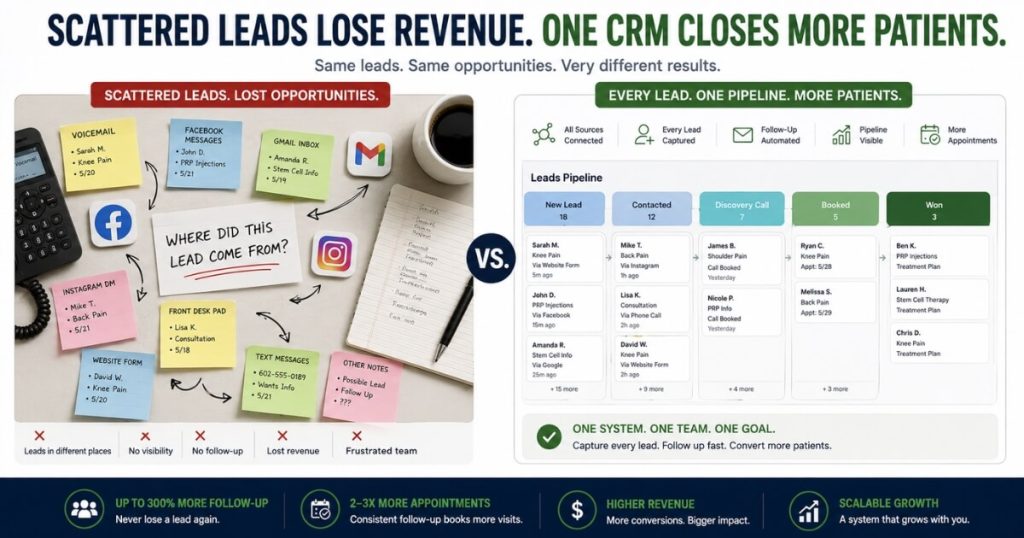
Walk up to your front desk and look at the monitor. If it’s ringed with sticky notes of patient names and callback reminders, you’re looking at a small fortune in revenue that will probably never be collected. Each of those notes represents a patient who slipped out of your system. The money doesn’t disappear quietly. Here’s the FAQ on what scattered patient contacts are really costing you and how to capture that revenue instead.
How much is a post-it note on the front desk really worth?
Roughly $5,000 each—and closer to $10,000 or more when you count the referrals that patient would have sent.
It sounds dramatic until you do the math.
In most clinics, a single sticky note with a patient’s contact information represents about $5,000 in revenue that will probably never be collected. That happens because the patient falls through the cracks instead of being followed up and booked.
The value doesn’t stop there. Every patient who has a great experience often refers someone else. That means each lost contact could actually be worth $10,000 or more once referrals are included.
Just three or four sticky notes can equal the entire annual salary of the front-desk employee whose monitor they’re stuck to.
That’s the hidden cost of an uncaptured lead. It doesn’t appear as a line item, so owners rarely notice it. But it’s real money walking out the door, one note at a time.
Plugging that leak is one of the fastest and cheapest ways to grow a clinic. It’s also the foundation of a reliable patient acquisition system.
Why can’t I just tell my front desk to use the CRM?
Because you already have—and it doesn’t stick.
Every time you tell your team to document contacts in the CRM, they do it for a little while. Then they gradually return to their old habits.
This is the frustrating reality every owner knows.
You buy the CRM. You train the team. For a few weeks, every contact goes into the system. Then the sticky notes slowly come back because you’re busy seeing patients all day. You can’t stand over the front desk making sure every lead gets logged.
Simply telling people to change their habits rarely works. Without a system that makes the right process the easiest process, old habits almost always return.
Hiring a new person usually doesn’t solve it either.
You’ve probably considered it. But then you’d still have to train them, and you don’t have the time because you’re with patients all day.
The issue isn’t the employee. The issue is that there’s no structure forcing every lead into one place automatically. Until that structure exists, you’ll keep losing contacts no matter who sits at the desk.
What actually stops leads from falling through the cracks?
An integrated funnel that automatically captures every single lead into one place—no post-it notes, no disjointed systems, and no multiple CRMs.
The fix isn’t willpower. It’s architecture.
Every lead should automatically flow into one system, whether it comes from:
- Your website
- Your phone
- Your Google Business Profile
- Your ads
- Walk-ins
When every lead lands in one place, there’s nowhere for a contact to hide on a sticky note.
One place. Every lead.
This is the first of the three things we implement in every clinic we work with. It’s also the one that immediately stops the bleeding.
A lead that’s captured can always be followed up. A lead sitting on a post-it usually can’t.
The proof is in the numbers.
Most of that growth came from capturing and converting the leads those clinics already had. It didn’t come from buying more leads. It’s the exact revenue that otherwise ends up forgotten on sticky notes.
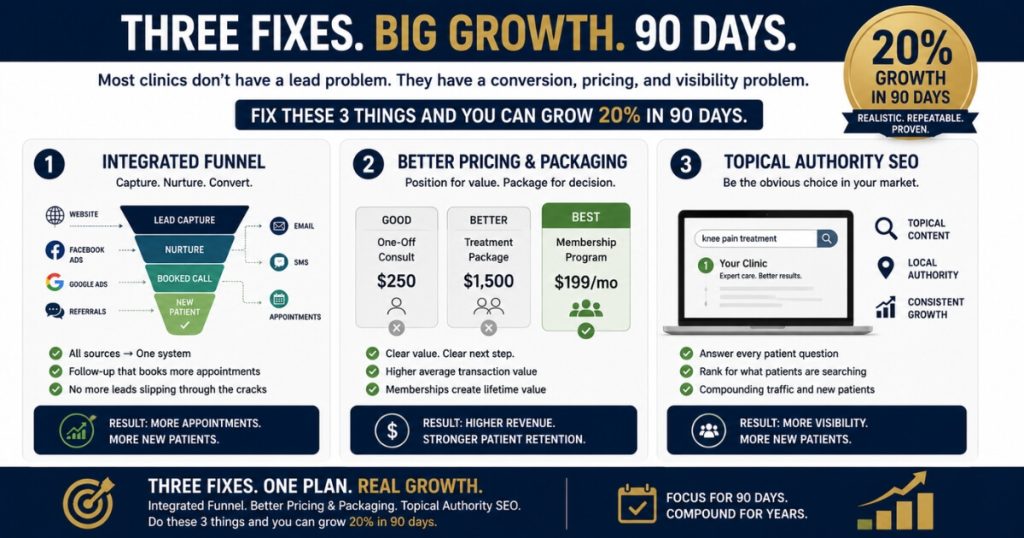
What are the three things that actually grow a clinic in 90 days?
An integrated funnel that captures every lead, better pricing and packaging that improve conversion and profit, and topical-authority SEO that makes you the go-to expert.
Together, these three consistently grow the clinics we work with by at least 20% in the first 90 days.
Start with the integrated funnel. It gets every lead into one place so nothing is lost.
Next, improve your pricing and packaging. Raising prices—or simply presenting pricing more effectively—can immediately increase both conversion and profit without generating a single new lead.
Finally, build topical-authority SEO. Publish content that positions your clinic as the trusted expert in your market so patients find and trust you organically.
Notice what these three improvements have in common.
None of them require buying more leads.
Instead, they help you:
- Capture more leads.
- Convert more leads.
- Attract better leads.
That’s why they work so reliably and so quickly.
This is the core of durable medical practice marketing. It’s built on assets you own rather than ad spend you rent.
How do I reactivate the patient contacts I’ve already lost?
Get every existing contact into one system. Then run a structured reactivation campaign.
Many of those “lost” patients will come back once someone finally follows up.
Before spending anything on new marketing, work the contacts you already have.
That includes:
- Every old lead
- Every no-show
- Every patient who drifted away
- Every sticky note
Import them into your CRM and follow up with calls, texts, and emails.
A large share of a clinic’s easiest revenue comes from people who already showed interest once. You already paid to acquire them, so reactivating them costs almost nothing.
These weren’t bad leads. They simply fell through the cracks.
Put them into a system and follow up consistently. A meaningful percentage will re-engage.
That’s proof of how much revenue comes from converting the leads you already have instead of constantly chasing new ones.
FAQ’s About Capturing Lost Front-Desk Revenue
How much revenue does a clinic lose to scattered patient contacts?
A lot.
In most clinics, a single sticky note with a patient’s contact information represents about $5,000 in revenue that will probably never be collected. Once referrals are counted, that number can climb to $10,000 or more.
Just three or four sticky notes can equal a front-desk employee’s annual salary.
Why doesn’t telling my team to use the CRM work?
Because habit change without structure doesn’t last.
Staff log contacts for a few weeks after training, then gradually return to sticky notes. Owners are usually too busy seeing patients to police the process.
The solution is an integrated funnel that automatically captures every lead into one place. The right way becomes the automatic way instead of another rule people have to remember.
What three things grow a clinic fastest?
Three things consistently make the biggest difference:
- An integrated funnel that captures every lead.
- Better pricing and packaging that improve conversion and profit.
- Topical-authority SEO that positions you as the local expert.
Done together in the first 90 days, these consistently grow clinics by at least 20%. None of them require buying more leads.
How do I reactivate old patient leads?
Pull every existing contact into one CRM. That includes old leads, no-shows, inactive patients, and even names written on sticky notes.
Then run structured outreach using calls, texts, and emails.
You already paid to acquire these contacts, so reactivating them is one of the lowest-cost sources of new revenue. Many re-engage simply because someone finally followed up.
What’s the next step?
If your front desk runs on sticky notes and your CRM has become a graveyard, you’re losing real revenue every week—and it’s recoverable.
Book a strategy call.
Before the call, we’ll audit your clinic and current sales process. During the session, we’ll show you how to:
- Get every lead into one place.
- Reactivate the contacts you’ve already lost.
- Put the three 90-day growth levers to work.
If it’s a fit, we’ll build it with your team.