
How Do I Get My Clinic Team to Actually Take Ownership? (The 4 R’s Framework)
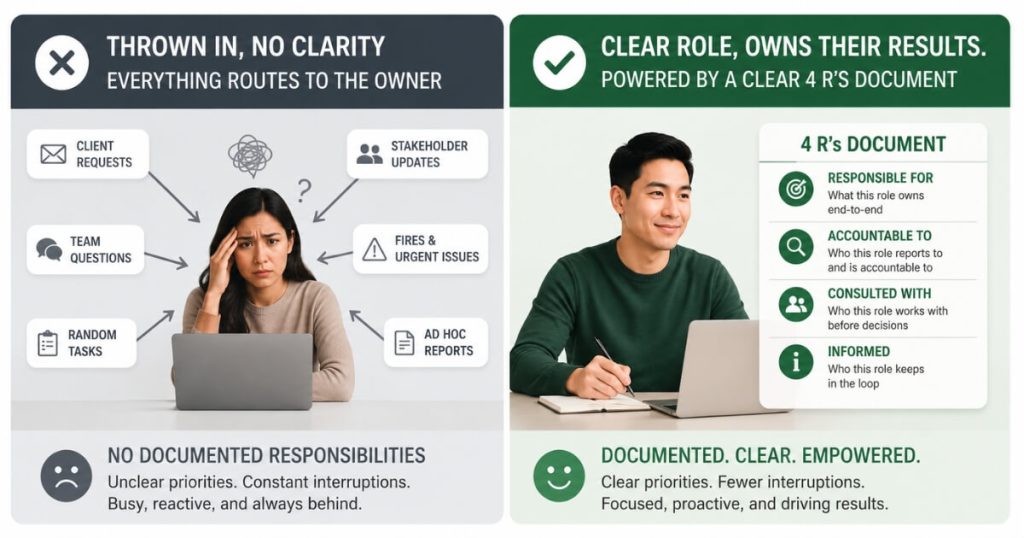
If you’re frustrated with your team’s productivity or their reluctance to change, the problem usually isn’t the people. It’s that they were never given a clear structure for what they own. Most clinic staff are thrown into their roles without documented responsibilities, so everything defaults back to the owner. The 4 R’s framework — Role, Responsibilities, Requirements, Results — fixes that. Here’s the FAQ on how to use it to build a team that takes ownership.
Why won’t my clinic team take ownership of their work?
Because they were never told exactly what they’re solely responsible for — so when problems arise, they route back to you.
When owners describe frustration with their team’s productivity or resistance to change, the root cause is almost always the same. The team doesn’t know what they’re supposed to be doing because, when they were hired, they weren’t given a clear list of what they alone are responsible for. On top of that, the owner usually doesn’t know what systems the team has cobbled together to make things work. Most staff are simply thrown into place with very little operational structure. Then they’re judged for not owning outcomes nobody clearly assigned them.
That’s not a people problem; it’s a structure problem. A capable person with no defined responsibilities will hedge, wait for direction, and escalate everything to the owner. That’s not out of laziness. It’s because ownership was never actually handed to them. Fixing the structure is one of the highest-leverage moves in running a cash-pay practice. It also underpins everything in medical practice marketing, because marketing only compounds when the team behind it executes reliably.
What are the 4 R’s?
Role, Responsibilities, Requirements, and Results — a simple document that defines each position on your team.
The 4 R’s break a job into four clear parts:
- Role is who they are and where they sit in the organization — the title and the seat.
- Responsibilities are the specific things they, and only they, own day to day.
- Requirements are what they need to do the job — the tools, skills, standards, and systems the position demands.
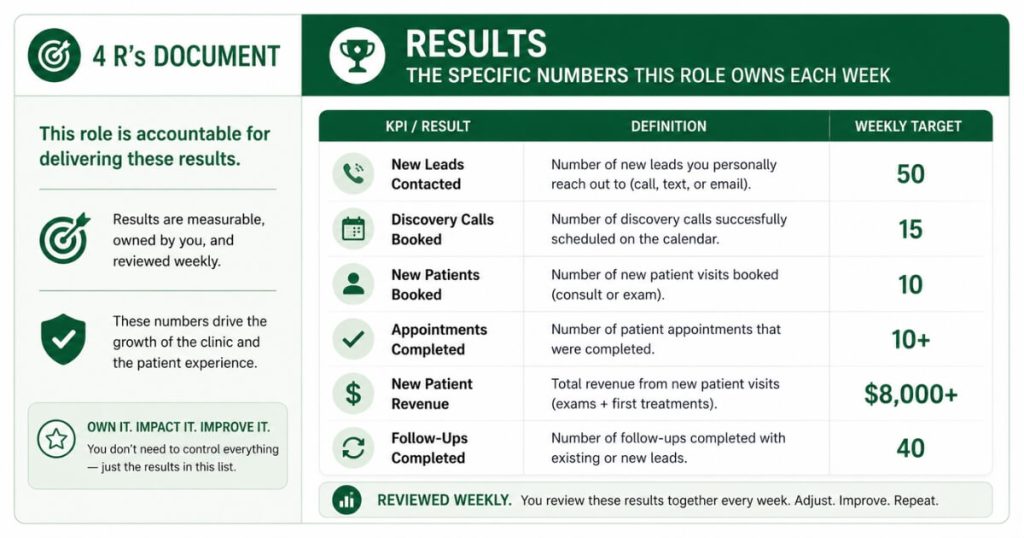
- Results are the measurable outcomes they’re accountable for. They’re the numbers that prove the role is being done well.
Written down for each position, the 4 R’s turn a vague job into a clear contract. The employee knows what they own, what they need, and how they’ll be measured. The owner knows exactly what to expect and where the line of accountability sits. It’s the difference between saying, “Help out at the front desk,” and saying, “You own new-patient bookings. Here’s how it’s done. Here’s the number you’re accountable for.”
How do the 4 R’s actually fix team performance?
By removing the two things that quietly wreck team performance: ambiguity about ownership and the owner being the invisible backstop for everything.
When every role has a documented 4 R’s, ambiguity disappears. Nobody wonders whose job something is because the responsibilities are written down. Also, nobody guesses at the standard because the requirements spell it out. Nobody escapes accountability because the results are defined and measured. That clarity allows a team member to genuinely own their area instead of deferring to the owner on every decision.
It also surfaces the systems problem. When the owner writes down what each role requires, they finally see the tools and processes the team is—or isn’t—using. That’s often where hidden inefficiencies live. Documenting the 4 R’s forces the operational structure into the open, where it can be improved. Eternity Health Partners removed both owner-operators from day-to-day operations while growing from $1M to $4M a year. That only happened because each role was clearly defined and accountable, so the practice could run without the owners making every decision.
How do I write a 4 R’s document for a position?
Start with the seat, list what only they own, define what the role requires, and attach the specific numbers they’re accountable for.
For each role, write it out plainly:
- Role: the title and where it fits.
- Responsibilities: a concrete list of what this person owns — not shared, not vague, theirs.
- Requirements: the skills, tools, systems, and standards needed to do the job well.
- Results: the weekly or monthly numbers that show it’s working.
A New Patient Coordinator’s results might include new-patient appointments booked and attendance rate. A front-desk manager’s results might include answer rate and follow-up speed. The numbers make the role objective.
Do this for every position — front desk, patient coordinator, marketing lead, and office manager. It doesn’t need to be long. It needs to be clear. Once each person has their 4 R’s, review the results with them on a regular cadence. The document becomes a living accountability tool instead of a file nobody opens.
How do the 4 R’s help me delegate and eventually step back?
They make delegation safe because you’re handing over a defined role with defined outcomes instead of a vague hope that someone will “figure it out.”
The reason many owners can’t step back is that nothing is written down. As a result, only they know how the practice actually runs. The 4 R’s change that. Once a role is documented — responsibilities, requirements, and results — you can hand it to a competent hire and hold them to the numbers. You no longer have to re-explain everything or do it yourself. That’s what turns an owner-dependent clinic into a business that runs without the owner in the building.
It also improves hiring and retention. Candidates perform better and stay longer when they know exactly what they own and how they’re measured. Clarity reduces the friction and resentment that come from shifting, undefined expectations. Dr. Groysman’s practice improved team retention while lifting monthly revenue by more than $40K. It’s a reminder that a clearly structured, accountable team and a healthier bottom line tend to arrive together.
FAQ’s About the 4 R’s Framework for Clinic Teams
What are the 4 R’s for a clinic team?
Role, Responsibilities, Requirements, and Results.
- Role is the seat and title.
- Responsibilities are what that person alone owns.
- Requirements are the tools, skills, and systems the job needs.
- Results are the measurable numbers they’re accountable for.
Documented for each position, the 4 R’s turn a vague job into a clear, accountable role.
Why doesn’t my team take ownership?
Usually because they were never told exactly what they’re solely responsible for. Most clinic staff are thrown into their roles without documented responsibilities, so problems default back to the owner. It’s a structure problem, not a laziness problem. Defining each role with the 4 R’s fixes it.
How do the 4 R’s improve performance?
They remove ambiguity about who owns what and eliminate the owner acting as the invisible backstop for everything. With responsibilities written, requirements defined, and results measured, team members can genuinely own their areas. Documenting requirements also surfaces hidden systems problems so they can be fixed.
How do the 4 R’s help me step back from the clinic?
They make delegation safe by letting you hand over a defined role with defined outcomes instead of hoping someone figures it out. Once roles are documented and measured, a competent hire can run them while you hold them to the numbers. That’s how an owner-dependent clinic becomes a business that runs without the owner.
What’s the next step?
If your team’s productivity frustrates you and everything still routes back to you, the fix is structure, not pressure. Book a strategy call. In 60 minutes we’ll map the 4 R’s for your key roles—what each person should own, what the role requires, and the numbers they’re accountable for. That way, your team takes ownership and your clinic can run without you in every decision.
If it’s a fit, we’ll build the role documents and accountability systems with your team.