
How Should I Structure Compensation for My Cash-Pay Clinic Team? (Aligning Pay With the Behaviors You Want)
Compensation is not just an expense — it’s the steering wheel for your team’s behavior. Whatever you reward, you get more of; whatever you ignore, you get less of. Most cash-pay clinics pay a flat wage and then wonder why nobody chases the booked patient, the review, or the upsell. This is the FAQ on structuring compensation that actually drives the outcomes you want, drawn from the compensation frameworks Real ADvice uses with its clients.
How should I structure compensation for my cash-pay clinic team?
Build a base plus a variable component tied directly to the behaviors and results you want more of.
Pay is the most powerful behavior tool you have, so use it to reward booked patients, reviews, upsells, and retention.
The core principle is alignment.
Your team will optimize for whatever you actually pay them to do.
If you only offer a flat hourly wage with no upside, you’ve told your team that booking another patient, earning a five-star review, or upselling a program doesn’t affect their paycheck.
As a result, many employees won’t prioritize those activities.
A well-designed compensation plan includes:
- A stable base through hourly pay or salary
- A variable component through bonuses, commission, or cash spiffs
The base provides financial stability.
The variable layer rewards the specific outcomes that help your clinic grow.
Together, they transform compensation from a cost you minimize into a system that drives conversion, reviews, upsells, and retention.
This is a major lever in patient acquisition and clinic growth because the people converting leads and caring for patients respond directly to how they’re compensated.
Reward the outcomes you genuinely want to see more often.
What compensation options work for a patient coordinator or front-desk role?
Several proven structures combine a stable base with meaningful incentives.
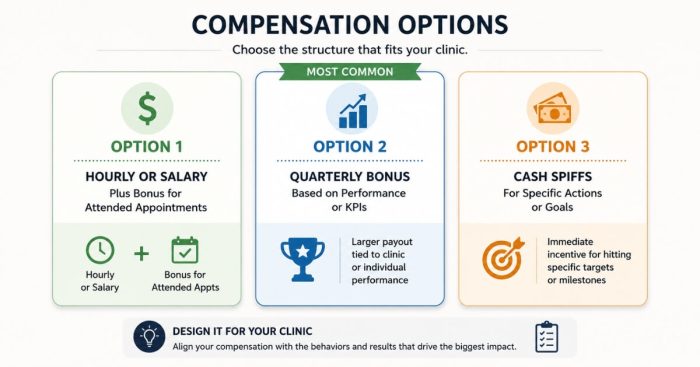
Common options include:
- Hourly pay plus a bonus for attended new-patient appointments
- Salary plus a bonus for attended new-patient appointments
- Hourly or salary plus a quarterly performance bonus
- Cash spiffs for booked patients, Google reviews, and upsells
There’s no single right structure.
The best option depends on your clinic, your economics, and the responsibilities of the role.
Many clinics combine several of these incentives.
Notice that most reward attended appointments or completed outcomes rather than simple activity.
That’s intentional.
You want to reward results, not effort alone.
A common progression for patient coordinators looks like this:
- Hourly pay during the first 90 days
- Transition to salary (often $40,000 to $60,000 annually)
- Add commission after they’ve proven themselves
Choose the combination that fits your business.
Regardless of the structure, include a variable component.
A flat wage alone leaves your team’s most valuable behaviors unrewarded.
Should I pay commission or a bonus on new patients?
Yes.
Tying bonuses or commission to attended new-patient appointments is one of the strongest ways to align your team with clinic growth.
The important detail is what earns the reward.
Paying for attended appointments—not simply booked appointments—ties compensation to a meaningful outcome.
Some clinics even calculate the bonus after confirming the patient kept the appointment.
That distinction matters.
If you reward bookings alone, team members may schedule patients who never intend to show.
When you reward attended appointments, you encourage better scheduling decisions and stronger follow-up.
The incentive follows the outcome that actually matters.
This type of compensation also changes how patient coordinators approach their work.
Every attended appointment benefits both the clinic and the coordinator.
As a result, they’re more likely to:
- Follow up quickly
- Stay engaged with leads
- Protect the show rate
Outcome-based bonuses separate someone who simply answers the phone from someone who actively grows your patient acquisition funnel.
What are “cash spiffs” and when should I use them?
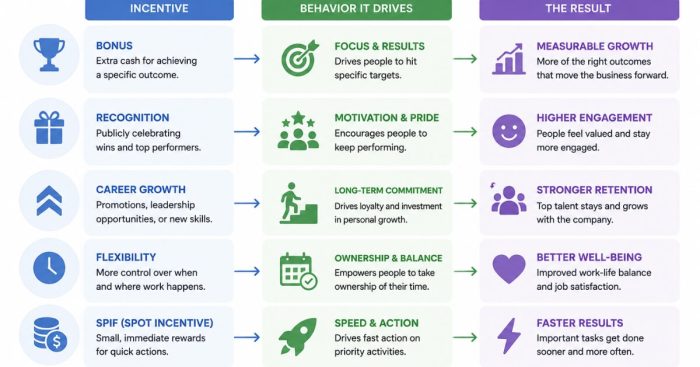
Cash spiffs are small, immediate rewards for specific actions.
Examples include:
- Booking a new patient
- Generating a Google review
- Completing an upsell
They’re especially effective because the reward is immediate and highly visible.
Unlike quarterly bonuses, a spiff is paid as soon as someone reaches the target.
That immediacy reinforces the exact daily behaviors that compound into long-term growth.
Employees naturally repeat behaviors that receive quick rewards.
Use cash spiffs to create momentum around priorities that might otherwise be overlooked.
For example, rewarding every new Google review encourages your team to consistently ask satisfied patients for feedback.
Spiffs work best alongside a broader compensation plan.
Think of it this way:
- The base provides stability.
- Quarterly bonuses reward long-term consistency.
- Cash spiffs reinforce important daily behaviors.
Just make sure you reward behaviors you genuinely want repeated.
Whatever receives a spiff quickly becomes the team’s focus.
How do I structure the transition from hourly to salary?
Start new team members on hourly pay.
Then transition them to salary plus commission after they’ve demonstrated they can perform.
A common structure begins with an hourly wage during the first 90 days.
After that, many clinics move coordinators to a salary, often between $40,000 and $60,000 annually, plus commission.
The hourly period serves as a mutual trial.
It limits your hiring risk while allowing the employee to prove themselves.
Once they’ve demonstrated success, the move to salary rewards their commitment and provides greater financial stability.
Adding commission keeps performance incentives in place even after the salary begins.
That ongoing upside encourages coordinators to continue booking and converting patients.
The structure also communicates something important to prospective hires.
It shows this is a career with growth potential, not simply another front-desk position.
That message attracts ambitious candidates and helps retain them.
How do I make sure my compensation drives the right behaviors, not the wrong ones?
Pay for the specific outcomes you want more of.
That includes attended patients, reviews, upsells, and retention.
Avoid rewarding activity or vanity metrics that don’t translate into meaningful results.
Compensation acts like a spotlight.
Your team naturally chases whatever it illuminates.
Because of that, be intentional about what you attach financial incentives to.
Reward outcomes such as:
- Attended appointments
- Five-star reviews
- Successful upsells
- Patient retention
For example, reward attended appointments instead of bookings alone.
That prevents people from filling the schedule with patients who are unlikely to show.
Likewise, rewarding reviews and upsells encourages behaviors that directly strengthen your clinic.
You can also reward retention so the team stays focused on keeping patients instead of only acquiring them.
Every incentive should support a behavior that genuinely improves your business.
Problems usually arise when clinics reward the wrong metrics.
Paying for raw activity, such as the number of calls made, often creates busy work instead of meaningful results.
If your team starts optimizing for the wrong thing, examine your compensation plan first.
The incentives are often the real cause.
A simple test is to ask:
“If someone maximized every dollar of their compensation, would that be great for my clinic?”
If the answer is yes, your incentives are aligned.
If the answer is no, redesign the structure.
Your team will always follow the money.
FAQ’s About Cash-Pay Clinic Compensation
What’s a good compensation range for a patient coordinator?
A common structure begins with hourly pay for the first 90 days.
After that, many clinics transition coordinators to a salary of roughly $40,000 to $60,000 per year plus commission.
Adjust those numbers for your local market.
The commission or bonus tied to attended new-patient appointments is what makes the role genuinely motivating.
More importantly, it aligns compensation with clinic growth.
The exact salary matters less than having a meaningful variable component alongside a stable base.
Should I pay for booked appointments or attended appointments?
In almost every case, reward attended appointments.
Paying only for bookings can encourage scheduling patients who never intend to show.
Instead, tie compensation to appointments that are actually attended.
Some clinics even calculate bonuses retroactively after attendance is confirmed.
That approach rewards quality scheduling and protects your show rate.
Remember:
You get what you pay for.
Reward the outcome you actually want.
How do quarterly bonuses work in this structure?
Quarterly bonuses reward sustained performance instead of individual actions.
They pair well with both a stable base and cash spiffs.
Start by setting quarterly targets.
Those goals might include:
- New patients
- Patient retention
- Google reviews
- Revenue
When the team achieves those objectives, pay the bonus.
This creates a balanced incentive structure:
- Cash spiffs encourage daily behaviors.
- Quarterly bonuses reward long-term consistency.
- Base pay provides financial stability.
How should I compensate providers versus coordinators?
The same compensation philosophy applies to every role.
Provide a stable base, then add incentives tied to outcomes each person directly controls.
For patient coordinators, reward:
- Booked patients
- Attended appointments
- Reviews
- Upsells
For providers, incentives may focus on:
- Patient retention
- Program enrollment
- Revenue generated
Design each compensation plan around responsibilities the individual can actually influence.
That alignment keeps every team member focused on the results that matter most.
What’s the next step?
If your team isn’t chasing booked patients, Google reviews, or upsells, examine how you’re paying them.
A flat wage tells employees those behaviors don’t matter.
Instead, build compensation around a stable base plus meaningful incentives.
Include bonuses for attended patients, quarterly performance bonuses, and cash spiffs for reviews and upsells.
When you pay for the behaviors you want, you’ll naturally see more of them.
On a strategy call we’ll design the compensation structure for your coordinators and team — the base, the incentives, and the metrics — so your pay drives growth instead of just covering payroll.
It’s the same team-building work behind clinics like an HRT clinic we grew from $1M to $4M a year with a team incentivized to close and retain.