
The 5 Stages of Customer Awareness: Why Your Cash-Pay Clinic’s Marketing Talks to the Wrong Patients
Most cash-pay clinic marketing shouts “book now” and lists a price — which only speaks to the tiny fraction of patients who are already ready to buy, and ignores the far larger market that isn’t there yet. The reason is a misunderstanding of customer awareness. Patients exist at five different stages of awareness, and each stage needs a completely different message. This is the FAQ on those five stages, drawn from the market-awareness framework Real ADvice teaches, and how to stop wasting your marketing on the wrong patients.
What are the 5 stages of customer awareness?
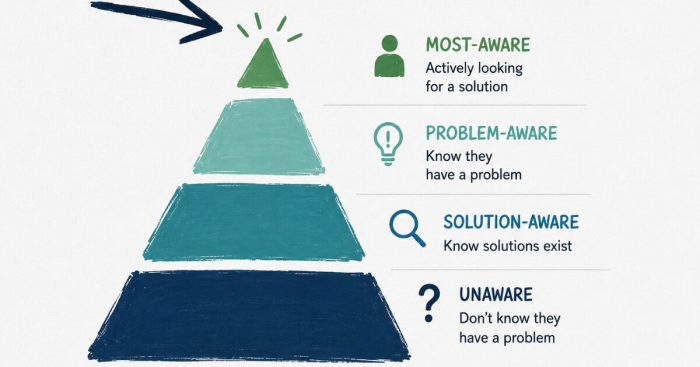
There are five stages: unaware, problem aware, solution aware, product aware, and most aware.
They range from the largest, hardest-to-reach segment (unaware) to the smallest, easiest-to-close segment (most aware).
Here’s how they progress:
- Most aware: Knows your offer, your price, and often your competitors.
- Product aware: Knows providers like you exist but hasn’t booked.
- Solution aware: Knows they want a solution and is beginning to compare options.
- Problem aware: Knows something is wrong but doesn’t yet know how to fix it.
- Unaware: Doesn’t recognize the problem yet or has simply accepted it as normal.
The critical insight is the size of each audience.
The most-aware segment is tiny.
Each stage below it becomes progressively larger.
Most patients aren’t ready to buy today.
Instead, they’re problem aware or solution aware.
Marketing that only speaks to the most-aware group fishes in the smallest pond while ignoring the ocean.
Understanding these stages is the foundation of medical practice marketing that reaches your entire market instead of only the small group already looking for prices.
Why does most cash-pay marketing talk to the wrong stage?
Because most clinics write every ad and landing page as though the patient is already most aware.
In reality, the vast majority of patients are only problem aware.
A message like “Book your appointment for $X per month” assumes the reader already:
- Knows they have a problem.
- Knows a solution exists.
- Knows about your clinic.
- Only needs a price and a calendar link.
That describes only the smallest segment of your market.
Everyone else still has questions.
Problem-aware patients know they don’t feel well but haven’t identified the right solution.
Solution-aware patients know solutions exist but are still deciding what to do.
For those audiences, a “book now” message feels irrelevant because it skips the steps they still need to take.
You’re asking for the sale before they’ve accepted they need one.
The result is expensive.
You compete against every other clinic for the tiny most-aware audience while the much larger problem-aware and solution-aware markets remain untouched.
The fastest-growing clinics reach patients much earlier in their awareness journey.
Then they guide those patients forward.
That’s the difference between fighting over scraps and opening up your real addressable market.
What is the “domino belief,” and how do I find mine?
The domino belief — sometimes called your marketing thesis — is the single belief a patient must hold before they buy.
If you can establish that belief, the purchase becomes much more likely.
Every purchase depends on one pivotal belief.
For a patient, that belief might be:
“This specific treatment, from this clinic, is the thing that will finally fix what I’m feeling.”
Once they genuinely believe that, they’re ready to book.
Your marketing exists to build that belief.
To find your domino belief, work backward from the sale.
Ask yourself:
What is the one thing a patient must believe before they’ll commit?
Everything in your marketing should support that answer.
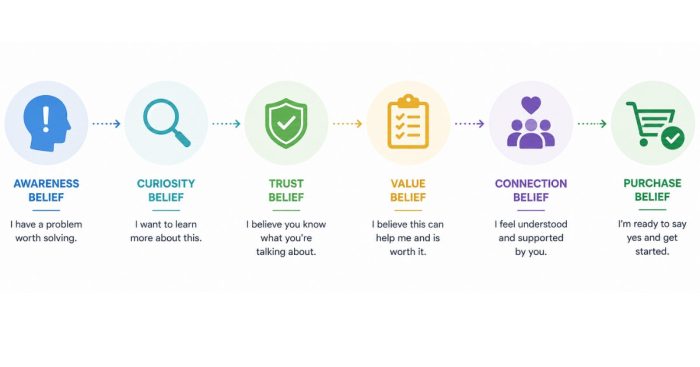
Patients at earlier awareness stages need additional beliefs first.
An unaware patient must first realize they have a problem.
Next, they need to believe solutions exist.
Then they must believe this type of solution fits them.
Only after that are they ready to believe your clinic is the right choice.
Finally, the domino belief tips them into action.
Identifying your domino belief clarifies your message.
Mapping the beliefs leading up to it clarifies your funnel.
That’s the strategic core of patient acquisition because you’re not simply running ads—you’re intentionally building belief.
How do I market to problem-aware patients — the biggest winnable segment?
Educate them about the problem and guide them, belief by belief, toward the solution.
Problem-aware patients represent a large, reachable audience that very few clinics address directly.
These patients know something is wrong.
They may experience:
- Fatigue
- Brain fog
- Weight that won’t move
- Chronic pain
What they don’t know is how to solve those problems or whether your type of treatment is the answer.
That’s why “book now” isn’t the right message.
Instead, create content that:
- Clearly identifies their problem.
- Helps them understand what’s happening.
- Introduces the idea that a solution exists.
- Explains why your approach fits that problem.
Education is the mechanism.
Each piece of content builds another belief in the chain.
Over time, the patient becomes ready to buy.
This opportunity is so valuable because it’s underserved.
While competitors fight over the small most-aware audience, you can build trust with the much larger problem-aware market.
By the time those patients are ready to act, your clinic is already the trusted authority.
Reaching patients earlier in their journey expands your market instead of forcing you to compete harder for the same small group.
Should I target the broad unaware market or a narrower, more-aware one?
Broader, less-aware markets offer more scale, but they also require stronger copy and a longer chain of beliefs.
For most clinics, targeting solution-aware patients with the best, most desirable solution is the sweet spot.
There’s an important tradeoff.
The earlier you begin in the awareness journey, the larger the market becomes.
However, you also have to guide patients through more beliefs before they’re ready to buy.
That demands stronger copywriting and more educational content.
The biggest marketing campaigns often target broad, unaware audiences.
Those campaigns succeed because they gradually build many beliefs over time.
They’re also created by world-class copywriters.
For most clinics, a more practical approach is to target solution-aware patients.
These patients already know they want to solve their problem.
Your job is simply to present the best and most desirable solution.
That creates:
- A shorter belief chain
- Easier marketing execution
- A much larger audience than the tiny most-aware segment
Match your ambition to your copywriting ability.
Reach as far back in the awareness journey as you can execute well, and no further.
How do I match my message to each awareness stage?
Give each awareness stage the message it actually needs.
Problem-aware patients need education.
Solution-aware patients need the best solution.
Product-aware patients need reasons to choose you.
Most-aware patients need an offer and a reason to act now.
The mistake is trying to use one message for everyone.
Instead, meet patients where they are.
- Unaware: Raise awareness that a problem exists.
- Problem aware: Explain the problem and introduce possible solutions.
- Solution aware: Position your approach as the best solution.
- Product aware: Differentiate your clinic and explain why you’re the right choice.
- Most aware: Present the offer, pricing, and a clear call to book.
The familiar “book now” message belongs only at the final stage.
When your marketing follows this framework, every piece of content serves a purpose.
Rather than demanding an immediate decision, it moves patients one belief closer to becoming ready.
Over time, your content, ads, and nurture campaigns work together to develop patients through every stage of awareness.
That’s how a clinic replaces a narrow “book now” megaphone with a marketing system that consistently develops future patients.
FAQ’s About the 5 Stages of Customer Awareness
Which awareness stage should my clinic focus on?
For most clinics, solution-aware patients are the sweet spot.
They’re large enough to drive meaningful growth while still being aware enough that the belief chain remains manageable.
Don’t ignore the most-aware segment because those patients close easily.
However, don’t build your entire marketing strategy around them.
That audience is small and highly competitive.
The greatest opportunity comes from reaching solution-aware and problem-aware patients.
Why is the unaware market bigger but harder to convert?
Because unaware patients don’t yet recognize they have a problem.
Your marketing must first build awareness before introducing solutions and eventually positioning your clinic as the answer.
That creates a much longer belief chain.
The reward is scale because it’s the largest audience available.
The challenge is execution.
Building that many beliefs requires exceptional copywriting and repeated educational touchpoints.
For most clinics, better ROI comes from targeting patients who are already problem aware or solution aware.
How does awareness relate to which channel I use?
Awareness and channel selection are closely connected.
Different platforms naturally reach patients at different stages.
For example:
- Google reaches more product-aware and most-aware patients actively searching for help.
- YouTube and social platforms reach problem-aware patients through educational content before they’re ready to buy.
Match the channel to the awareness stage you’re trying to reach, not simply to the treatment you provide.
Can AI and LLM search help me reach problem-aware patients?
Yes.
Problem-aware patients increasingly describe their symptoms to AI tools and search engines while trying to understand what’s happening.
If your content answers those problem-level questions clearly, you can reach patients at the exact moment they’re becoming aware that solutions exist.
Educational, question-based content helps you appear in AI-generated answers.
It also positions your clinic long before patients become ready to buy.
What’s the next step?
If your marketing only says “book now” and lists a price, you’re speaking to the smallest segment of your market while ignoring everyone else.
Instead, map the five stages of awareness.
Identify your domino belief.
Then create content that meets problem-aware and solution-aware patients where they are.
Guide them one belief at a time until they’re ready to act.
That’s how you expand your market instead of competing for the tiny group already prepared to buy.
On a strategy call we’ll map your patients across the awareness stages, define your domino belief, and build the right message for each stage so your marketing develops patients instead of simply chasing the ones already searching.
It’s the same strategy behind clinics like a weight-loss and medspa clinic where we added $6.7M in a year across 3,727 new patients.