
How Do I Create a No-Brainer Offer for My Cash-Pay Clinic? (Give Away More Than Your Competition Dares To)
A no-brainer offer is one where saying yes is so obviously worth it that the patient barely has to think — and it’s the single biggest lever on your patient acquisition. Most clinics never build one because they’re afraid to “give away” value. The clinics that win understand the opposite: you can only gain by offering more value than your competition dares to, then repricing so you still make money. This is the FAQ on creating a no-brainer offer, drawn from the offer-creation framework Real ADvice teaches its clients.
How do I create a no-brainer offer for my cash-pay clinic?
Give away more value than your competition is willing to, structured so the patient’s decision is easy and your margin stays intact — because if you don’t make them an offer that makes sense, someone else will.
The mindset shift comes first: there is plenty of business to go around, and you gain by offering value and educating prospects on how to solve their problems, not by hoarding.
The “scarcity” fear — that a competitor will steal your stuff, or that you can’t make money giving value away — is what keeps most clinics stuck with weak, forgettable offers.
A no-brainer offer flips that.
You stack so much genuine value that the patient would feel foolish not to take it, and you engineer the pricing so you still profit.
The practical rule is simple:
- Figure out how much you can afford to give away.
- Figure out how to still make money doing it.
That’s not a discount and it’s not charity — it’s a deliberate value stack with the economics worked out behind it.
Done right, a no-brainer offer is the most powerful patient acquisition tool you have because it removes the friction that kills the yes.
And the alternative is stark: the clinic down the road that does make a compelling offer will win the patient you didn’t.
Won’t giving stuff away lose me money?
No — not if you do the math and reprice.
The move is to give away the high-perceived-value pieces and fold their cost into the price of what you’re actually selling.
Here’s the classic example.
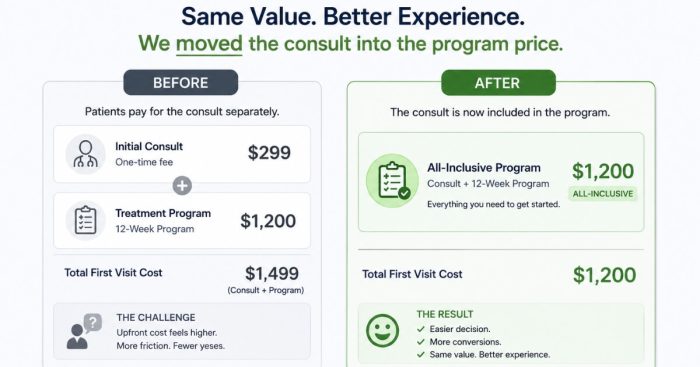
Say your initial consult is normally $250 and your program — the thing you actually want to sell people into — is $1,500.
Give the consult away for free and charge $1,750 for the program.
The patient perceives a free consult (a clear, valuable giveaway), and you’ve simply moved the $250 into the program price, keeping your margin fully intact.
You didn’t lose anything; you repackaged the same economics into an offer that’s far easier to say yes to.
That’s the whole trick to giving away value profitably: reprice, don’t discount.
You can also prorate the cost of the consult off the program or procedure, which accomplishes the same thing while rewarding the patient for moving forward.
The point is that “free” is a powerful word to the patient and a pricing decision to you.
Once you internalize that you can give generously and still protect margin, you stop fearing the giveaway and start using it as your sharpest tool.
What can I give away that costs me little or nothing?
The best giveaways are the ones with high perceived value and near-zero marginal cost — things already included in your program, and information products you create once.
Start with what’s already baked in.
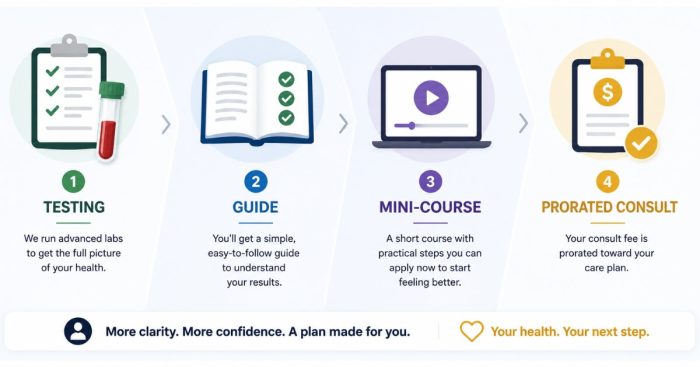
If your program usually includes some type of testing, offer that testing “for free” — no patient knows it was going to be included anyway, and it reads as a generous bonus.
That’s found value: high perceived worth, zero added cost.
Then create information products you make one time and give away endlessly:
- A helpful guide
- A mini-course
- An educational resource
Each costs you effort once and can be given to every prospect forever, so the marginal cost of adding it to your offer is essentially nothing.
These low-cost, high-value inclusions are how you stack an offer that feels enormous without eroding your economics.
A patient weighing your clinic against a competitor sees a free consult, free testing, and a free guide — and yours is obviously the better deal, even though the actual cost to you was minimal.
The skill is identifying everything you can include that costs you little but is worth a lot to the patient, and putting all of it into the stack.
How do I add perceived value to my offer without adding cost?
Bundle in items the patient perceives as valuable but that cost you little — testing you already do, guides and mini-courses you create once, and education — so the offer’s perceived value climbs while your cost stays flat.
If your baseline consult is $250, you can add $500 of perceived value to it by including more “stuff” — additional testing, resources, or education — that doesn’t meaningfully cost you anything to provide.
Now the same consult feels like a far bigger deal, and you haven’t spent more to deliver it.
Perceived value is what the patient is actually comparing when they choose between clinics, so raising it (without raising your cost) is how you win the comparison while protecting margin.
This is a different lever than price.
You’re not making the offer cheaper; you’re making it feel richer.
A stack of genuinely useful inclusions — each one high-value to the patient and low-cost to you — makes your offer the obvious choice.
And because you engineered the economics on the back end (repricing, prorating, folding costs into the program), the richer the offer feels, the more patients say yes without your margin taking the hit.
Should I give away things that competitors are afraid to give away?
Yes — this is the most powerful move of all.
Giving away things other people charge for, or are terrified to give away, builds trust and goodwill that competitors can’t match.
The instinct most business owners have is to guard their best material.
The counterintuitive truth is that giving away things others charge money for is exactly what makes you the obvious choice when the patient is ready to buy.
When you freely provide something valuable that competitors hoard, you demonstrate confidence and generosity, and you earn the prospect’s trust before they’ve spent a dollar.
Real ADvice’s own example is instructive: giving away an entire course and program for free, which most marketers would be nervous to do, precisely because it helps people — and when they need more help, they think of the source.
That’s the long game, and it pays massive dividends.
You’re nurturing your ideal patients, building authority and goodwill, so that when the timing is right they choose you without even considering anyone else.
Playing not to lose — hoarding value out of scarcity fear — is how you stay forgettable.
Playing to win — giving away as much as you can afford, and never stopping — is how you become the clinic patients feel they already know and trust.
Why does the “long game” of giving away value actually pay off?
Because generosity compounds into trust and authority, so that when a prospect is finally ready to act, you’re the only clinic they seriously consider.
Not every prospect is ready to buy today.
When you give away genuine value — guides, education, honest help — to people who aren’t ready yet, you nurture them over time and create more of your ideal patients.
You’re building a reservoir of goodwill and authority with an audience that will eventually need exactly what you offer.
When that moment comes, the clinic that spent months helping them is the obvious choice, and the clinics that only ever “asked for the sale” aren’t in the running.
This is why the no-brainer offer isn’t just a conversion tactic; it’s a positioning strategy.
Give away as much as you can afford, keep giving, and you become the trusted authority in your market rather than one of many interchangeable options competing on price.
The dividends show up as higher conversion, more referrals, and patients who arrive already sold — because they’ve been receiving your value for a while.
And it all rests on the same foundation: if you don’t make patients an offer that makes sense, a competitor will.
FAQ’s About Creating a No-Brainer Offer
Should I give away my initial consult for free?
Often yes — a free consult is one of the strongest giveaways, as long as you reprice so the economics still work.
If the consult is normally $250 and your program is $1,500, give the consult free and charge $1,750 for the program, or prorate the consult against the program.
You keep your margin while the patient perceives a valuable free first step, which lowers the friction to getting them in the door.
How do I reprice so a generous offer still protects my margin?
Fold the cost of what you give away into the price of what you sell, or prorate it against the program.
Giving away a $250 consult and adding $250 to the program price keeps your total economics identical while making the offer far more attractive.
The principle is “reprice, don’t discount” — you’re repackaging the same margin into a more compelling structure, not cutting into it.
Won’t competitors just steal my offer or my free material?
Maybe some will — and it won’t matter.
Scarcity thinking is a myth in this business; there is plenty of demand to go around, and the goodwill and authority you build by giving generously is not something a competitor can copy by lifting your PDF.
The clinic that gives the most value and builds the most trust wins, regardless of who imitates the mechanics.
What’s an example of a no-brainer offer for a cash-pay clinic?
A strong template:
- A free initial consult
- Free testing that was already part of your program
- A free educational guide or mini-course
…with the program priced to absorb those costs.
The patient sees a generous, low-risk first step and obvious value.
You keep your margin because you engineered the pricing behind it.
Tailor the specific inclusions to your services and your ideal patient.
What’s the next step?
If your offer is forgettable, your marketing will be too — no amount of ad spend fixes a weak offer.
The fix is to build a no-brainer offer:
- Give away more value than your competition dares.
- Stack in the things that cost you little but are worth a lot.
- Reprice so your margin stays intact.
Do that and you win the comparison every time a patient is choosing between you and someone else.
On a strategy call we’ll build the no-brainer offer for your specific services and ideal patient, with the pricing engineered so you give generously and still profit.
It’s the same offer work behind clinics like a weight-loss and medspa clinic where we added $6.7M in a year across 3,727 new patients.