
What Should My Front Desk Say When a Joint-Pain Patient Calls? (The Inbound Script + $49 Consult Offer)
A joint-pain patient who picks up the phone to call your clinic is one of the highest-intent leads you’ll ever get—they’re in pain and looking for relief right now. Yet most front desks blow it by jumping straight to scheduling or reciting services, when what the caller needs first is to feel heard. This is the FAQ on handling that inbound call, built from a real regenerative pain clinic’s script: lead with empathy, learn about the pain, guide them to a low-barrier consult, and close the appointment without pressure.
What should my front desk say when a joint-pain patient calls?
Answer warmly, let them explain why they’re calling, and then—for a new patient in pain—lead with genuine empathy before anything else.
The script opens simply and warmly:
“Hello, this is ___ with [clinic], how can I help you today?”
Deliver it with a smile and an empathetic tone because the whole premise is simple:
“We’re here to help people.”
When the caller explains they’re in pain, don’t jump into scheduling or pitching services.
Instead, acknowledge what they’re experiencing.
For example:
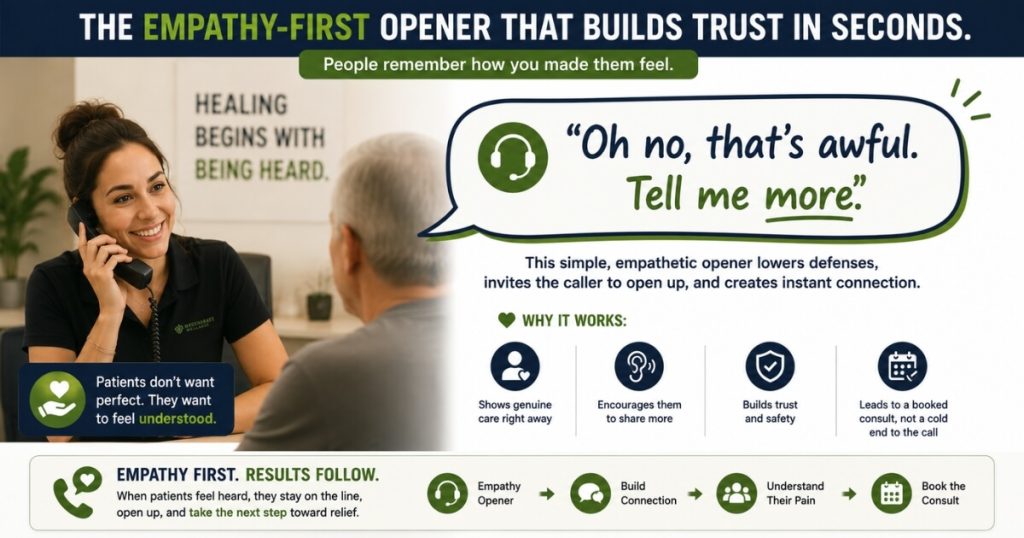
“Oh no, that’s awful. I’m sorry to hear that. Tell me more—what’s going on?”
That single response often does more to convert the call than any list of treatments because it tells the patient they’ve reached people who genuinely care.
From there, keep the conversation focused on the patient’s pain—not your services.
Only after understanding what they’re going through have you earned the right to recommend the next step.
This empathy-first approach is the foundation of converting inbound pain leads, and it’s a core part of effective pain management marketing. The caller is already high-intent, so your job isn’t to sell—it’s to connect and guide.
Why open with empathy instead of a pitch?
Because someone in pain wants to feel heard before they want to be sold to.
Empathy builds the trust that makes the patient comfortable saying yes to the next step.
Joint pain is personal.
Most callers have already:
- Been dealing with the pain for weeks or months.
- Tried treatments that didn’t work.
- Become frustrated with previous providers.
When your front desk responds with:
“That’s awful. Tell me more.”
…it feels like genuine care.
When they immediately begin listing treatments or pushing appointment times, however, the conversation becomes transactional.
Patients who’ve already felt like “just another number” in the healthcare system tend to pull back.
Empathy isn’t a sales tactic.
It’s the appropriate human response.
It also happens to be one of the strongest trust-builders available.
Once patients feel understood, they’re naturally more open to your recommendation because they believe it comes from someone who understands their situation.
Trust becomes the currency of the entire conversation.
Without that trust, you’re trying to schedule an appointment before you’ve earned the right to ask.
What discovery questions should I ask a joint-pain caller?
Keep the questions short, caring, and conversational.
A simple sequence works well:
- How long have you been in pain?
- What have you tried for relief?
- Has anything helped?
- How did you hear about us?
Each question has a purpose.
“How long have you been in pain?”
Shows you recognize the length of their struggle.
“What have you tried for relief?”
Helps uncover previous treatments while showing you’re taking their history seriously.
“Has anything helped so far?”
Demonstrates that you’re paying attention to the details instead of assuming every patient is the same.
Finally:
“How did you hear about us?”
Serves two purposes:
- It tells you where the lead came from.
- It subtly reinforces that other patients recommend your clinic.
Asked naturally, these questions don’t feel like an intake form.
Instead, they feel like a conversation.
The objective isn’t to interrogate the caller.
It’s to understand their story well enough that they feel genuinely heard.
Once both sides understand the situation, transitioning into booking becomes easy because the patient already feels cared for.
How do I transition from the pain conversation to booking a consult?
Bridge with confidence and hope.
One of the strongest transition statements is:
“You definitely came to the right place.”
The script then continues:
“We offer solutions for patients to get real, lasting relief from their [problem] without medications, drugs, or surgery.”
Immediately after that, move naturally into the next step:
“Maybe we can help. The next step is to get you scheduled with our doctor for a personalized consultation, where they’ll review your history and symptoms, make recommendations for immediate relief, and create a treatment plan for lasting relief. Does that sound like what you were looking for?”
That transition works because it’s earned.
By this point, you’ve already:
- Listened carefully.
- Asked thoughtful questions.
- Demonstrated empathy.
Now, “You came to the right place” feels reassuring rather than promotional.
The consultation also feels like the obvious next step instead of a sales pitch.
Most joint-pain patients are searching for alternatives to medications or surgery.
Presenting the consultation as the pathway toward that goal makes the recommendation feel both logical and hopeful.
You’re not switching from caring to selling.
You’re simply showing how caring naturally leads to the next step.
Should I offer a low-cost initial consult like $49?
Yes.
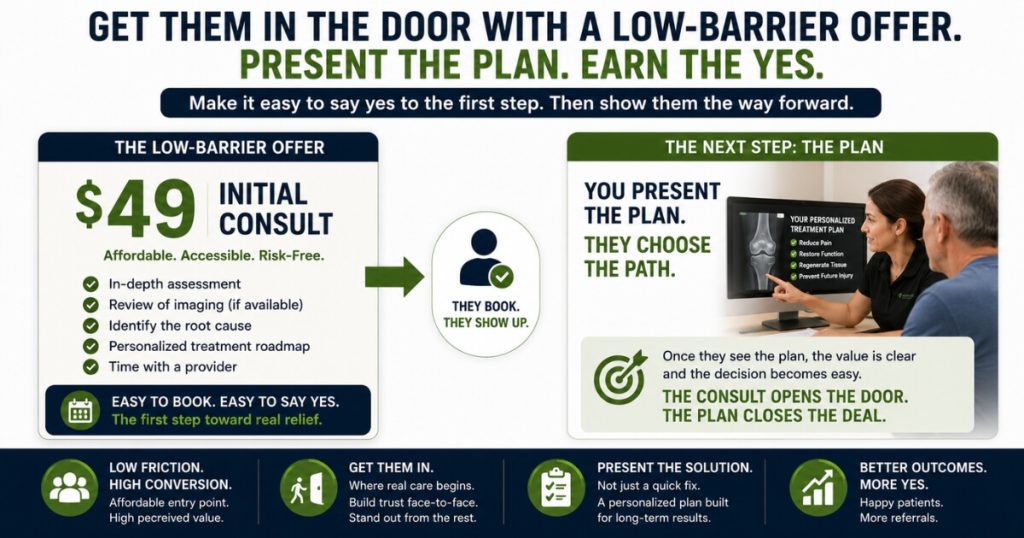
A low-barrier consultation—such as $49—is an excellent way to help a high-intent pain patient take the first step.
The script uses a $49 consultation because it’s easy to say yes to.
The patient is already looking for relief.
A small investment removes the final barrier between the phone call and the appointment.
Remember the purpose of the consultation.
It is not where the clinic generates most of its revenue.
Instead, it’s where the doctor can:
- Review the patient’s history.
- Understand their symptoms.
- Recommend immediate relief strategies.
- Develop a personalized treatment plan.
The low introductory price earns the opportunity to build trust face-to-face before discussing the larger regenerative treatment plan.
This two-step approach consistently converts better than trying to explain and sell a comprehensive regenerative program over the phone.
The caller receives:
- A simple first step today.
- A complete treatment discussion during the visit.
That low-friction entry point is one of the most reliable ways to fill a pain clinic’s schedule with the leads your patient acquisition is generating.
How do I close the appointment without being pushy?
Use assumptive scheduling.
Instead of asking whether the patient wants to book, offer them a choice between two appointment options and collect the information needed to secure the visit.
Once the patient agrees the consultation sounds like the right next step, don’t ask:
“Would you like to schedule?”
Instead, assume they’ve already decided.
For example:
“Great, let’s see what we have available. Does today or tomorrow work better?”
Once they choose a day, narrow it further:
“Perfect. We have this time or this time available. Which works better for you?”
Offering two appointment options keeps the conversation moving naturally.
The patient isn’t deciding whether to commit anymore.
They’re simply choosing the time that works best.
After selecting the appointment, collect the information needed to secure it.
That includes:
- Full name
- Email address
- Phone number
- Date of birth
- Credit card to hold the appointment
Collecting the card while the patient’s commitment is highest transforms a verbal “yes” into a confirmed appointment.
The close never feels pushy because you’re simply helping the patient take the next logical step toward relief.
FAQ’s About Handling Inbound Joint-Pain Calls
How much should the initial pain consult cost?
Keep the initial consultation affordable enough that a motivated patient in pain can comfortably say yes.
One clinic’s script uses $49.
The consultation isn’t designed to generate significant revenue.
Instead, its purpose is to:
- Get the patient in front of the provider.
- Build trust.
- Begin the diagnostic process.
- Present the personalized treatment plan.
Price the consultation appropriately for your market, but avoid making your front door expensive.
The real value—and the long-term revenue—comes from the treatment plan developed during the visit.
What do I say if the caller asks, “Does this actually work?”
Acknowledge the question honestly.
Then confidently explain that the consultation is where the provider determines exactly how the clinic can help.
For example, explain that your clinic focuses on helping patients achieve lasting relief without drugs or surgery while avoiding guarantees over the phone.
The provider will evaluate:
- Their condition.
- Their history.
- Their symptoms.
From there, they’ll recommend the most appropriate treatment plan.
Avoid making promises before the patient has been evaluated.
The consultation exists specifically to determine the right solution for their individual situation.
How do I handle a caller who’s just price-shopping?
Treat price-shopping as a request for more information—not as a sign they’re uninterested.
Answer the pricing question honestly.
Then quickly reconnect the conversation to what really matters:
Their pain.
For example:
- Acknowledge the consultation fee.
- Remind them the consultation is designed to determine whether you can help.
- Position the low-cost consultation as an easy first step toward relief.
Many callers who appear focused on price are actually asking a different question:
“Can you really help me?”
Empathy, combined with an affordable first visit, answers that question far better than simply quoting a fee.
Should I collect a credit card when booking the consult?
Yes.
Taking a credit card during scheduling significantly improves appointment show rates.
Patients are most committed at the exact moment they agree to schedule.
That’s the ideal time to secure the appointment.
A confirmed appointment with a card on file consistently performs better than a tentative booking without one.
For high-value joint-pain leads, protecting against unnecessary no-shows is an important part of maximizing your marketing investment.
What’s the next step?
If joint-pain callers aren’t converting at your clinic, the problem usually isn’t a lack of leads.
More often, it’s how the phone is being answered.
Start with empathy.
Let the patient tell their story.
Bridge naturally with:
“You definitely came to the right place.”
Then:
- Offer a low-barrier consultation.
- Use assumptive scheduling.
- Collect a credit card to secure the appointment.
That sequence consistently turns high-intent pain callers into booked—and kept—appointments.
If you’d like help building the exact inbound phone script for your pain or regenerative clinic, we’ll help your front desk deliver it naturally and consistently. It’s the same conversion work behind clinics like a pain and regenerative practice where we added more than $2 million in revenue in 10 months.