
Why Does Patient Experience Drive Revenue at a Cash-Pay Clinic (and What Is Your Front Desk Getting Wrong)?
Walk into most cash-pay clinics and you’ll see the same thing: the front-office staff is too busy doing administrative work to actually greet patients or schedule new ones. They’re buried in admin—and admin doesn’t generate revenue. Excellent patient experiences do. This FAQ explains why patient experience is a revenue driver, not just a soft nicety, and why most front desks are unintentionally set up to fail at the one thing that actually grows the practice.
Why does patient experience drive revenue at a cash-pay clinic?
Because in cash-pay medicine, patients are paying out of pocket and can leave at any time.
The experience determines whether they:
- Stay.
- Refer others.
- Say yes in the first place.
Insurance-based practices can sometimes survive a mediocre patient experience because patients are limited by their insurance network.
Cash-pay clinics do not have that advantage.
Every month, each patient makes a new decision about whether your clinic is worth paying for.
If patients feel processed instead of cared for, retention quietly begins to decline.
Over time, that affects:
- Recurring revenue.
- Referrals.
- New patient conversion.
A great patient experience becomes one of the biggest revenue drivers inside the practice.
The mistake many clinics make is treating patient experience as customer service that sits beside the business.
It is not separate from the business.
It is the business.
Administrative work such as:
- Filing paperwork
- Data entry
- Insurance-related tasks
- Miscellaneous office work
keeps operations running.
However, none of those tasks directly generate revenue.
Patient experience does.
Clinics that organize around that reality grow consistently.
Clinics that bury patient-facing staff in administrative work slowly undermine both patient acquisition and long-term retention.
What is my front desk getting wrong?
Usually nothing about effort.
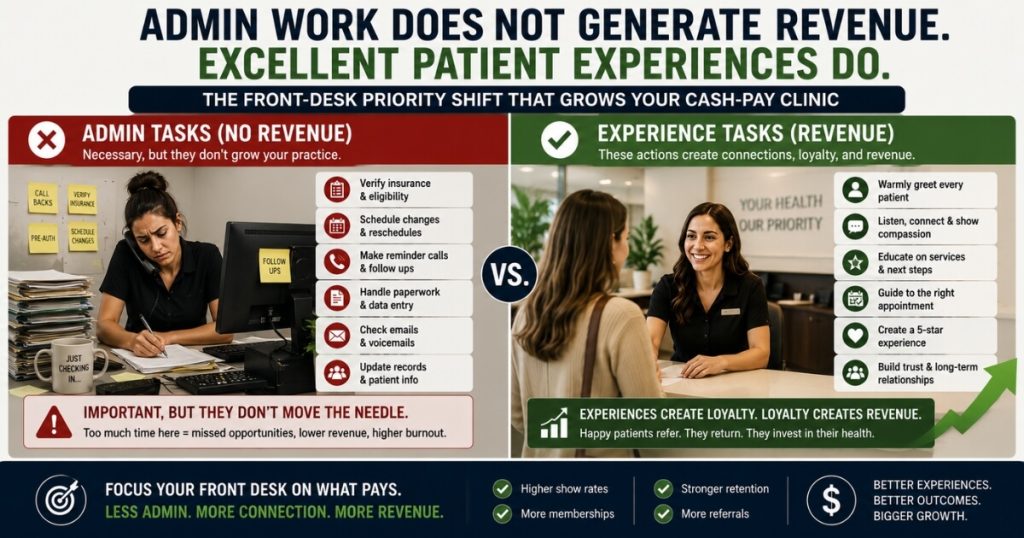
The real issue is that the front desk spends too much time doing administrative work and not enough time doing the revenue-generating work of greeting, scheduling, and converting patients.
Many clinics experience the same pattern.
The front desk is constantly busy.
Staff members work hard all day.
Yet they rarely have time to:
- Welcome patients warmly.
- Answer the phone properly.
- Guide new callers toward booking.
Administrative work takes over.
Because it always feels urgent, it wins every day.
Meanwhile, the activities that actually grow the clinic get pushed aside.
This is not a people problem.
It is a structural problem.
When your most patient-facing employees also carry the majority of your administrative workload, something has to give.
Usually, that “something” is the patient experience.
The solution is simple in principle.
Make the front desk’s primary responsibility:
- Patient experience.
- Patient conversion.
Then protect enough time for them to actually perform those responsibilities well.
Should my front desk focus on admin or on patient experience?
Patient experience and patient conversion should always come first.
Those are the activities that directly generate revenue.
Think of your front desk as the concierge of the practice—not the back office.
Their highest-value responsibilities include:
- Greeting every patient warmly.
- Answering the phone like a real person.
- Helping callers become scheduled patients.
- Creating a memorable first impression.
Those activities produce:
- Better retention.
- More referrals.
- More booked appointments.
Administrative work still matters.
However, repetitive tasks should not dominate your most patient-facing employees.
Instead, remove as much administrative work as possible through:
- Automation.
- Better systems.
- A dedicated administrative employee.
- A virtual assistant (VA).
When administrative work moves elsewhere, the front desk can finally focus on the work that grows the clinic.
The exact same employees often become a revenue engine simply because they have time to perform their highest-value responsibilities.
Remember:
Your front desk produces more of whatever occupies its time.
Protect the right priorities.
Why won’t my front desk do sales calls, and how do I fix it?
Because most front-desk employees were hired for hospitality—not sales.
Selling feels uncomfortable.
Avoiding sales calls is completely normal.
It is also completely fixable.
A great front-desk concierge usually enjoys:
- Greeting patients.
- Helping people check in.
- Providing outstanding service.
Those strengths do not automatically translate into confidently converting inquiries into paying patients.
That requires a different skill set.
Without training, many employees avoid outbound sales conversations entirely.
The result is predictable.
Marketing generates leads.
The leads quietly disappear at the front desk.
Two solutions work particularly well.
First, give your team the tools they need.
That includes:
- Call scripts.
- Role-playing.
- Recorded-call reviews.
- Ongoing coaching.
Sales conversations become much easier when employees are not forced to improvise.
Second, separate the roles when volume justifies it.
Allow:
- A concierge-focused employee to own the patient experience.
- A dedicated patient coordinator to own sales and conversion calls.
Either approach works.
The important point is recognizing that patient experience and sales are different skills.
Hire and organize your team intentionally instead of expecting one person to naturally excel at both.
How does patient experience actually convert into more revenue?
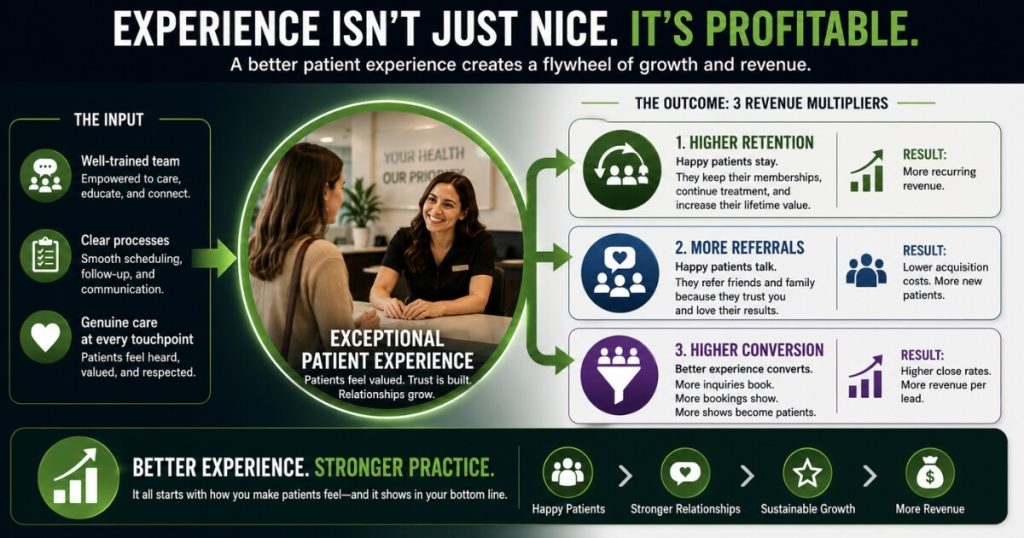
Patient experience creates revenue through three primary channels:
- Better retention.
- More referrals.
- Higher inquiry-to-booking conversion.
Retention is the largest opportunity.
Patients who genuinely feel cared for remain members much longer.
In recurring-revenue businesses, every additional month matters.
Referrals come next.
Patients who have exceptional experiences naturally recommend the clinic to friends and family.
Referral patients are typically:
- Less expensive to acquire.
- Easier to close.
- More trusting from the beginning.
Finally, patient experience improves conversion.
A prospective patient who feels welcomed during the first phone call is much more likely to schedule an appointment than someone who experiences a rushed, transactional interaction.
Notice something important.
None of these activities appear on a typical administrative task list.
That is why patient experience is so often undervalued.
Its returns are indirect.
They compound quietly over time.
When you invest in patient experience, you simultaneously improve:
- Retention.
- Referrals.
- Conversion.
That makes patient experience a growth multiplier—not an expense.
It is also one of the foundations of successful medical practice marketing, because it strengthens every other marketing channel.
How do I structure my front desk so it generates revenue instead of just processing?
Organize responsibilities according to outcomes.
Protect the concierge experience.
Create a dedicated conversion role as your clinic grows.
Move repetitive administrative work to automation or a virtual assistant.
Start by defining the front desk’s true purpose.
Its primary responsibilities should be:
- Patient experience.
- Patient conversion.
Next, audit how the team actually spends its day.
Any repetitive administrative work that can be:
- Automated
- Systematized
- Assigned to a VA
should leave the front desk whenever possible.
As patient volume increases, introduce a dedicated patient coordinator.
That role focuses specifically on converting inquiries into booked appointments.
Meanwhile, the concierge remains focused on delivering an outstanding patient experience.
The result is a front-of-house team that actively produces revenue by:
- Greeting patients.
- Converting inquiries.
- Increasing retention.
Instead of simply processing paperwork.
This is not about asking employees to work harder.
It is about organizing responsibilities more effectively.
When revenue-generating work becomes someone’s protected priority, administrative tasks stop crowding it out.
Clinics that make this structural shift often discover that the very same team begins producing:
- More bookings.
- Better retention.
- Stronger patient relationships.
Not because they changed people—but because they changed priorities.
FAQ’s About Patient Experience and Front-Desk Revenue
Should I split the front-desk role into experience and sales?
In many cases, yes.
As your clinic grows, patient experience and sales become two different jobs.
A warm, service-oriented concierge is not automatically comfortable making outbound sales calls.
Trying to combine both responsibilities often means the sales work never gets done.
A better structure looks like this:
- Concierge: Greeting patients, check-in, customer service, and the overall experience.
- Patient Coordinator: Converting inquiries into booked appointments and handling outbound follow-up.
If your clinic is not yet large enough for two separate roles, keep one person in place but give them the tools they need.
That includes:
- Sales scripts
- Role-playing
- Recorded-call reviews
- Ongoing coaching
The goal is to remove guesswork so sales conversations become a natural extension of great service.
How do I measure patient experience?
Measure the outcomes that patient experience creates.
Focus on metrics such as:
- Patient retention
- Churn rate
- Referral volume
- Inquiry-to-booking conversion
- Online reviews
- Post-visit surveys
These numbers often reveal problems before revenue does.
For example:
- Declining retention
- Fewer referrals
- Lower booking rates
usually indicate that the patient experience has started slipping.
Treat these metrics with the same importance as revenue.
They are leading indicators of where future revenue is headed.
Can automation free my front desk to focus on experience?
Yes.
Automation removes repetitive administrative work so your team can spend more time with patients.
Good candidates for automation include:
- Appointment reminders
- Intake forms
- Follow-up sequences
- Routine scheduling
- Administrative notifications
The purpose is not to replace the human touch.
It is to let technology handle repetitive tasks while your team focuses on the conversations that require empathy and attention.
Every hour your front desk gets back is high-value capacity.
Those hours can be reinvested into:
- Better patient experiences
- More meaningful conversations
- Higher conversion rates
That is one of the highest-ROI improvements a cash-pay clinic can make.
Does a great patient experience justify charging higher prices?
Yes.
Patient experience is one of the primary reasons cash-pay patients choose to stay.
Patients are not simply paying for treatment.
They are paying for:
- The relationship
- The attention
- The confidence
- The overall experience
Clinics that consistently deliver exceptional experiences can confidently maintain premium pricing.
Patients are far more willing to pay higher prices when they feel:
- Valued
- Heard
- Cared for
On the other hand, patients often leave over a poor experience even when prices are relatively low.
Strong patient experience protects both:
- Your pricing power
- Your long-term retention
What’s the next step?
If your front desk is working hard but your clinic still is not growing the way it should, look closely at how your team’s time is actually being spent.
When administrative work crowds out patient experience and conversion, the clinic loses the very activities that generate:
- Better retention
- More referrals
- More booked patients
Protect the patient experience.
Build conversion into someone’s dedicated responsibility.
Move repetitive administrative work onto systems, automation, or a virtual assistant whenever possible.
The result is often the same team producing dramatically better outcomes because they finally have time to focus on the work that actually grows the practice.
On a strategy call, we’ll review exactly how your front-of-house team spends its time.
We’ll identify where patient experience and conversion are getting squeezed.
Then we’ll show you how to restructure those responsibilities so your front desk becomes a true revenue engine.
It’s the same approach we’ve used with clinics like an HRT clinic we grew from $1M to $4M per year, where long-term growth came from stronger retention and referrals—not simply higher ad spend.