
Why Do Patients Keep No-Showing My Cash-Pay Clinic — And How Do I Stop It?
No-shows feel like a patient problem. They’re almost always a system problem. When someone books with zero commitment, through a clunky flow, with no reminders, a certain percentage simply won’t show—and it has little to do with how much they wanted the treatment.
The fix is a small set of operational changes that cost almost nothing: a deposit at booking, two well-timed reminders, and a booking flow simple enough that people actually finish it. This is the FAQ on stopping no-shows, drawn from a clinic that runs a $29 deposit on every appointment and grew from $13,000 to a $20,500-day by tightening exactly this part of the operation.
Why do patients keep no-showing my cash-pay clinic?
Most patients no-show because the booking system creates very little commitment.
It’s usually a system problem rather than a patient problem.
When someone books an appointment without putting anything at risk, skipping it carries almost no consequence.
If the booking process also lacks confirmations and reminders, it’s easy for patients to forget—or simply decide not to come.
As a result, a predictable portion of your calendar disappears every week.
The clinic experiences lost revenue and wasted provider time.
However, those outcomes are usually caused by the process rather than the patients themselves.
Fortunately, system problems have system solutions.
Three changes solve most no-show issues:
- A booking deposit that creates commitment
- Appointment reminders that reduce forgetfulness
- A booking process that’s simple enough to complete without frustration
None of these improvements are expensive.
Together, they protect the calendar your patient acquisition efforts are working to fill.
Does taking a deposit actually reduce no-shows at a cash-pay clinic?
Yes.
A booking deposit is one of the most effective ways to reduce no-shows.
It also doesn’t need to be large.
One clinic owner explains it simply:
“If I don’t take a deposit, people don’t show up.”
That clinic requires only a $29 deposit.
The amount is small enough that serious patients rarely object.
At the same time, it’s large enough to transform a casual appointment into a genuine commitment.
The value isn’t the money itself.
Rather, it’s the psychological commitment that happens once patients enter their payment information.
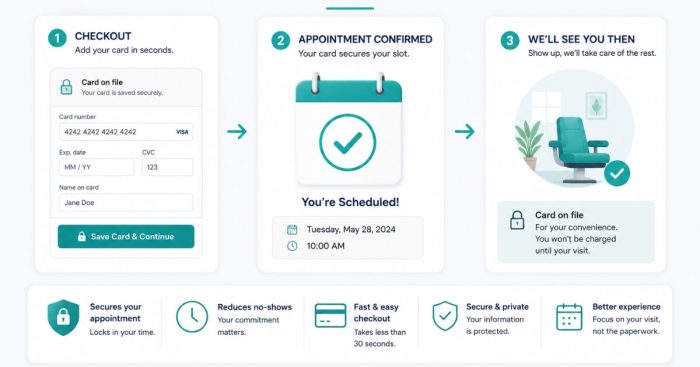
For the best results, collect the deposit during the booking process.
Use your online calendar together with a payment processor such as Stripe so the card is captured before the appointment is confirmed.
That approach creates commitment while motivation is at its highest.
Instead of hoping patients remain committed later, you secure that commitment immediately.
A deposit collected at booking prevents many no-shows before they ever reach your calendar.
Is my booking system causing no-shows and lost bookings?
Very likely.
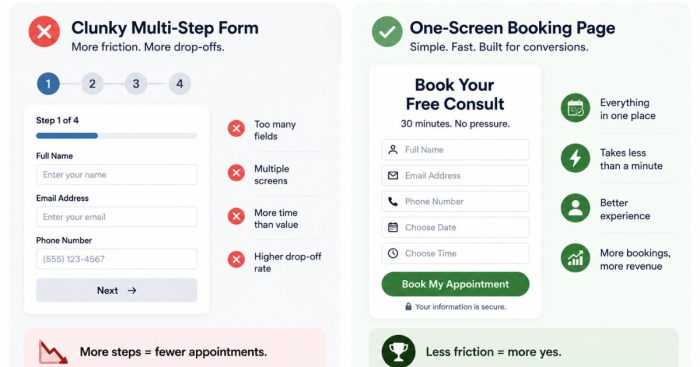
A complicated booking process causes patients to abandon appointments before booking and increases no-shows among those who finish.
One common problem is an EMR scheduling flow that requires patients to create a complete profile before they can even select a time.
Every additional step increases the likelihood that someone will quit before completing the process.
Even patients who finish often feel less engaged after working through a frustrating experience.
If your scheduling system can’t send a simple booking link, doesn’t support texting, or hides appointment selection behind account creation, it’s costing you patients.
Instead, simplify the process.
Ask only for the essentials:
- Name
- Email address
- Phone number
- Payment information
Then allow patients to choose a time and confirm the appointment immediately.
If your EMR can’t provide that experience, use a simpler calendar tool as the booking front end.
Afterward, sync or manually enter appointments into your EMR.
Patients enjoy a faster experience while your clinical records remain organized.
A streamlined booking process improves both booking completion rates and appointment attendance.
That’s why it’s a foundational part of effective medical practice marketing.
What appointment reminders should I send to reduce cancellations?
Send three automated messages:
- A confirmation immediately after booking
- A reminder 24 hours before the appointment
- A final reminder one hour before the appointment
Include your clinic address in every reminder.
The confirmation reinforces the patient’s commitment while motivation is still high.
Then, the 24-hour reminder gives patients enough time to adjust their schedules instead of simply missing the appointment.
Finally, the one-hour reminder helps patients who simply forgot they were coming.
Including the clinic address removes one last point of friction before arrival.
For best results, automate every message through both SMS and email.
That way, reminders go out consistently without relying on someone on your team to remember.
Fortunately, this automation is simple to build.
It’s also one of the highest-return systems a cash-pay clinic can implement.
Patients who receive confirmation followed by two timely reminders consistently show up at much higher rates than patients who hear nothing after booking.
Most patients don’t view reminders as marketing.
Instead, they see them as excellent customer service.
That’s exactly why they work.
How do I turn ad replies and inquiries into booked appointments before they cool off?
Respond immediately with an automated booking link.
The faster patients receive the next step, the more likely they are to schedule.
For example, if someone replies “text” to your advertisement, trigger an automated workflow that instantly sends your online booking calendar.
That response happens within seconds instead of waiting for a staff member to notice the inquiry.
Speed matters because interest fades quickly.
An inquiry that sits unanswered for several hours often becomes a missed opportunity.
The same principle applies to every inbound lead.
Whenever someone expresses interest, present the booking link immediately.
Then pair that fast response with your booking deposit.
Together, those two steps move patients quickly from “interested” to “committed.”
As a result, you stop losing the leads your advertising and referrals have already generated.
How do I protect my schedule as a solo owner without hurting availability?
Build your calendar intentionally.
That means creating enough availability for patients while protecting enough time to run the business.
A balanced schedule should include:
- Defined working hours
- One booking per appointment slot
- Approximately one-hour buffers between appointments
- Same-day booking availability
- One dedicated administrative day each week
Those settings protect both your patients’ experience and your own workload.
For example, limiting appointments to one per time slot prevents double-booking and unnecessary stress.
Meanwhile, allowing same-day scheduling captures highly motivated patients who want to be seen immediately.
Equally important, block one full day each week for administrative work.
One clinic owner reserves every Tuesday specifically to manage the business instead of seeing patients.
That dedicated time prevents operations from constantly falling behind.
Ultimately, the goal is a schedule that’s easy for patients to book and sustainable for you to maintain.
With the right calendar structure, clinics can continue growing without creating burnout.
FAQ’s About Reducing No-Shows at a Cash-Pay Clinic
Can I use GoHighLevel for booking if my EMR won’t integrate?
Yes.
GoHighLevel can function as your front-end booking system even without a direct EMR integration.
Patients schedule through the simpler calendar.
Then your team receives an immediate notification and manually enters the appointment into the EMR.
Until a full integration becomes available, simply block already-filled EMR appointment times inside the booking calendar on a regular basis.
That process helps prevent double-booking while maintaining a much better patient experience.
How big should the deposit be?
The deposit should be large enough to create commitment but small enough that serious patients don’t hesitate.
For many clinics, that falls between $25 and $50.
One clinic successfully uses a $29 deposit.
However, the exact amount matters less than capturing a payment method during booking.
The deposit’s primary purpose is psychological commitment—not additional revenue.
For higher-ticket services, a larger deposit or a full card-on-file policy with a no-show fee may be appropriate.
Should I allow same-day booking?
Yes.
In most situations, same-day appointments capture highly motivated patients who are ready to act.
Those patients also tend to keep their appointments.
For even better results, require a booking deposit so convenience doesn’t encourage casual scheduling.
Only limit same-day appointments when genuine staffing or preparation requirements make it necessary.
What’s a healthy pace of monthly revenue growth for a cash-pay clinic?
Steady growth is usually more sustainable than dramatic spikes.
Adding approximately $7,000 to $10,000 in monthly revenue over time represents a healthy pace for many growing cash-pay clinics.
For example, one clinic progressed from a $13,000 month toward a $20,500 day simply by improving its booking process and reducing no-shows.
Consistent operational improvements compound over time.
By comparison, chasing one massive revenue jump often creates unnecessary strain on the business.
What’s the next step?
If no-shows are hurting your clinic, stop treating them as a patient problem.
Instead, improve the system that produces them.
Start by collecting a small booking deposit.
Next, automate an immediate confirmation along with reminders 24 hours and one hour before every appointment.
Then simplify your booking flow so patients can schedule quickly without unnecessary obstacles.
Finally, respond to every inquiry immediately with an automated booking link.
Each improvement costs very little.
Together, however, they can dramatically increase your show rate and improve every metric that depends on patients actually arriving.
During a strategy call, we’ll review your booking process, evaluate your reminder system, and identify exactly where patients are dropping between expressing interest and showing up.
Then we’ll show you how to configure a system that consistently keeps your schedule full.
It’s the same operational approach behind a longevity and functional medicine clinic where we lifted inbound calls by 100+ a month and helped turn those additional calls into kept appointments.